
[논문 리뷰] Pre-optimizing variational quantum eigensolvers with tensor networks
이 논문은 파라미터화된 양자회로를 행렬곱 상태로 근사화하여 초기 매개변수를 찾고, 이를 이용해 양자 하드웨어에서 VQE를 1D 및 2D Fermi-Hubbard 모델에 대해 초기화하는 고전적 사전최적화 방식인 VTNE를 제시한다.
The variational quantum eigensolver (VQE) is a promising algorithm for demonstrating quantum advantage in the noisy intermediate-scale quantum (NISQ) era. However, optimizing VQE from random initial starting parameters is challenging due to a variety of issues including barren plateaus, optimization in the presence of noise, and slow convergence. While simulating quantum circuits classically is generically difficult, classical computing methods have been developed extensively, and powerful tools now exist to approximately simulate quantum circuits. This opens up various strategies that limit the amount of optimization that needs to be performed on quantum hardware. Here we present and benchmark an approach where we find good starting parameters for parameterized quantum circuits by classically simulating VQE by approximating the parameterized quantum circuit (PQC) as a matrix product state (MPS) with a limited bond dimension. Calling this approach the variational tensor network eigensolver (VTNE), we apply it to the 1D and 2D Fermi-Hubbard model with system sizes that use up to 32 qubits. We find that in 1D, VTNE can find parameters for PQC whose energy error is within 0.5% relative to the ground state. In 2D, the parameters that VTNE finds have significantly lower energy than their starting configurations, and we show that starting VQE from these parameters requires non-trivially fewer operations to come down to a given energy. The higher the bond dimension we use in VTNE, the less work needs to be done in VQE. By generating classically optimized parameters as the initialization for the quantum circuit one can alleviate many of the challenges that plague VQE on quantum computers.
연구 동기 및 목표
- NISQ 디바이스에서의 VQE 최적화에서 발생하는 문제(배치 플래토, 노이즈, 느린 수렴)를 해결한다.
- 텐서 네트워크를 사용하여 PQC를 고전적으로 사전최적화하기 위한 VTNE를 제안한다.
- 1D 및 2D Fermi-Hubbard 모델에서 최대 32퀘비츠까지 접근하여 접근법을 시연한다.
- MPS 본드 차원이 고전적 사전최적화 및 양자 자원 절감에 어떠한 영향을 미치는지 정량화한다.
제안 방법
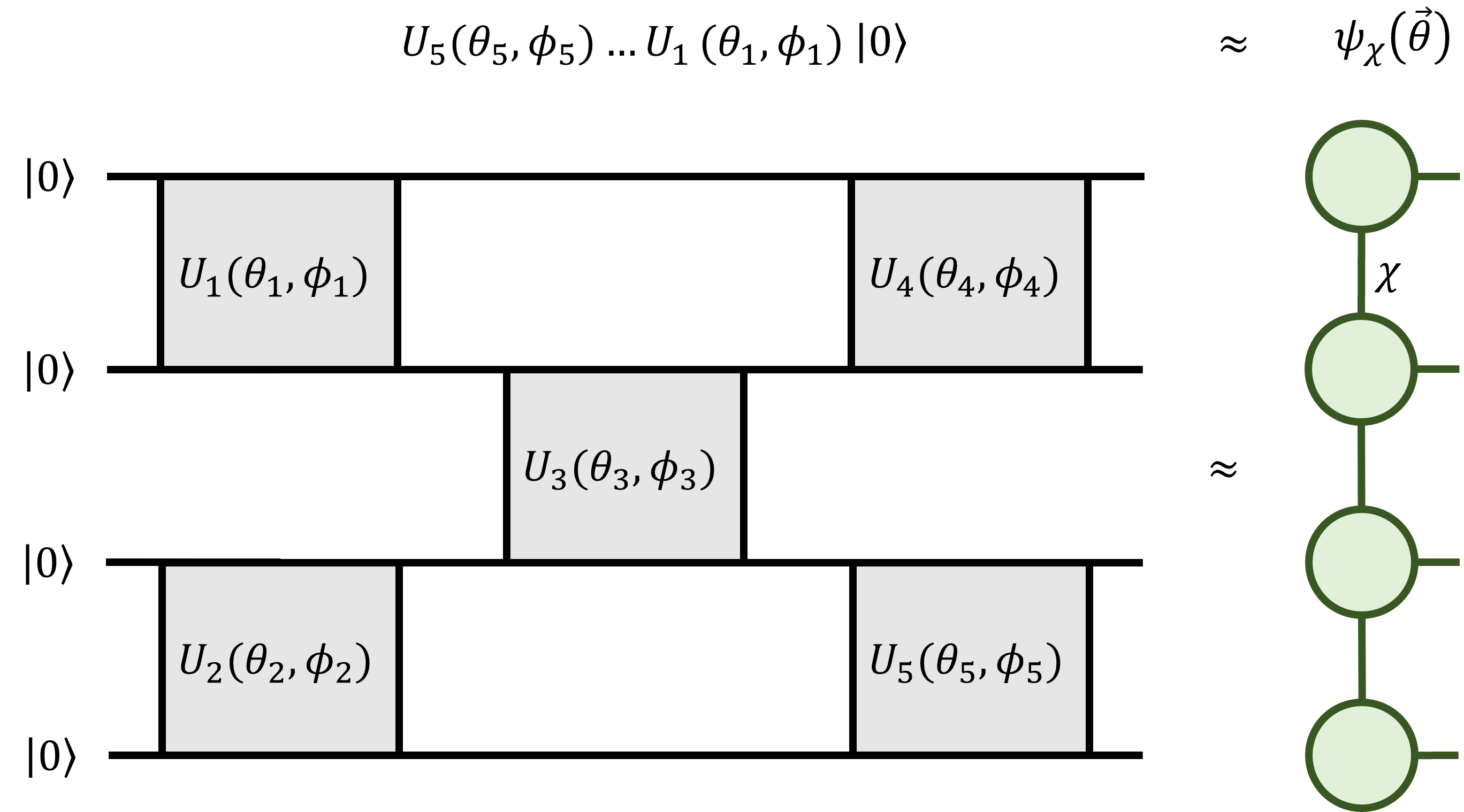
- 고정된 본드 차원 chi를 갖는 매개변수화된 양자회로(PQC)를 TEBD 수축을 통해 MPS로 표현한다.
- 해밀토니안을 위해 MPO를 사용하여 근사 에너지 E_chi(theta) = <psi_chi(theta)|H|psi_chi(theta)>를 계산한다.
- 두 회로 평가를 통해 L 및 R MPS 인자를 업데이트하는 경로를 사용하여 근사 기울기를 계산하고(식 7-11), 재귀 중에 본드 차원 chi로 잘라낸다.
- 수렴을 돕기 위해 간섭(상호작용 U=2) 최적화를 비상호작용(U=0) 최적 매개변수에서 초기화한다.
- 텐서 네트워크 계산을 수행하기 위해 ITensor를 사용한다.
- Adam 최적화를 사용하는 VQE에서 PTNE-사전최적 매개변수를 무작위 초기화와 비교한다.
실험 결과
연구 질문
- RQ1고전적 VTNE 사전최적화가 양자 하드웨어에서 VQE에 대해 고품질의 초기 매개변수를 도출할 수 있는가?
- RQ2MPS 본드 차원 chi가 VTNE-사전계산 매개변수의 정확도와 이후 VQE 에너지에 어떤 영향을 미치는가?
- RQ3VTNE로 초기화된 VQE 실행은 무작위 초기화에 비해 목표 에너지에 도달하기 위해 필요한 양자 자원(게이트) 작동을 더 적게 사용하는가?
- RQ41D와 2D Fermi-Hubbard 모델 간에 VTNE의 성능 차이가 있는가?
- RQ5이 시스템들에 대한 기존의 고전적 벤치마크(DMRG 등)와 VTNE 결과 간의 관계는 무엇인가?
주요 결과
- 1D에서 VTNE는 적절한 매개변수에 대해 기준상태 에너지에 대해 상대적으로 0.5% 이내의 오차를 낼 수 있다.
- 2D에서 VTNE 유도 매개변수는 무작위 시작보다 에너지가 크게 낮고, 사전최적화가 이후 VQE 노력을 줄여준다.
- MPS 본드 차원 chi를 증가시키면 에너지 오차와 VQE에서 필요한 그래디언트 평가 수가 감소한다.
- 1D 시스템에서 최대 32퀘비츠까지의 경우 chi_b = 16이 상대 에너지 오차≲3%를 달성한다.
- 클래식으로 최적화된 VTNE 매개변수에서 시작한 VQE는 무작위 매개변수에서 시작한 경우보다 그래디언트 평가 수를 현저히 적게 필요로 한다(예시로 제시된 경우 약 400-1000 단계 절감).
- VQE의 수축에 사용할 더 큰 MPS 본드 차원 chi_a(chi_b보다 큼)를 사용하면 chi_b와 동등하거나 더 나은 에너지를 얻을 수 있어 하드웨어 실행 시 이점이 있을 수 있다.
이 논문 읽기
누빈트 뷰어에서 원문을 열고, 읽으면서 궁금한 곳을 바로 물어보세요.
누빈트에서 이 논문 읽기이 리뷰는 AI가 논문 원문을 바탕으로 만들었습니다. 인용하기 전에 원문을 확인해 주세요.