
[논문 리뷰] Topological Mixed Valence Model for Twisted Bilayer Graphene
이 논문은 매직-각도 비틀림 이층 그래핀의 Song–Bernevig 토폴로지적 무가치-유효 상태 그림을 혼합가치 앤더슨 격자로 재구성하고, 고에너지 및 저에너지 Kondo 격자 거동을 분석하며, 도핑- 및 포논-재정규화가 하이브리드화에 미치는 효과를 논의한다.
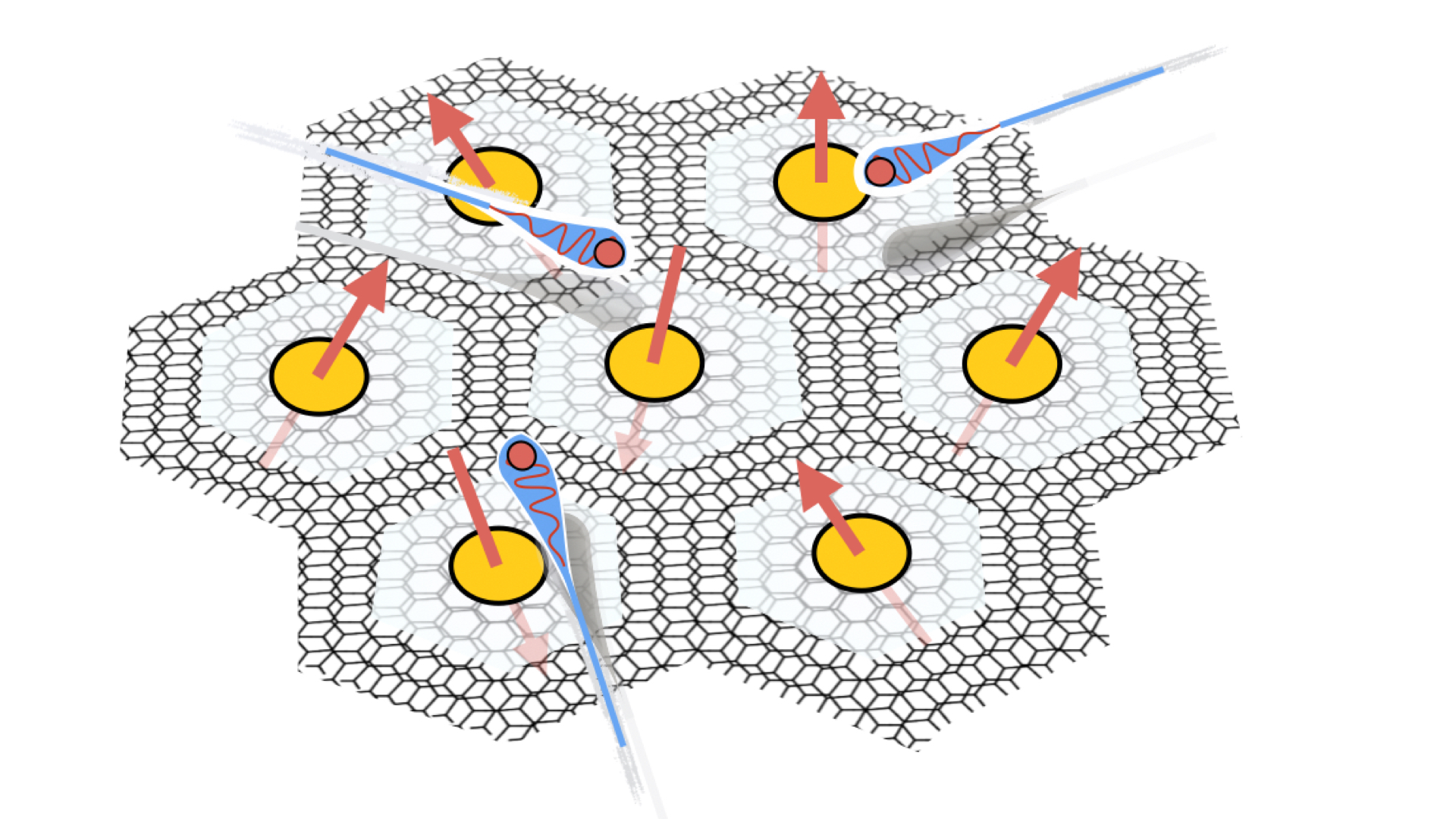
Song and Bernevig (SB) have recently proposed a topological heavy fermion description of the physics of magic angle twisted bilayer graphene (MATBG), involving the hybridization of flat band electrons with a relativistic conduction sea. We explore the consequences of this model, seeking a synthesis of understanding drawn from heavy fermion physics and MATBG experiments. We identify a key discrepancy between measured and calculated onsite Coulomb interactions, implicating renormalization effects that are not contained in the current model. With these considerations in mind, we consider an SB model with a single, renormalized onsite interaction between the f-electrons, containing a phenomenological heavy fermion binding potential on the moiré AA-sites. This feature allows the simplified model to capture the periodic reset of the chemical potential with filling and the observed stability of local moment behavior. We argue that a two stage Kondo effect will develop in MATBG as a consequence of the relativistic conduction band: Kondo I occurs at high temperatures, establishing a coherent hybridization at the $Γ$ points and a non-Fermi liquid of incoherent fermions at the moiré K-points; at much low temperatures Kondo II leads to a Fermi liquid in the flat band. Utilizing an auxiliary-rotor approach, we formulate a mean-field treatment of MATBG that captures this physics, describing the evolution of the normal state across a full range of filling factors. By contrasting the relative time-scales of phonons and valence fluctuations in bulk heavy fermion materials with that of MATBG we propose a valley-polaron origin to the Coulomb renormalization and the heavy fermion binding potential identified from experiment. We also discuss the possibility that the two-fluid, non-Fermi liquid physics of the relativistic Kondo lattice is responsible for the strange metal physics observed in MATBG.
연구 동기 및 목표
- MATBG의 현(local moments)과 대칭 이상현상을 포착하는 실공간, 위상적 설명을 동기화한다.
- Song–Bernevig 모델을 혼합가치(밸런스) fluctuations를 가진 앤더슨 격자로 재구성한다.
- 고에너지 U(8) 및 저에너지 U(4) Kondo 격자 거동과 이들의 밴드 구조에 대한 함의를 분석한다.
- 에너지와 채움에 따라 하이브리드화 및 허버드 밴드 폭의 스케일링을 예측하고, 포논의 재정규화 효과를 논의한다.
제안 방법
- localized f-유사 Wannier 상태를 위상적 c-대 band와 결합하는 Song–Bernevig 해밀토니안을 시작점으로 삼는다.
- f 및 c 구간을 연결하기 위한 강도 γ0와 형식인자 φ^(η)(k, γ0)을 갖는 하이브리드화 H_fc를 정의한다.
- 밸런스 변동을 혼합가치(b, t) 보손 표현으로 매핑하고 앤더슨 격자 작용을 도출한다.
- 밸런스 변동에 대한 평균장 처리로 SU(8) 궤도를 갖는 위상적 Kondo 격자를 형성한다.
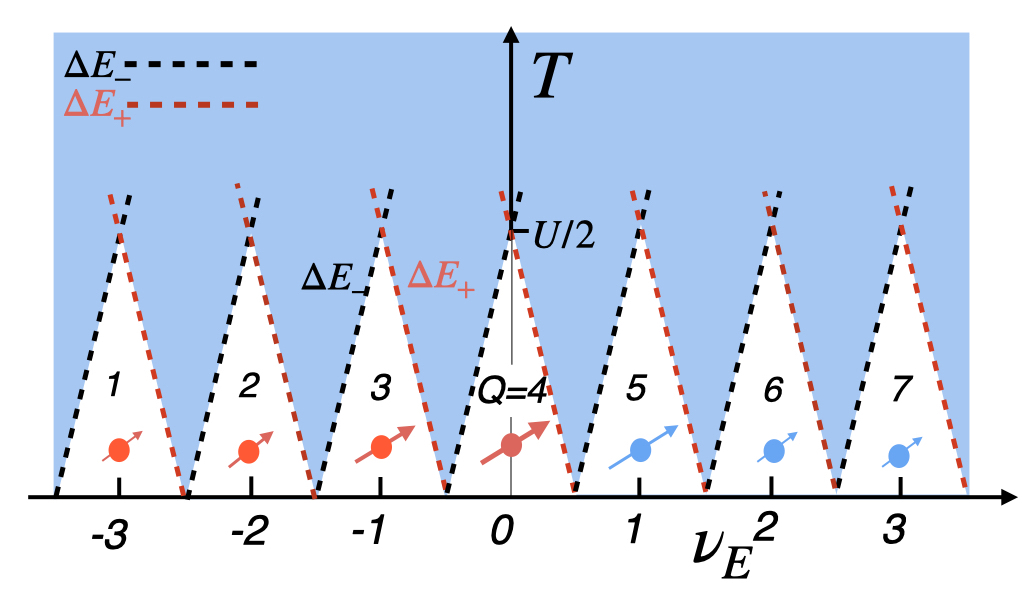
- Kondo 스크리닝(T_K)과 RKKY(T_RKKY) 사이의 돈리악(Doniach) 유형 경쟁을 논의하고 정수 채움 주변의 위상 다이어그램을 서술한다.
실험 결과
연구 질문
- RQ1SB 토폴로지적 무거운 페르미온 그림을 MATBG에 대한 혼합가치 앤더슨 격자로 재구성할 수 있는가?
- RQ2밸런스 변동과 하이브리드화가 저에너지 밴드 구조 및 국부 모멘트 형성에 어떤 영향을 미치는가?
- RQ3정수 채움 근처에서의 에너지 규모(키온도, RKKY, 허버드)가 어떻게 채움의 함수로 구성되며, 위상 다이어그램을 어떻게 조직하는가?
- RQ4bare한 하이브리드화 γ0가 포논(폴로론) 효과로 재정규화되어 관측된 국부 모멘트 거동을 설명하는가?
- RQ5고에너지(U) 및 저에너지(Kondo) 한계가 SU(8)에서 SU(4) Kondo 격자 설명으로 매핑되는가?
주요 결과
- 고에너지에서 conduction sea와의 상호작용은 U(8) Kondo 격자로, 저에너지에서 U(4) Kondo 격자로 작용한다.
- 근본적인 하이브리드화 스케일 및 허버드 밴드 폭은 에너지(μ ~ Uν 및 상태 밀도)를 통해 선형으로 스케일링된다.
- SB 모델에서 예측된 bare 하이브리드화 γ0는 큰 채움에서 관측된 국부 모멘트 거동을 설명하기에 너무 크며, 포논에 의한 재정규화를 시사한다.
- 혼합가치 형식은 SU(8) 합성체와 tunable Kondo 스케일 T_K를 갖는 위상적 Kondo 격자를 제시하며 RKKY 상호작용과 경쟁한다.
- 이 연구는 자성-밸리-스핀 위상, 거대 페르미 액체 영역, 그리고 약하게 결합된 Song–Bernevig 페르미 액체 영역이 가능할 수 있는 돈니악(Doniach) 유형의 위상 다이어그램을 예측한다.
이 논문 읽기
누빈트 뷰어에서 원문을 열고, 읽으면서 궁금한 곳을 바로 물어보세요.
누빈트에서 이 논문 읽기이 리뷰는 AI가 논문 원문을 바탕으로 만들었습니다. 인용하기 전에 원문을 확인해 주세요.