
[Paper Review] Adaptive Gains to Super-Twisting Technique for Sliding Mode Design
This paper proposes an adaptive super-twisting algorithm (STA) for second-order sliding mode control that eliminates chattering and reduces control gains by using a third-order sliding mode observer to exactly estimate perturbation magnitude, enabling online adaptation of both STA gains without low-pass filters. The method ensures finite-time convergence and robustness with only one adjustable parameter, validated via simulation on a perturbed LTI system.
This paper studies the super-twisting algorithm (STA) for adaptive sliding mode design. The proposed method tunes the two gains of STA on line simultaneously such that a second order sliding mode can take place with small rectifying gains. The perturbation magnitude is obtained exactly by employing a third-order sliding mode observer in opposition to the conventional approximations by using a first order low pass filter. While driving the sliding variable to the sliding mode surface, one gain of the STA automatically converges to an adjacent area of the perturbation magnitude in finite time. The other gain is adjusted by the above gain to guarantee the robustness of the STA. This method requires only one parameter to be adjusted. The adjustment is straightforward because it just keeps increasing until it fulfills the convergence constraints. For large values of the parameter, chattering in the update law of the two gains is avoided by employing a geometry based backward Euler integration method. The usefulness is illustrated by an example of designing an equivalent control based sliding mode control (ECBC-SMC) with the proposed adaptive STA for a perturbed LTI system.
Motivation & Objective
- To address chattering and high control gains in conventional super-twisting algorithms.
- To eliminate reliance on low-pass filters for approximating equivalent control in adaptive gain tuning.
- To enable online, robust adaptation of both super-twisting gains using exact perturbation estimation.
- To ensure finite-time convergence and robustness with minimal control effort.
- To simplify tuning by requiring only one adjustable parameter.
Proposed method
- A third-order sliding mode observer is designed to exactly estimate the perturbation magnitude, replacing low-pass filter approximations.
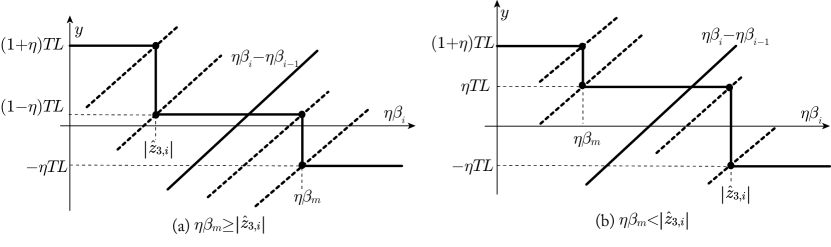
- The observer dynamics are formulated as a differential inclusion to enable implicit Euler integration for chattering suppression.
- Two adaptive gains, α and β, are updated online using a Lyapunov-based law that ensures robustness and finite-time convergence.
- The gain β is adapted to the exact perturbation magnitude, while α is adjusted proportionally to maintain robustness.
- A geometry-based backward Euler integration method is applied to the update law to prevent chattering from large gain values.
- The method is integrated into an equivalent control-based sliding mode controller (ECB-SMC) for a perturbed LTI system.
Experimental results
Research questions
- RQ1Can the super-twisting algorithm achieve finite-time convergence with minimal control gains using exact perturbation estimation?
- RQ2How can chattering be eliminated in adaptive gain updating without relying on low-pass filters?
- RQ3What is the impact of using a third-order sliding mode observer on gain adaptation accuracy and robustness?
- RQ4Can the adaptive gain mechanism ensure robustness while minimizing control effort?
- RQ5How does the proposed method compare to conventional adaptive laws based on low-pass filtering in terms of convergence speed and gain magnitude?
Key findings
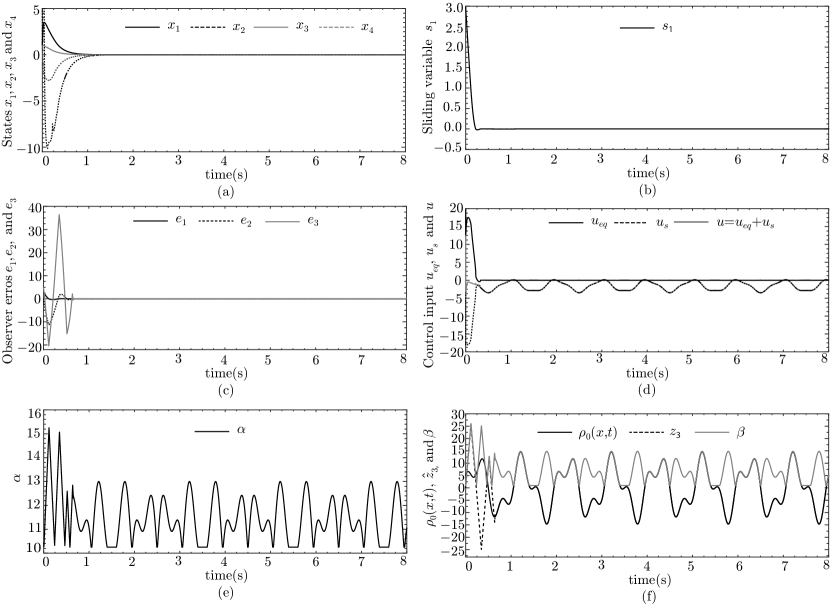
- The third-order sliding mode observer successfully estimates the perturbation magnitude exactly, enabling precise adaptation of the super-twisting gains.
- The adaptive gain update law ensures that β converges to |ρ₀(x,t)|/η, achieving the minimum possible gain while maintaining robustness.
- The state x asymptotically converges to zero, and the sliding variable s₁ reaches zero in finite time despite perturbations.
- Observer error e converges to zero in less than 1 second, preceding the convergence of the state, enabling fast and independent gain adaptation.
- The gain α is proportionally adjusted to β, ensuring robustness without excessive amplification.
- Chattering is effectively eliminated due to the geometry-based backward Euler integration of the update law, even for large L values.
Read this paper
Open the full text in the Nubint reader and ask about any passage as you read.
Read this paper on NubintThis review was generated by AI from the original paper. Please check the paper before citing it.