
[Paper Review] Cosmic muon flux attenuation methods for superconducting qubit experiments
This paper proposes two practical methods to reduce cosmic muon flux in superconducting qubit experiments: orienting chips toward the horizon to achieve a 1.6× reduction in muon counts, and utilizing shallow underground sites (e.g., 100 m depth) to achieve up to 35× attenuation. The authors validate both methods using a custom-built muon detector, demonstrating that muon-induced noise—critical for qubit stability—can be significantly mitigated through environmental shielding and device placement.
We propose and demonstrate two practical mitigation methods to attenuate the cosmic muon flux, compatible with experiments involving superconducting qubits: shallow underground sites and specific device orientation. Using a specifically-built cosmic muon detector, we identify underground sites, widely present in urban environments, where significant attenuation of cosmic muon flux, up to a factor 35 for 100-meter depths, can be attained. Furthermore, we employ two germanium wafers in an above-ground laboratory, each equipped with a particle sensor, to show how the orientation of the chip with respect to the sky affects the amount and type of energy deposited on the substrate by ionizing radiation. We observe that the horizontal detector sees more counts at lower energy, while the vertical one is impacted by more particles at higher energy. The methods here described proposed ways to directly understand and reduce the effects of cosmic rays on qubits by attenuating the source of this type of decoherence, complementing existing on-chip mitigation strategies. We expect that both on-chip and off-chip methods combined will become ubiquitous in quantum technologies based on superconducting qubit circuits.
Motivation & Objective
- To address cosmic muon-induced decoherence in superconducting qubits, a growing concern despite not yet being the dominant noise source.
- To identify and validate practical, off-chip mitigation strategies that directly reduce the muon flux before it reaches qubit devices.
- To demonstrate that environmental shielding and device orientation can significantly lower muon flux without requiring deep underground facilities.
- To provide a portable, reusable muon detection system for replication by other research groups.
- To position muon flux attenuation as a critical, complementary strategy alongside on-chip noise mitigation for future fault-tolerant quantum computing.
Proposed method
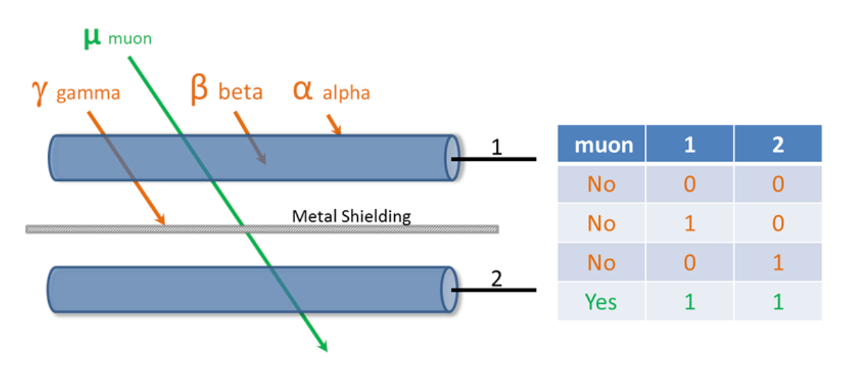
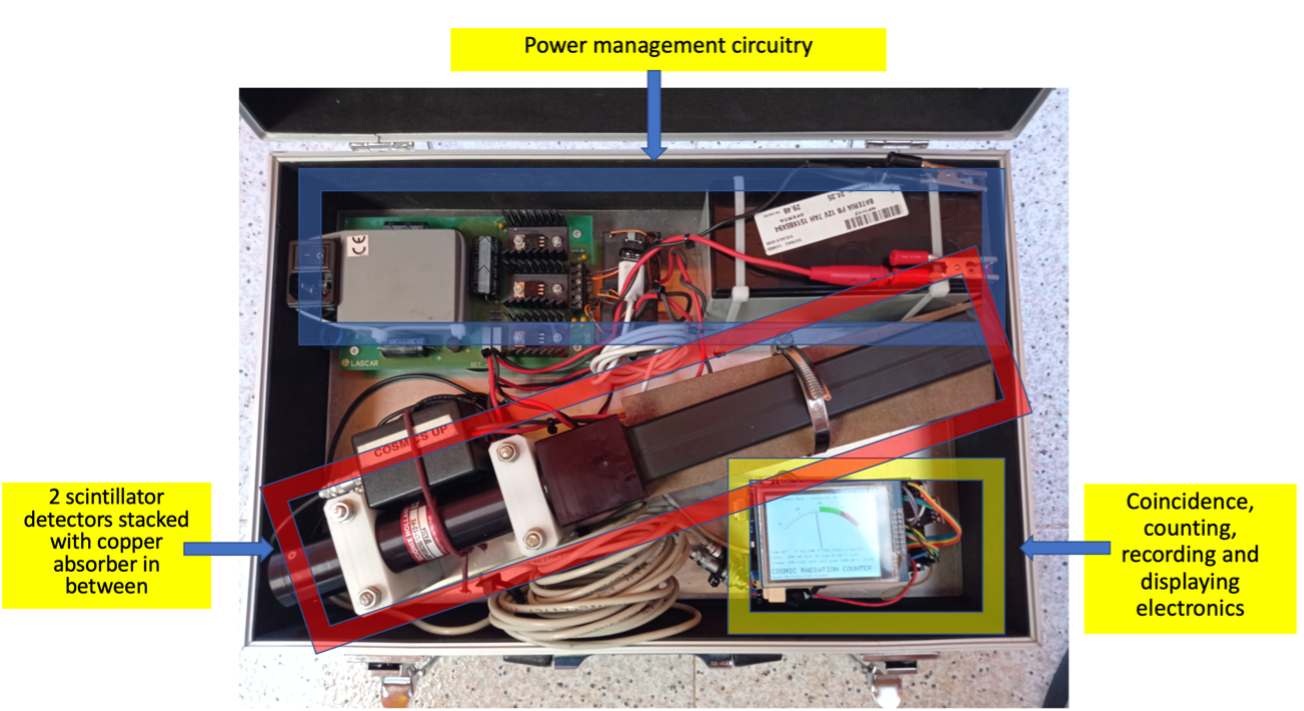
- Designed and constructed a portable, two-scintillator coincidence muon detector to measure cosmic muon flux in real-world environments.
- Used the detector to measure muon counts at surface level, various shallow underground sites (e.g., subway tunnels, synchrotron sub-basement), and at different chip orientations relative to the zenith.
- Applied angular dependence modeling to quantify how muon flux varies with chip orientation, leveraging the atmospheric absorption of muons at oblique angles.
- Measured muon flux attenuation as a function of rock overburden depth, confirming exponential decay trends consistent with known muon absorption physics.
- Subtracted spurious coincidence counts due to detector dead time to ensure accurate flux measurements.
- Used the ALBA synchrotron sub-basement as a representative shallow underground lab site to benchmark performance under moderate shielding.
Experimental results
Research questions
- RQ1Can chip orientation toward the horizon reduce cosmic muon flux exposure in superconducting qubit experiments?
- RQ2To what extent can shallow underground sites (10–100 m depth) attenuate cosmic muon flux compared to surface-level exposure?
- RQ3What is the quantitative reduction in muon flux achievable through combined orientation and shallow underground shielding?
- RQ4How does environmental radioactivity in shallow underground sites (e.g., from heavy minerals) affect muon detection and whether it necessitates additional shielding?
- RQ5Can a portable, low-cost muon detector be reliably used to characterize muon flux in diverse experimental environments?
Key findings
- Chips oriented toward the horizon experience a 1.6× reduction in muon flux compared to those pointing directly at the sky, due to increased atmospheric path length and absorption.
- At a depth of 100 m, muon flux is attenuated by a factor of up to 35 compared to surface measurements, with the Vallvidrera tunnel site achieving 36× attenuation.
- A shallow site at 6 m depth reduces muon flux by a factor of 2, demonstrating significant protection even at minimal depths.
- The ALBA synchrotron sub-basement site recorded 1.1 CPM, corresponding to a 36× screening factor relative to the surface (40 CPM), confirming effective shielding.
- The TMB subway site recorded 1.4 CPM (29× screening), though slightly elevated compared to surface due to local radioactivity from heavy minerals, necessitating additional shielding like lead.
- At 100 m depth, the muon event rate drops to ~3×10⁻⁴ s⁻¹ cm⁻², resulting in only 0.3 mHz per cm² device area—compared to 9 mHz at the surface—demonstrating a substantial reduction in ionizing radiation impact.
Better researchstarts right now
From reading papers to final review, dramatically reduce your research time.
No credit card · Free plan available
This review was created by AI and reviewed by human editors.