
[Paper Review] Dynamic transition in an atomic glass former: a molecular dynamics evidence
This study provides molecular dynamics evidence for a first-order dynamic phase transition in a Lennard-Jones atomic glass former (Kob-Andersen mixture), using a large-deviation formalism to analyze trajectory activity. It identifies a transition point at s_c(∞) ≈ 0, indicating that the dynamic transition is accessible in experiments and confirms the relevance of kinetically constrained model theory in atomistic systems.
We find that a Lennard-Jones mixture displays a dynamic phase transition between an active regime and an inactive one. By means of molecular dynamics simulations and of a finite-size study, we show that the space time dynamics in the supercooled regime coincides with a dynamic first order transition point.
Motivation & Objective
- To establish the existence of a dynamic phase transition in an atomistic glass former using finite-size scaling.
- To precisely locate the dynamic transition point in the thermodynamic limit, addressing whether it lies at experimentally accessible values.
- To define a physically transparent activity observable based on effective forces, avoiding phenomenological assumptions.
- To confirm the relevance of the dynamic transition scenario from kinetically constrained models in realistic atomic systems.
Proposed method
- Employed a molecular dynamics version of the cloning algorithm to sample rare trajectories with large deviations in activity.
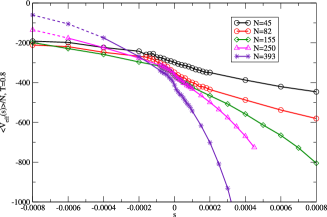
- Defined the activity as the time-averaged effective force, linking it to physical forces between particles.
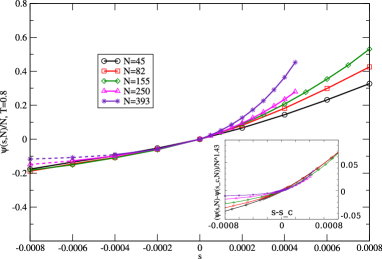
- Used the cumulant generating function ψ(s) to analyze the statistics of trajectory activity across different system sizes.
- Applied finite-size scaling via spline fitting and second derivative maximization to locate s_c(N), the transition point at size N.
- Analyzed scaling behavior of the free energy ψ(s) as ∼N for s<0 and ∼N^{1+α} with α≈0.43 for s>0, indicating distinct dynamical phases.
- Used rescaling and finite-size extrapolation to infer the infinite-size limit s_c(∞) of the transition point.
Experimental results
Research questions
- RQ1Does a dynamic phase transition exist in an atomistic glass former such as the Kob-Andersen Lennard-Jones mixture?
- RQ2Where is the critical point of this dynamic transition located in the thermodynamic limit, and is it accessible experimentally?
- RQ3Can the concept of dynamical activity be defined in terms of physical forces rather than phenomenological constructs?
- RQ4How does the scaling of the free energy with system size distinguish the active and inactive dynamical phases?
- RQ5What is the geometric and topological nature of the inactive configurations in the large-deviation ensemble?
Key findings
- The system exhibits a first-order dynamic phase transition between active and inactive states, confirmed by a bimodal activity distribution and a kink in the free energy ψ(s).
- The transition point s_c(N) decreases with system size N and is consistent with converging to a value near zero in the infinite-size limit.
- The free energy ψ(s) scales as ∼N for s<0 (active phase) and ∼N^{1+α} with α≈0.43 for s>0 (inactive phase), indicating non-trivial geometry in inactive configurations.
- The non-integer exponent α≈0.43 suggests the presence of long-range effective interactions and complex spatial structures in the inactive phase.
- The transition is located at s_c(∞)≈0, making it potentially observable in experiments that probe trajectory statistics.
- The activity observable, defined via effective forces, provides a physically transparent and measurable characterization of dynamical heterogeneity.
Read this paper
Open the full text in the Nubint reader and ask about any passage as you read.
Read this paper on NubintThis review was generated by AI from the original paper. Please check the paper before citing it.