
[Paper Review] Enhanced Entanglement in the Measurement-Altered Quantum Ising Chain
This paper demonstrates that stochastic local measurements can enhance both bipartite and multipartite entanglement in the quantum Ising chain, contrary to the common assumption that measurements always destroy entanglement. Using large-scale numerical simulations and perturbative analysis, the authors show that forced on-site measurements induce a non-trivial entanglement enhancement mechanism tied to the monogamy of entanglement, and extend these findings to non-Hermitian Ising models, where measurement effects preserve key entanglement scaling features.
Understanding the influence of measurements on the properties of many-body systems is a fundamental problem in quantum mechanics and for quantum technologies. This paper explores how a finite density of stochastic local measurement modifies a given state's entanglement structure. Considering various measurement protocols, we explore the typical quantum correlations of their associated projected ensembles arising from the ground state of the quantum Ising model. Using large-scale numerical simulations, we demonstrate substantial differences among inequivalent measurement protocols. Surprisingly, we observe that forced on-site measurements can enhance both bipartite and multipartite entanglement. We present a phenomenological toy model and perturbative calculations to analytically support these results. Furthermore, we extend these considerations to the non-Hermitian Ising model, naturally arising in optically monitored systems, and we show that its qualitative entanglement features are not altered by a finite density of projective measurements. Overall, these results reveal a complex phenomenology where local quantum measurements do not simply disentangle degrees of freedom, but may actually strengthen the entanglement in the system.
Motivation & Objective
- To investigate how finite-density stochastic local measurements affect the entanglement structure of many-body quantum states.
- To challenge the heuristic view that measurements universally reduce entanglement by demonstrating entanglement enhancement under specific protocols.
- To develop a phenomenological toy model and perturbative framework to explain the observed entanglement enhancement mechanism.
- To extend the analysis to non-Hermitian Ising models and assess the robustness of entanglement features under projective measurements.
- To clarify the relationship between non-Hermitian Hamiltonian descriptions and measurement-induced phase transitions in open quantum systems.
Proposed method
- Numerical simulations of the quantum Ising chain ground state under various measurement protocols, including Born rule and forced measurements.
- Use of entanglement witnesses: entanglement entropy (EE), quantum Fisher information (QFI), and two-body fermionic negativity (FN) to quantify bipartite and multipartite correlations.
- Perturbative calculations to analytically support the observed entanglement enhancement in the presence of forced measurements.
- Development of a toy model of an entanglement network to capture the physical mechanism behind enhanced correlations.
- Extension to non-Hermitian Ising models via quantum jump stochastic Schrödinger equations, modeling forced projections via Kraus operators.
- Derivation of the quantum jump equation from weak measurement formalism, leading to a non-Hermitian effective Hamiltonian for the stochastic trajectory.
Experimental results
Research questions
- RQ1Can local projective measurements enhance entanglement in a many-body quantum system, contrary to the expectation of disentanglement?
- RQ2How do different measurement protocols—Born rule versus forced measurements—affect the entanglement structure of the quantum Ising chain?
- RQ3What is the underlying physical mechanism enabling entanglement enhancement under forced measurements, and how can it be captured by a simplified model?
- RQ4To what extent do the entanglement scaling properties of non-Hermitian Ising models remain invariant under finite-density projective measurements?
- RQ5Is the discrepancy between non-Hermitian descriptions and measurement-induced phase transitions dynamical or static?
Key findings
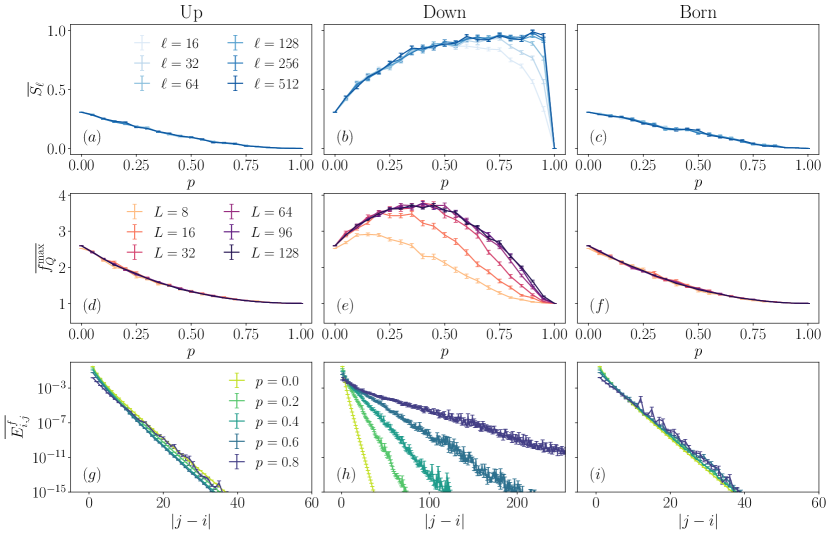
- Forced on-site measurements can enhance both bipartite and multipartite entanglement in the quantum Ising chain, as evidenced by increases in entanglement entropy, quantum Fisher information, and fermionic negativity.
- The entanglement enhancement is attributed to a mechanism rooted in the monogamy of entanglement, where local projections redistribute entanglement across the system.
- Perturbative analysis confirms that the enhancement arises from the interplay between local measurements and the underlying spin correlations in the Ising ground state.
- The toy model of an entanglement network successfully reproduces the key features of entanglement enhancement, providing a conceptual framework for the phenomenon.
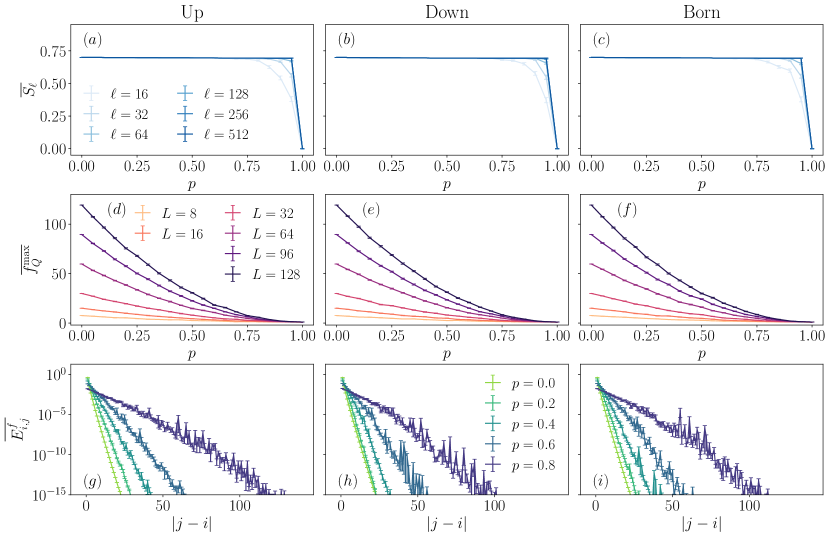
- In the non-Hermitian Ising model, the qualitative entanglement scaling features—including area-law entanglement and finite-range correlations—remain unchanged under projective measurements.
- The study reveals that any mismatch between non-Hermitian Hamiltonian descriptions and actual measurement-induced physics must be dynamical, not static, as the equilibrium entanglement structure is preserved.
Better researchstarts right now
From reading papers to final review, dramatically reduce your research time.
No credit card · Free plan available
This review was created by AI and reviewed by human editors.