
[Paper Review] Fault-tolerant quantum simulation of materials using Bloch orbitals
This paper presents a fault-tolerant quantum simulation framework for materials using Bloch orbitals derived from symmetry-adapted atom-centered basis sets, enabling efficient simulation of periodic systems with reduced quantum resources. By adapting qubitization-based algorithms—particularly with tensor factorizations like double factorization and tensor hypercontraction—it achieves a √Nₖ asymptotic speedup in walk operator construction, significantly lowering Toffoli and logical qubit costs for materials like lithium nickel oxide.
The simulation of chemistry is among the most promising applications of quantum computing. However, most prior work exploring algorithms for block-encoding, time-evolving, and sampling in the eigenbasis of electronic structure Hamiltonians has either focused on modeling finite-sized systems, or has required a large number of plane wave basis functions. In this work, we extend methods for quantum simulation with Bloch orbitals constructed from symmetry-adapted atom-centered orbitals so that one can model periodic extit{ab initio} Hamiltonians using only a modest number of basis functions. We focus on adapting existing algorithms based on combining qubitization with tensor factorizations of the Coulomb operator. Significant modifications of those algorithms are required to obtain an asymptotic speedup leveraging translational (or, more broadly, Abelian) symmetries. We implement block encodings using known tensor factorizations and a new Bloch orbital form of tensor hypercontraction. Finally, we estimate the resources required to deploy our algorithms to classically challenging model materials relevant to the chemistry of Lithium Nickel Oxide battery cathodes within the surface code.
Motivation & Objective
- Address the challenge of simulating large, periodic materials with fault-tolerant quantum computers using efficient basis sets.
- Overcome the high resource cost of simulating materials with large unit cells and dense k-point meshes in ab initio electronic structure methods.
- Extend quantum simulation algorithms—originally developed for molecules—to periodic systems using Bloch orbitals and translational symmetry.
- Develop symmetry-adapted block encodings for Hamiltonian representations (sparse, single factorization, double factorization, tensor hypercontraction) to reduce quantum resource overhead.
- Provide practical quantum resource estimates for classically challenging materials like lithium nickel oxide (LNO) under surface code constraints.
Proposed method
- Construct Bloch orbitals from symmetry-adapted atom-centered basis functions to model periodic systems with fewer basis functions than plane waves.
- Adapt qubitization-based Hamiltonian simulation using block encodings, incorporating Abelian symmetry (e.g., translational) to reduce circuit depth and gate count.
- Implement symmetry-adapted block encodings for four Hamiltonian representations: sparse, single factorization (SF), double factorization (DF), and tensor hypercontraction (THC).
- Leverage tensor factorizations to express the two-electron Coulomb operator in low-rank form, enabling efficient quantum simulation circuits.
- Use unary iteration in THC-based block encodings, with analysis of its linear cost limiting asymptotic speedup despite practical improvements.
- Compile resource estimates in terms of Toffoli gates and logical qubits for LNO using surface code error correction, comparing symmetry-adapted vs. non-symmetry-adapted implementations.

Experimental results
Research questions
- RQ1Can symmetry-adapted block encodings in Bloch orbital representations provide asymptotic quantum speedups for periodic materials simulation?
- RQ2How do different tensor factorization schemes (SF, DF, THC) compare in terms of resource efficiency when applied to materials Hamiltonians with translational symmetry?
- RQ3What is the impact of k-point sampling on quantum resource scaling, and can symmetry-adapted encodings achieve √Nₖ speedup in walk operator construction?
- RQ4Why does tensor hypercontraction fail to achieve asymptotic speedup despite symmetry adaptation, and what are the practical implications for resource costs?
- RQ5To what extent do finite-size effects and prefactor trade-offs influence the practical performance of THC-based simulations in materials like LNO?
Key findings
- Symmetry-adapted block encodings for sparse, single factorization (SF), and double factorization (DF) Hamiltonians achieve an asymptotic √Nₖ speedup in walk operator construction, where Nₖ is the number of k-points.
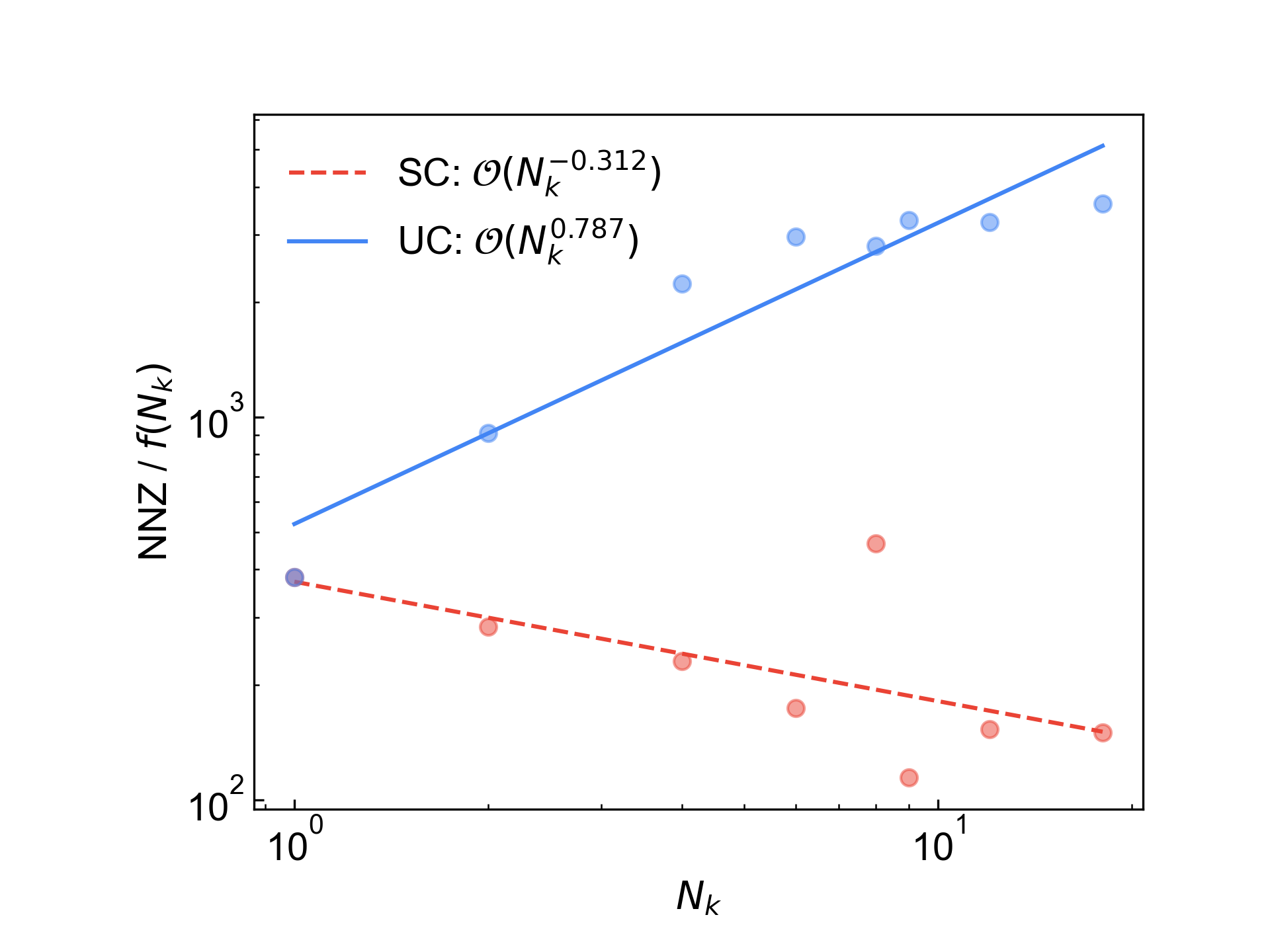
- For tensor hypercontraction (THC), no asymptotic speedup is formally possible due to the linear cost of unary iteration over basis states, though a √Nₖ scaling improvement is observed in Toffoli and logical qubit cost due to competing prefactors.
- Quantum resource estimates for simulating lithium nickel oxide (LNO) with a 3×3×3 k-point mesh require O(10²) to O(10³) days using the double factorization LCU method, indicating current impracticality.
- The use of Bloch orbitals with symmetry adaptation reduces the number of basis functions needed, enabling more efficient simulation of periodic materials compared to plane wave or non-symmetry-adapted local basis methods.
- Classical simulations of LNO with even coarse k-meshes take hours, highlighting the computational burden that quantum simulation must overcome.
- Despite high resource costs, the favorable scaling of phase estimation with system size supports continued pursuit of algorithmic improvements for materials simulation.
Read this paper
Open the full text in the Nubint reader and ask about any passage as you read.
Read this paper on NubintThis review was generated by AI from the original paper. Please check the paper before citing it.