
[Paper Review] Fluidisation of yield stress fluids under vibration
This study investigates the vibrational fluidisation of yield-stress fluids using molten chocolate and Carbopol microgel under vertical sinusoidal oscillations. It reveals that while both materials spread above a critical forcing acceleration, Carbopol rapidly relaxes to a new equilibrium shape with large-amplitude oscillations, indicating complex nonlinear viscoelastic behavior near the yield threshold, whereas chocolate exhibits slow, history-dependent spreading.
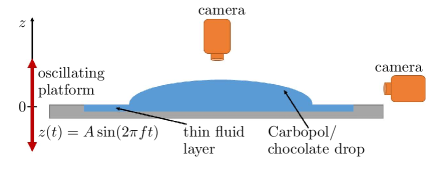
Motivated by the industrial processing of chocolate, we study experimentally the fluidisation of a sessile drop of yield-stress fluid on a pre-existing layer of the same fluid under vertical sinusoidal oscillations. We compare the behaviours of molten chocolate and Carbopol which are both shear-thinning with a similar yield stress but exhibit very different elastic properties. We find that these materials spread when the forcing acceleration exceeds a threshold which is determined by the initial deposition process. However, they exhibit very different spreading behaviours: whereas chocolate exhibits slow long-term spreading, the Carbopol drop rapidly relaxes its stress by spreading to a new equilibrium shape with an enlarged footprint. This spreading is insensitive to the history of the forcing. In addition, the Carbopol drop performs large-amplitude oscillations with the forcing frequency, both above and below the threshold. We investigate these viscoelastic oscillations and provide evidence of complex nonlinear viscoelastic behaviour in the vicinity of the spreading threshold. In fact, for forcing accelerations greater than the spreading threshold, our drop automatically adjusts its shape to remain at the yield stress. We discuss how our vibrated-drop experiment offers a new and powerful approach to probing the yield transition in elastoviscoplastic fluids.
Motivation & Objective
- To understand the mechanics of fluidisation in yield-stress fluids under vertical vibration, motivated by industrial processing of materials like chocolate.
- To compare the spreading behavior of two shear-thinning, yield-stress fluids with similar yield stress but different elastic properties: molten chocolate and Carbopol microgel.
- To investigate the role of viscoelasticity and forcing history in the onset and dynamics of spreading near the yield threshold.
- To characterize the dynamic yield stress and post-yield rheology of Carbopol microgel using cyclic rheometry and stress ramping.
- To develop a vibrated-drop experiment as a novel tool for probing the yield transition in elastoviscoplastic fluids.
Proposed method
- Conducted experiments on sessile drops of molten chocolate and Carbopol microgel on a pre-existing layer of the same fluid under vertical sinusoidal oscillations.
- Varied forcing acceleration to identify the threshold for spreading, using a range of frequencies and amplitudes.
- Performed cyclic rheometric measurements with constant-rate stress ramps (0.83–2.67 Pa/s) to determine the dynamic yield stress and post-yield flow curve.
- Used numerical inversion to solve the inverse problem and extract shear rate from angular velocity in a Couette-like geometry without assuming a rheological model.
- Fitted the post-yield data to the Herschel-Bulkley model to quantify viscosity and flow behavior, with parameters determined from experimental data.
- Analyzed hysteresis between ramp-up and ramp-down phases to assess thixotropy and viscoelastic memory effects.
Experimental results
Research questions
- RQ1What is the critical forcing acceleration required to initiate spreading in yield-stress fluids under vertical vibration?
- RQ2How do the spreading dynamics differ between a viscous, weakly elastic fluid (molten chocolate) and a highly elastic, shear-thinning gel (Carbopol) under the same vibrational forcing?
- RQ3To what extent is the spreading behavior of Carbopol dependent on the forcing history or pre-shear history?
- RQ4What is the dynamic yield stress of Carbopol microgel, and how does it compare to the static yield stress?
- RQ5How do viscoelastic effects, such as stick-slip and large-amplitude oscillations, influence the fluidisation process near the yield threshold?
Key findings
- Spreading in both chocolate and Carbopol occurs above a critical forcing acceleration, but the threshold depends on the initial deposition process.
- Carbopol exhibits rapid, history-independent spreading to a new equilibrium shape with an enlarged footprint, indicating stress relaxation through viscoelastic flow.
- Carbopol drops perform large-amplitude oscillations at the forcing frequency both above and below the spreading threshold, indicating nonlinear viscoelastic response.
- The dynamic yield stress of 2.2 g/L Carbopol microgel is measured as 35 ± 3 Pa, with a consistent value of 35 ± 5 Pa across multiple experiments.
- The post-yield flow behavior of Carbopol is well described by the Herschel-Bulkley model with parameters K = 8.2 Pa s^n and n = 0.49 ± 0.02 for 2.2 g/L concentration.
- Hysteresis between ramp-up and ramp-down stress cycles is minimal (within 5%), indicating negligible thixotropy in the tested parameter range.
Better researchstarts right now
From reading papers to final review, dramatically reduce your research time.
No credit card · Free plan available
This review was created by AI and reviewed by human editors.