
[Paper Review] Full Eigenstate Thermalization via Free Cumulants in Quantum Lattice Systems
The paper numerically tests the general ETH in chaotic many-body systems by decomposing higher-order correlators into free cumulants, showing that four-time correlators are encoded in the fourth free cumulant with nontrivial frequency structure.
The Eigenstate-Thermalization-Hypothesis (ETH) has been established as the general framework to understand quantum statistical mechanics. Only recently has the attention been paid to so-called full ETH, which accounts for higher-order correlations among matrix elements, and that can be rationalized theoretically using the language of Free Probability. In this work, we perform the first numerical investigation of the full ETH in physical many-body systems with local interactions by testing the decomposition of higher-order correlators into thermal free cumulants for local operators. We perform exact diagonalization on two classes of local non-integrable (chaotic) quantum many-body systems: spin chain Hamiltonians and Floquet brickwork unitary circuits. We show that the dynamics of four-time correlation functions are encoded in fourth-order free cumulants, as predicted by ETH. Their dependence on frequency encodes the physical properties of local many-body systems and distinguishes them from structureless, rotationally invariant ensembles of random matrices.
Motivation & Objective
- Motivate and test the general Eigenstate Thermalization Hypothesis (ETH) for higher-order correlations in local, non-integrable quantum many-body systems.
- Demonstrate that four-point correlators decompose into free cumulants as predicted by Free Probability theory.
- Show that crossing partitions are exponentially suppressed and non-crossing partitions factorize, reproducing ETH structure in time and frequency domains.
- Distinguish physical many-body dynamics from structureless random matrices through frequency-resolved free cumulants.
- Explore the potential universality and higher-order correlations in non-integrable lattice models and Floquet circuits.
Proposed method
- Perform exact diagonalization on two chaotic quantum many-body systems: a non-integrable Ising spin chain and Floquet brickwork circuits.
- Compute four-point time correlation functions and express them via free cumulants within the Free Probability framework.
- Test ETH predictions by verifying exponential suppression of crossing partitions and factorization of non-crossing partitions in both time and frequency domains.
- Evaluate the fourth free cumulant k4 and its Fourier transform to obtain the frequency-resolved ETH function tilde{k4}(ω1, ω2, ω3).
- Compare results against rotationally invariant random matrices to highlight non-flat, system-specific frequency dependence of free cumulants.
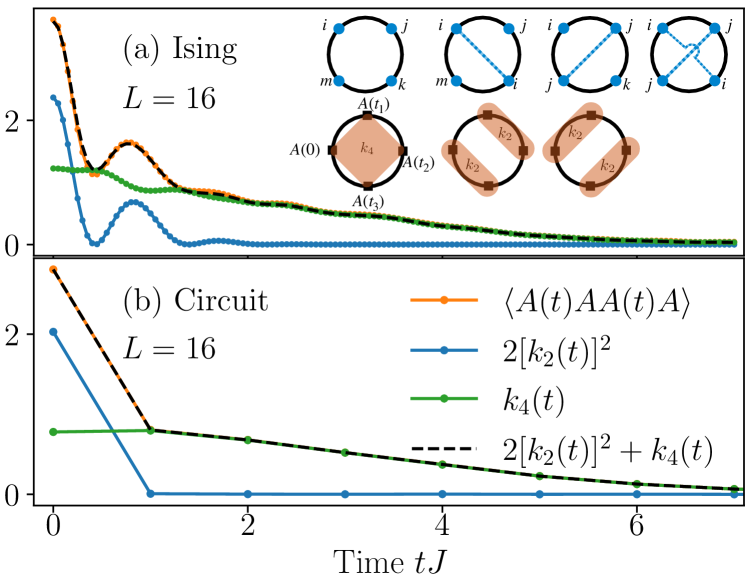
- Analyze OTOCs such as <A(t) A A(t) A> using the k2 and k4 decompositions to quantify longer-time dynamics.
Experimental results
Research questions
- RQ1Does the general ETH, expressed via free cumulants, hold in finite-size chaotic quantum lattice systems with local interactions?
- RQ2Are crossing diagrams exponentially suppressed and non-crossing diagrams factorized in time and frequency domains as ETH predicts?
- RQ3What is the frequency dependence of the fourth free cumulant tilde{k4}(ω1, ω2, ω3) in physical systems versus random matrix ensembles?
- RQ4Can four-point correlators, including OTOCs, be accurately described by the k2 and k4 terms, and what does this imply about higher-order correlations beyond two-point functions?
- RQ5Do Floquet circuits and Hamiltonian spin chains exhibit similar ETH signatures and potential universality in k4 dynamics?
Key findings
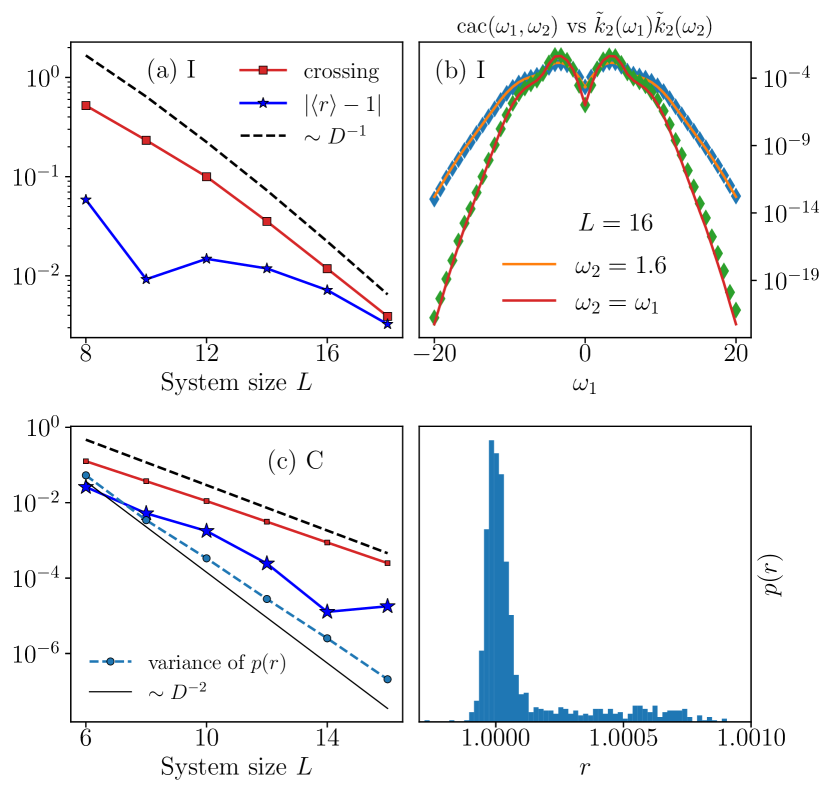
- Crossing partition contributions are exponentially suppressed with system size, supporting ETH predictions.
- Non-crossing (cactus) contributions factorize, with the ratio cac(ω1, ω2) approaching the product tilde{k2}(ω1) tilde{k2}(ω2) as L grows.
- The fourth free cumulant k4(t) captures the residual OTOC dynamics after two-point correlators decay, indicating nontrivial higher-order correlations.
- The frequency-resolved tilde{k4}(ω1, ω2, ω3) shows nontrivial structure for Ising Hamiltonians (decaying at large frequencies) and Floquet circuits (periodic with nontrivial dynamics within 2π), distinguishing ETH from flat random-matrix behavior.
- The ETH framework via free cumulants accurately reproduces the full four-point correlator as <A(t) A A(t) A> ≈ 2[k2(t)]^2 + k4(t) for both Ising and circuit models.
- Results persist across two model classes (Hamiltonian and Floquet) and differ from structureless, rotationally invariant random matrices.
Read this paper
Open the full text in the Nubint reader and ask about any passage as you read.
Read this paper on NubintThis review was generated by AI from the original paper. Please check the paper before citing it.