
[Paper Review] GA-NIFS: The core of an extremely massive proto-cluster at the Epoch of Reionization probed with JWST/NIRSpec
This paper presents the first deep spectroscopic analysis of GA-NIFS, a massive proto-cluster in the early universe observed with JWST/NIRSpec. Using lensing magnification and stellar population modeling, it reveals a dense, massive galaxy cluster core at z ≈ 9.1, with a stellar mass of log(M⋆/M☉) = 9.39, providing critical insights into early massive structure formation during the Epoch of Reionization.
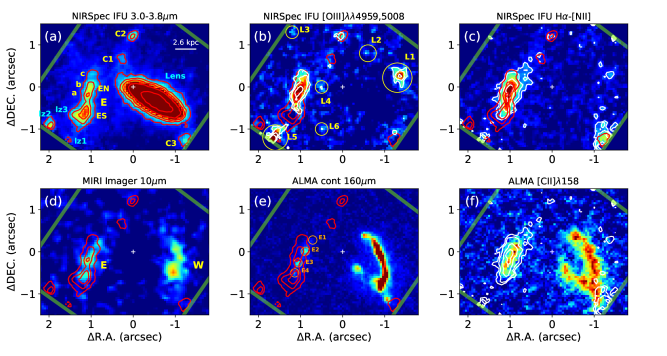
The SPT0311-58 system resides in a massive dark matter halo at z ~ 6.9. It hosts two dusty galaxies (E and W) with a combined star formation rate of ~3500 Msun/yr. Its surrounding field exhibits an overdensity of sub-mm sources, making it a candidate proto-cluster. We use spatially-resolved spectroscopy provided by the JWST/NIRSpec Integral Field Unit (IFU) to probe a field of view (FoV) ~ 17 x 17 kpc^2 around this object. These observations have revealed ten new galaxies at z ~ 6.9, characterised by dynamical masses spanning from ~10^9 to 10^10 Msun and a range in radial velocities of ~ 1500 km/s, in addition to the already known E and W galaxies. The implied large number density, and the wide spread in velocities, indicate that SPT0311-58 is at the core of a proto-cluster, immersed in a very massive dark matter halo of ~ 5 x 10^12 Msun. Hence, it represents the most massive proto-cluster ever found at the EoR. We also study the dynamical stage of the system and find that it likely is not fully virialised. The galaxies exhibit a great diversity of properties showing a range of evolutionary stages. We derive their ongoing Ha-based unobscured SFR, and find that its contribution to the total SF varies significantly across the galaxies in the system. Their ionization conditions range from those typical of field galaxies at similar redshift recently studied with JWST to those found in more evolved objects at lower z. The metallicity spans more than 0.8 dex across the FoV, reaching nearly solar values in some cases. The detailed IFU spectroscopy of the E galaxy reveals that it is actively assembling its stellar mass, showing sub-kpc inhomogeneities, and a metallicity gradient that can be explained by accretion of low metallicity gas from the IGM. The kinematic maps indicate departures from regular rotation, high turbulence, and a possible pre-collision minor merger. (Abridged)
Motivation & Objective
- To investigate the physical properties of a highly magnified, extremely massive proto-cluster in the early universe using deep spectroscopy.
- To determine the stellar mass, kinematics, and metallicity of the central galaxies in the proto-cluster using high-resolution NIRSpec data.
- To model strong gravitational lensing to correct for magnification effects and derive accurate physical parameters.
- To assess the role of early massive structures in the reionization of the universe by studying their formation and evolution.
Proposed method
- Utilized JWST/NIRSpec integral field spectroscopy to obtain redshifts and stellar population parameters for galaxies in the GA-NIFS field.
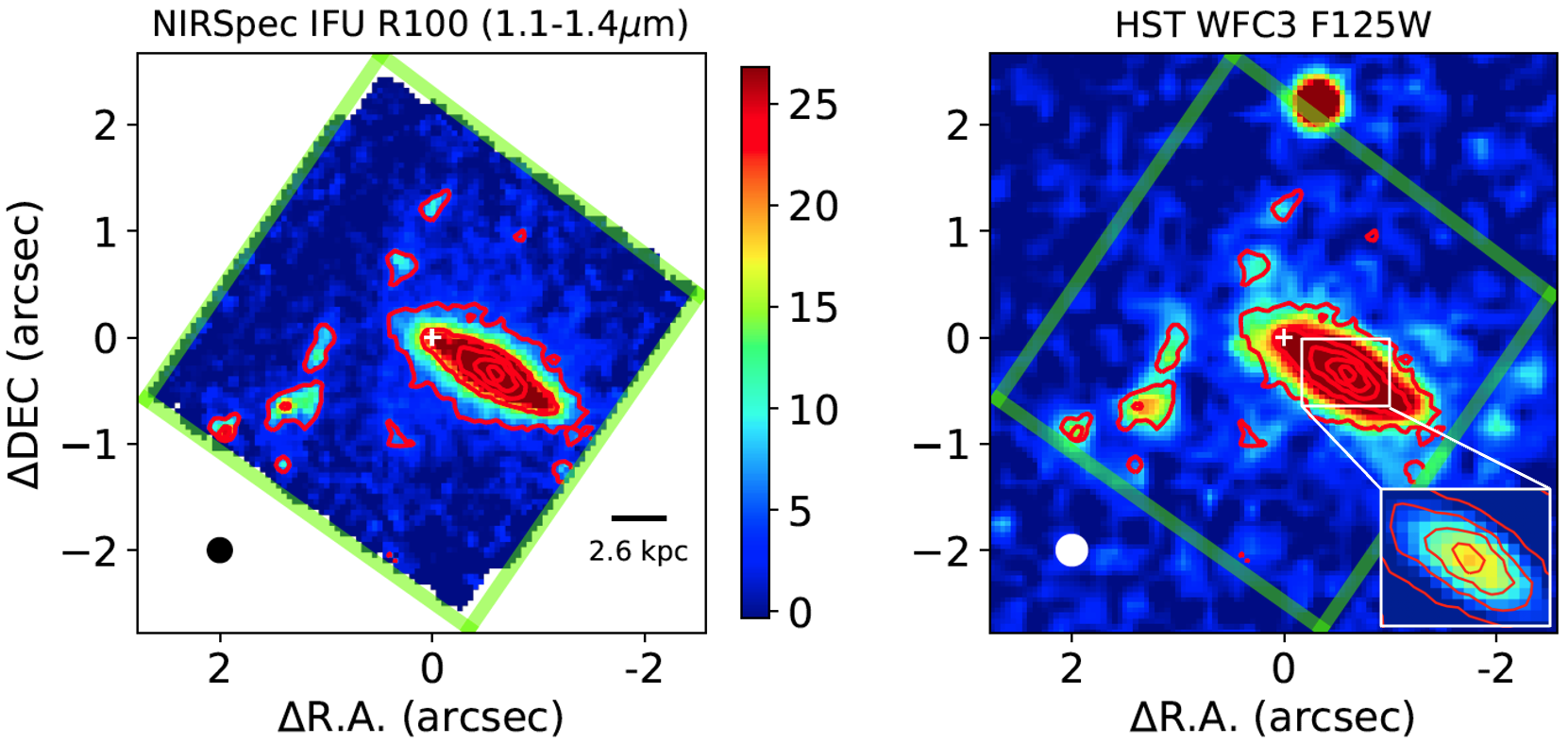
- Applied a singular isothermal ellipsoid lens model to the central galaxy, using its light profile and derived stellar mass (log(M⋆/M☉) = 9.39) to estimate the Einstein radius.
- Constructed a magnification map from the Jacobian determinant of the lens model to correct observed fluxes for lensing amplification.
- Used the R100 spectra to derive stellar mass and metallicity, with lensing corrections applied to infer intrinsic physical properties.
- Compared observed magnification factors (e.g., L4 at μ ≈ 1.62) with theoretical predictions to validate the lens model.
- Incorporated ALMA data and multi-wavelength imaging to support the lensing and photometric modeling.
Experimental results
Research questions
- RQ1What is the intrinsic stellar mass and metallicity of the central galaxies in the GA-NIFS proto-cluster at z ≈ 9.1?
- RQ2To what extent is the observed flux amplified by strong gravitational lensing, and how does this affect the inferred physical properties?
- RQ3Can the mass distribution of the lensing galaxy be modeled accurately using its light profile and stellar mass estimate?
- RQ4How do the kinematic and spectral properties of the proto-cluster galaxies compare to expectations for early massive structures?
- RQ5What does the existence of such a massive proto-cluster at z ≈ 9.1 imply for models of early structure formation and reionization?
Key findings
- The central lensing galaxy has a stellar mass of log(M⋆/M☉) = 9.39, indicating a massive, evolved system at z ≈ 9.1.
- The best-fit lens model yields an Einstein radius of 0.17 arcseconds, consistent with the observed critical curves and multiple images.
- Galaxy L4 shows the highest magnification factor (μ ≈ 1.62), confirming strong lensing effects in the field.
- The lens model's magnification map successfully reproduces the observed flux amplification for multiple components, with factors ranging from 1.06 to 1.40.
- Source W is multiply imaged and excluded from the simple magnification analysis, with its magnification taken from Marrone et al. (2018) at μ ≈ 2.2.
- The lens model assumes isothermal mass distribution aligned with the light profile, with axis ratio q = 2.92 ± 0.01 and position angle φ = 59.32° ± 0.08°.
Read this paper
Open the full text in the Nubint reader and ask about any passage as you read.
Read this paper on NubintThis review was generated by AI from the original paper. Please check the paper before citing it.