
[Paper Review] Geometry-Complete Diffusion for 3D Molecule Generation and Optimization
This paper introduces Geometry-Complete Diffusion Model (GCDM), a novel 3D molecular generation framework that leverages SE(3)-equivariant graph neural networks with geometry-complete message passing to learn geometric and physical priors during denoising. GCDM achieves state-of-the-art performance on QM9 and GEOM-Drugs, generating stable, realistic large molecules and enabling direct optimization of existing molecules for target properties without retraining.
Denoising diffusion probabilistic models (DDPMs) have pioneered new state-of-the-art results in disciplines such as computer vision and computational biology for diverse tasks ranging from text-guided image generation to structure-guided protein design. Along this latter line of research, methods have recently been proposed for generating 3D molecules using equivariant graph neural networks (GNNs) within a DDPM framework. However, such methods are unable to learn important geometric properties of 3D molecules, as they adopt molecule-agnostic and non-geometric GNNs as their 3D graph denoising networks, which notably hinders their ability to generate valid large 3D molecules. In this work, we address these gaps by introducing the Geometry-Complete Diffusion Model (GCDM) for 3D molecule generation, which outperforms existing 3D molecular diffusion models by significant margins across conditional and unconditional settings for the QM9 dataset and the larger GEOM-Drugs dataset, respectively, and generates more novel and unique unconditional 3D molecules for the QM9 dataset compared to previous methods. Importantly, we demonstrate that the geometry-complete denoising process of GCDM learned for 3D molecule generation enables the model to generate a significant proportion of valid and energetically-stable large molecules at the scale of GEOM-Drugs, whereas previous methods fail to do so with the features they learn. Additionally, we show that extensions of GCDM can not only effectively design 3D molecules for specific protein pockets but also that GCDM's geometric features can be repurposed to consistently optimize the geometry and chemical composition of existing 3D molecules for molecular stability and property specificity, demonstrating new versatility of molecular diffusion models. Our source code and data are freely available at https://github.com/BioinfoMachineLearning/Bio-Diffusion.
Motivation & Objective
- To address the limitations of existing 3D molecular diffusion models that fail to learn key geometric and physical properties due to non-geometric, molecule-agnostic GNNs.
- To develop a generative model that can scale effectively to large 3D molecules, such as those in the GEOM-Drugs dataset, which previous models struggle with.
- To investigate whether geometric diffusion models can be repurposed for molecular optimization tasks without fine-tuning or retraining.
- To establish a new SOTA in 3D molecule generation by integrating physical inductive biases like chirality and invariant attention into a diffusion framework.
Proposed method
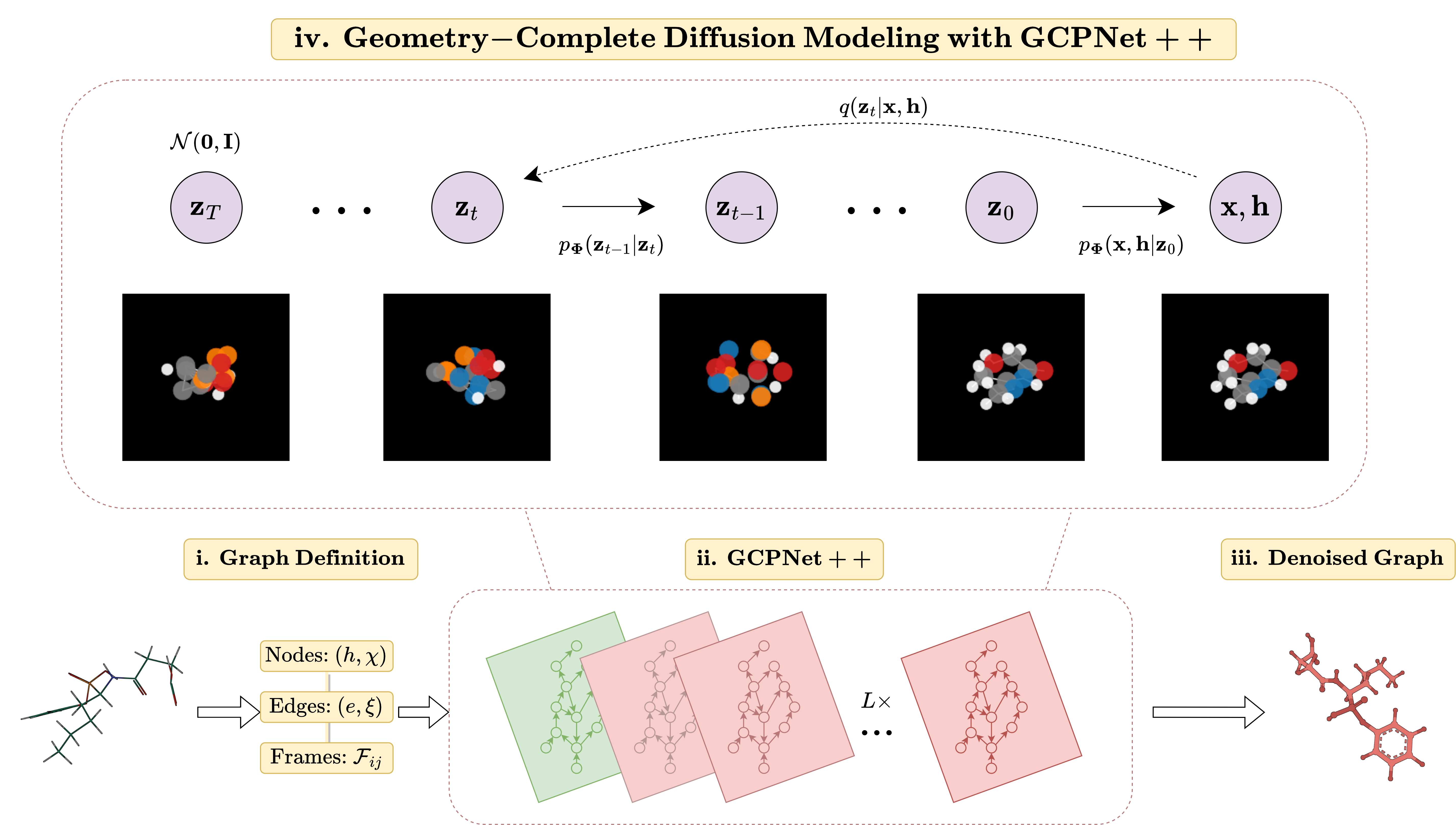
- GCDM employs a geometry-complete message-passing framework using GCPNet++ to denoise 3D molecular graphs with vector features, ensuring SE(3) equivariance.
- The model uses a denoising diffusion probabilistic framework where noise is iteratively removed from a noisy 3D molecular graph to generate realistic structures.
- It incorporates physical inductive biases such as invariant graph attention and molecular chirality to improve geometric fidelity and validity of generated molecules.
- The training objective is a standard DDPM loss with weighted MSE between predicted and ground-truth noise, with w(t) = 1 for optimal generation.
- The model performs unconditional and conditional 3D molecule generation by predicting atom types, charges, and 3D coordinates through a unified graph denoising process.
- GCDM enables direct molecular optimization by leveraging learned geometric features to iteratively improve existing molecules for specific properties without retraining.
Experimental results
Research questions
- RQ1Can a diffusion model that incorporates SE(3)-equivariant, geometry-complete message passing generate more realistic and stable 3D molecules than non-geometric counterparts?
- RQ2Does the inclusion of physical inductive biases such as chirality and invariant attention improve the validity and quality of generated 3D molecules?
- RQ3Can a single pre-trained geometric diffusion model be effectively repurposed for molecular optimization tasks without fine-tuning or retraining?
- RQ4How does GCDM perform on large 3D molecules, such as those in the GEOM-Drugs dataset, compared to existing methods that fail at this scale?
- RQ5Can GCDM outperform non-geometric diffusion models in protein pocket-conditioned 3D molecule generation and in direct molecular optimization?
Key findings
- GCDM achieves state-of-the-art performance on both unconditional and conditional 3D molecule generation for the QM9 dataset, outperforming prior methods in validity, stability, and property specificity.
- On the GEOM-Drugs dataset, GCDM successfully generates realistic and stable large 3D molecules, whereas previous methods fail to do so due to insufficient geometric learning.
- GCDM demonstrates the ability to optimize existing 3D molecules for specific molecular properties without retraining, a first-of-its-kind result for geometric diffusion models.
- The model’s geometry-complete denoising process enables it to learn and preserve key physical and geometric properties such as chirality and bond angles.
- GCDM achieves competitive results in protein pocket-conditioned 3D molecule generation, showing strong potential for drug design applications.
- The use of SE(3)-equivariant, vector-based message passing in GCPNet++ leads to significantly better geometric generalization compared to scalar-only message passing in prior models.
Read this paper
Open the full text in the Nubint reader and ask about any passage as you read.
Read this paper on NubintThis review was generated by AI from the original paper. Please check the paper before citing it.