
[Paper Review] iEDA: An Open-Source Intelligent Physical Implementation Toolkit and Library
iEDA is an open-source, end-to-end physical implementation toolkit for chip design, supporting the full flow from netlist to GDSII across 110nm and 28nm processes. It enables successful tapeouts of three RISC-V chips (700k–1.5M gates), demonstrating its robustness, extensibility, and viability as a research and industrial platform for EDA innovation.
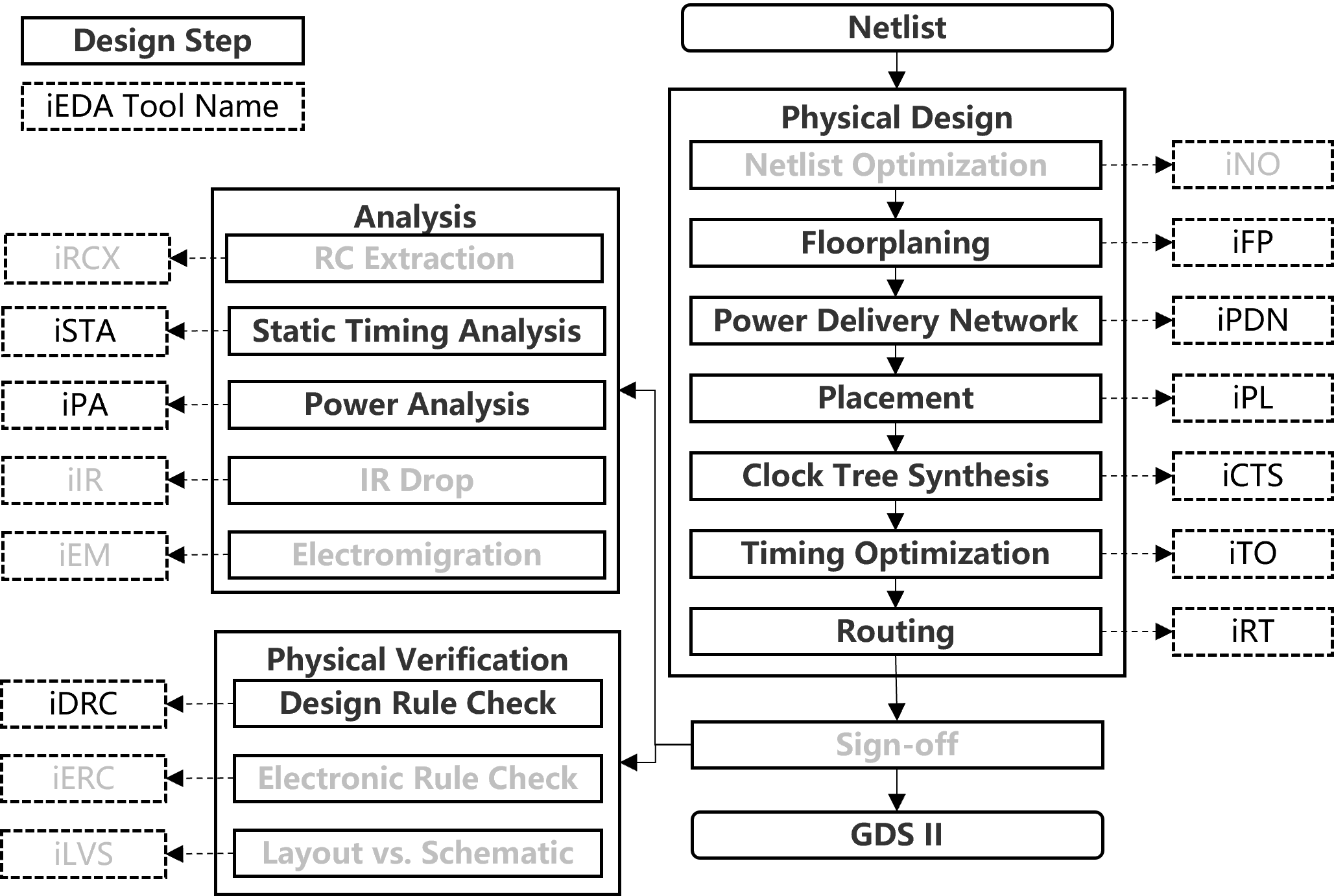
Open-source EDA shows promising potential in unleashing EDA innovation and lowering the cost of chip design. This paper presents an open-source EDA project, iEDA, aiming for building a basic infrastructure for EDA technology evolution and closing the industrial-academic gap in the EDA area. iEDA now covers the whole flow of physical design (including Floorplan, Placement, CTS, Routing, Timing Optimization etc.), and part of the analysis tools (Static Timing Analysis and Power Analysis). To demonstrate the effectiveness of iEDA, we implement and tape out three chips of different scales (from 700k to 1.5M gates) on different process nodes (110nm and 28nm) with iEDA. iEDA is publicly available from the project home page http://ieda.oscc.cc.
Motivation & Objective
- To bridge the industrial-academic gap in EDA by providing a comprehensive, open-source physical design infrastructure.
- To support the full physical design flow—floorplanning, placement, CTS, routing, timing and power optimization—within a single extensible framework.
- To enable reproducible, scalable, and high-performance chip tapeouts using open-source tools and AI integration.
- To foster innovation in EDA by offering a community-driven platform with extensible toolkits, data models, and AI-ready infrastructure.
- To advance EDA research by providing a unified, modular, and cloud-ready system for algorithm development, hardware acceleration, and AI-driven design.
Proposed method
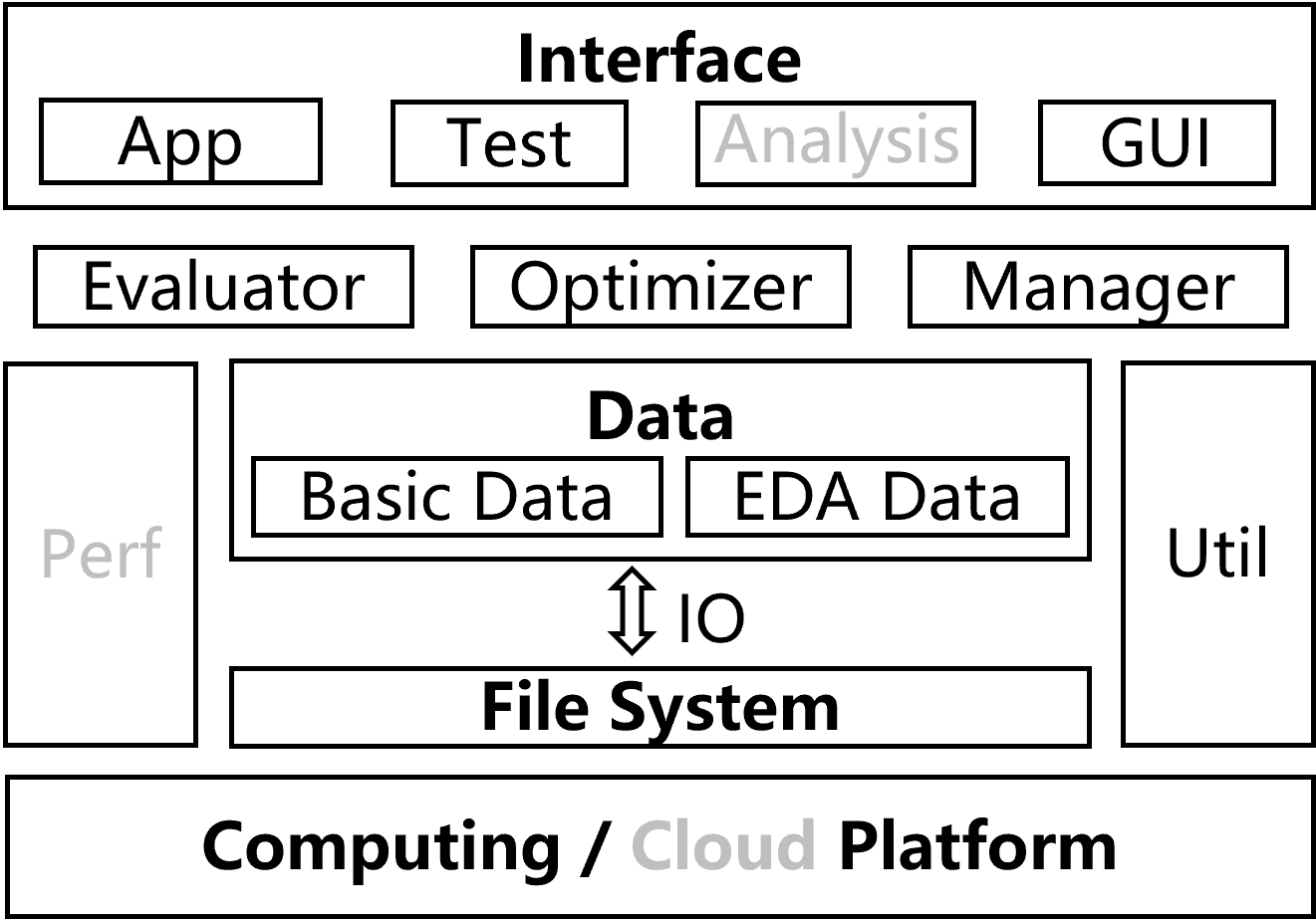
- iEDA integrates a modular software infrastructure with file parsers, database managers, evaluators, optimizers, and a GUI for unified EDA workflow management.
- The platform uses a layered data model to decouple design data from algorithms, enabling plug-and-play integration of solvers and AI models.
- Each physical design stage (e.g., floorplanning, placement, routing) is implemented as a set of low-coupling functional operations calling specific algorithms on designated data models.
- iFlow, a Python-based flow orchestrator, composes tool commands (TCL/Python) to automate the netlist-to-GDSII flow, integrating Yosys/ABC for synthesis and commercial signoff tools.
- The system supports incremental timing analysis, composite current source (CCS) delay modeling, and vector-based power analysis with glitch and toggle rate propagation.
- Future extensions include microservices-based decomposition, cloud-native deployment, and integration of AI models via a new AI infrastructure (AiEDA) for intelligent EDA.
Experimental results
Research questions
- RQ1Can an open-source EDA platform achieve industrial-grade reliability and scalability for full physical design flows?
- RQ2How effectively can open-source tools support tapeout of complex, multi-million-gate chips across multiple process nodes?
- RQ3To what extent can modular, extensible software architecture and AI integration enhance EDA tool development and innovation?
- RQ4Can a unified, community-driven EDA infrastructure reduce barriers to entry for academic and industrial researchers?
- RQ5How can AI models be effectively integrated into EDA toolchains through open, accessible, and extensible infrastructure?
Key findings
- iEDA successfully enabled the tapeout of three RISC-V chips—two 11-stage and one 5-stage—across 110nm and 28nm process nodes, validating its end-to-end capability.
- The 5-stage RISC-V chip on 110nm successfully booted up, confirming functional correctness and the robustness of the iEDA flow.
- The platform supports comprehensive physical design flows, including floorplanning, placement, CTS, routing, timing and power optimization, and static timing analysis.
- iSTA provides incremental timing propagation, CCS-based delay modeling, cross-talk analysis, and on-chip variation support with parallelized liberty loading.
- iPA enables vectorless and vector-based power analysis with glitch and probability-aware delay modeling, supporting accurate power estimation.
- The project has established a foundation for future AI integration through the AiEDA initiative, aiming to unify EDA tools with AI models in a modular, extensible framework.
Read this paper
Open the full text in the Nubint reader and ask about any passage as you read.
Read this paper on NubintThis review was generated by AI from the original paper. Please check the paper before citing it.