
[Paper Review] Improved machine learning algorithm for predicting ground state properties
This paper presents a classical machine learning algorithm that predicts ground state properties of n-qubit gapped local Hamiltonians using only O(log n) training data points, leveraging a geometrically biased nonlinear feature map and L1-regularized regression. The method achieves near-linear O(n log n) training and prediction time, significantly improving over prior O(n^c) sample complexity with high accuracy on systems up to 45 qubits.
Finding the ground state of a quantum many-body system is a fundamental problem in quantum physics. In this work, we give a classical machine learning (ML) algorithm for predicting ground state properties with an inductive bias encoding geometric locality. The proposed ML model can efficiently predict ground state properties of an $n$-qubit gapped local Hamiltonian after learning from only $\mathcal{O}(\log(n))$ data about other Hamiltonians in the same quantum phase of matter. This improves substantially upon previous results that require $\mathcal{O}(n^c)$ data for a large constant $c$. Furthermore, the training and prediction time of the proposed ML model scale as $\mathcal{O}(n \log n)$ in the number of qubits $n$. Numerical experiments on physical systems with up to 45 qubits confirm the favorable scaling in predicting ground state properties using a small training dataset.
Motivation & Objective
- To develop a classical machine learning algorithm that efficiently predicts ground state properties of quantum many-body systems.
- To reduce the sample complexity of existing ML methods from O(n^c) to O(log n) by encoding geometric locality as an inductive bias.
- To achieve near-linear computational time scaling in the number of qubits n, enabling efficient prediction on larger systems.
- To demonstrate robust performance on physical systems with up to 45 qubits using small, randomly sampled training datasets.
- To validate the method across various Hamiltonian parameterizations and observables without requiring quantum state access or knowledge of the Hamiltonian structure.
Proposed method
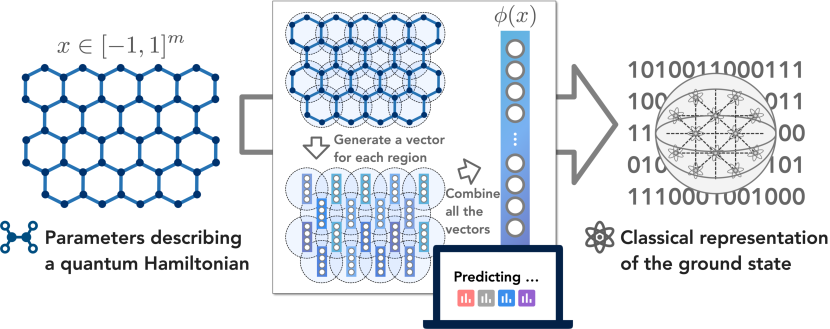
- The algorithm uses a nonlinear feature map φ(x) that encodes geometric locality by mapping local regions of the Hamiltonian parameter space into high-dimensional feature vectors.
- Each local region corresponds to edges or interactions on a lattice, with features computed using random Fourier features with tunable parameters R, γ.
- The model performs L1-regularized regression (LASSO) on the feature space to learn a linear predictor w* that approximates Tr(Oρ(x)).
- The feature map is constructed by decomposing the parameter vector x into local components, applying φ to each, and concatenating the results to form φ(x).
- Model hyperparameters R, γ, and α (regularization strength) are selected via 4-fold cross-validation on a held-out subset of the data.
- Numerical experiments use classical shadows with T randomized Pauli measurements to estimate ground state properties from sampled data.
Experimental results
Research questions
- RQ1Can a classical ML model predict ground state properties of gapped local Hamiltonians using only logarithmic-scale training data in the number of qubits?
- RQ2Does incorporating geometric locality as an inductive bias in the feature map enable sample complexity reduction below polynomial scaling?
- RQ3Can the proposed method achieve near-linear O(n log n) training and prediction time while maintaining high accuracy?
- RQ4How does the model perform across different system sizes and observables when trained on minimal data?
- RQ5Is the method robust to variations in training data size and classical shadow measurement count?
Key findings
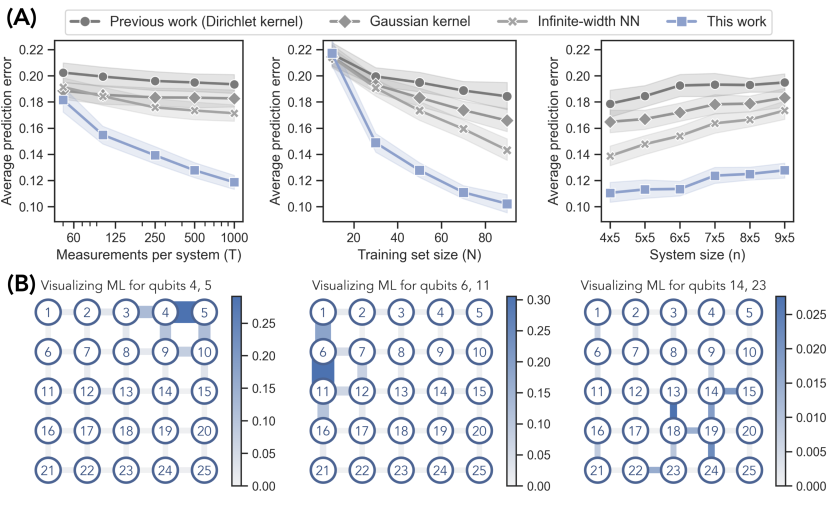
- The proposed algorithm achieves a sample complexity of O(log n), a substantial improvement over the O(n^c) scaling of prior methods, with c being a large constant.
- The training and prediction time scale as O(n log n), enabling efficient inference on systems with up to 45 qubits.
- Numerical experiments show statistically sound prediction errors averaged over 1500 to 3500 correlation function predictions, even with only ~50 training data points.
- The method maintains low root-mean-square error across different system sizes, with normalized standard deviation of correlation functions around 0.191.
- Performance remains stable when varying training data size (pM for p ∈ {0.1, 0.3, 0.5, 0.7, 0.9}) and classical shadow size (T ∈ {50, 100, 250, 500, 1000}).
- Model selection via cross-validation successfully identifies optimal hyperparameters R, γ, and α, leading to consistent generalization on test data.
Read this paper
Open the full text in the Nubint reader and ask about any passage as you read.
Read this paper on NubintThis review was generated by AI from the original paper. Please check the paper before citing it.