
[Paper Review] Learning ground states of gapped quantum Hamiltonians with Kernel Methods
This paper introduces a kernel method-based approach to learn ground states of gapped quantum Hamiltonians by reformulating the power method as a supervised learning problem. Using kernel ridge regression, the method transforms the non-trivial optimization in traditional variational methods into a linear system solution, achieving polynomial-time convergence under a learning-efficiency assumption and demonstrating accurate ground-state energy estimation on 1D and 2D quantum systems.
Neural network approaches to approximate the ground state of quantum hamiltonians require the numerical solution of a highly nonlinear optimization problem. We introduce a statistical learning approach that makes the optimization trivial by using kernel methods. Our scheme is an approximate realization of the power method, where supervised learning is used to learn the next step of the power iteration. We show that the ground state properties of arbitrary gapped quantum hamiltonians can be reached with polynomial resources under the assumption that the supervised learning is efficient. Using kernel ridge regression, we provide numerical evidence that the learning assumption is verified by applying our scheme to find the ground states of several prototypical interacting many-body quantum systems, both in one and two dimensions, showing the flexibility of our approach.
Motivation & Objective
- To address the computational challenge of approximating ground states in strongly correlated quantum many-body systems with exponential classical resource costs.
- To overcome the non-trivial optimization burden in neural network-based variational quantum state methods.
- To enable efficient ground-state learning by transforming the power method into a supervised learning task using kernel methods.
- To validate the feasibility of the learning-efficiency assumption underlying the method on prototypical quantum systems.
- To demonstrate polynomial resource scaling and accurate ground-state energy estimation in one and two dimensions.
Proposed method
- The method reformulates the power method as a supervised learning problem, where each iteration learns the next state via regression.
- Kernel ridge regression is used to solve the learning task, reducing optimization to solving a linear system of equations.
- A symmetry-aware kernel is constructed using the group action of spatial translations, enabling efficient kernel computation via circulant structure.
- The neural tangent kernel (NTK) of a symmetrized restricted Boltzmann machine (RBM) is analytically derived to define the kernel function.
- The kernel is approximated using a Gaussian integral trick with an error-minimizing approximation of tanh by erf(αx), enabling analytical expressions.
- The final kernel is expressed as a group-averaged sum over rotated input correlations, ensuring invariance and scalability.

Experimental results
Research questions
- RQ1Can the power method for ground-state approximation be reformulated as a supervised learning problem to simplify optimization?
- RQ2Does kernel ridge regression enable efficient learning of the next state in the power iteration under a learning-efficiency assumption?
- RQ3Is the learning-efficiency assumption numerically verifiable for small gapped quantum systems?
- RQ4What is the system-size scaling of the ground-state energy estimation accuracy using this kernel-based approach?
- RQ5Can the method achieve accurate ground-state approximation in both one and two dimensions with polynomial resources?
Key findings
- The proposed kernel-based method achieves convergence to the ground state of gapped Hamiltonians under the learning-efficiency assumption, with optimization reduced to solving a linear system.
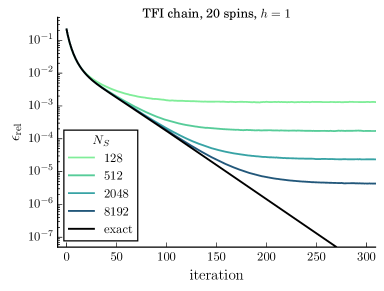
- Numerical results on the transverse-field Ising and antiferromagnetic Heisenberg models confirm the method's accuracy in both 1D and 2D systems.
- For small systems, the learning-efficiency assumption is verified numerically, supporting the theoretical convergence guarantee.
- The method shows favorable system-size scaling for ground-state energy estimation, suggesting polynomial resource complexity in practice.
- The use of kernel ridge regression enables stable and efficient learning without the non-convex optimization challenges of neural networks.
- The derived kernel structure leverages spatial symmetries, reducing computation and improving generalization across quantum states.
Read this paper
Open the full text in the Nubint reader and ask about any passage as you read.
Read this paper on NubintThis review was generated by AI from the original paper. Please check the paper before citing it.