
[Paper Review] Mortality modeling at old-age: a mixture model approach
This paper proposes a novel mixture model for mortality at old ages (+70 years) that decomposes mortality into premature and senescent death components using a parametric, frequentist framework. The model outperforms traditional models (Beard, Gompertz, Makeham, Perks) by capturing mortality deceleration and plateauing at advanced ages, achieving a mean absolute percentage error of less than 7% in Japan—significantly lower than the 30%+ errors of competing models.
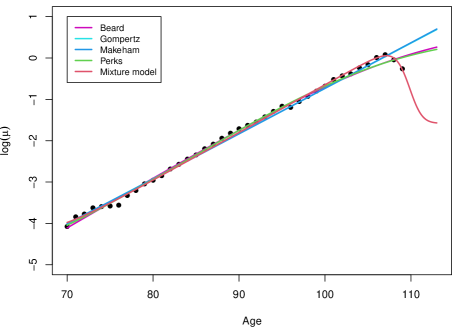
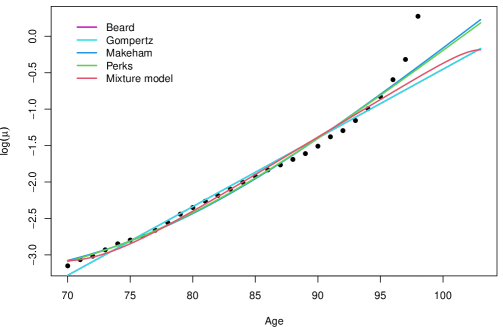
This paper presents a novel approach for modeling mortality rates above age 70 by proposing a mixture-based model. This model is compared to four other widely used models: the Beard, Gompertz, Makeham, and Perks models. Our model can capture the complex behavior of mortality rates at all ages, providing a more accurate representation of the data. To evaluate the performance of our model, we applied it to two countries with different data quality: Japan and Brazil. Our results show that the proposed model outperforms the other models in both countries, particularly in Japan where it obtained an absolute mean percentage error of less than 7%, while the other models presented values greater than 30%. This highlights the ability of our model to adapt to different data quality and country-specific mortality patterns. In summary, this paper presents a mixture-based model that captures the behavior of mortality rates at all ages and outperforms other widely used models in both high- and low-quality data settings. This model can improve mortality prediction and inform public health policy.
Motivation & Objective
- To address the challenge of modeling mortality at advanced ages, particularly where data quality is low or mortality deceleration occurs.
- To develop a flexible, parametric mortality model that captures the observed decline in mortality rates at very old ages (e.g., above 80–100).
- To provide a robust alternative to overparameterized or Bayesian models by using a frequentist mixture framework with minimal computational cost.
- To evaluate model performance across diverse data quality contexts, including high-quality Japanese data and lower-quality Brazilian data.
- To enable decomposition of mortality into biologically interpretable components: premature vs. senescent deaths.
Proposed method
- Proposes a finite mixture model combining a Gompertz distribution (for premature deaths) and an exponential distribution (for senescent deaths), with mixing proportion $ p $.
- Models the force of mortality as a weighted sum: $ u(x) = p \cdot \mu_G(x) + (1-p) \cdot \mu_E(x) $, where $ \mu_G $ is Gompertz and $ \mu_E $ is exponential.
- Estimates parameters via maximum likelihood using a genetic algorithm to ensure convergence to global optima.
- Applies leave-one-out cross-validation with MAPE on log-hazard to compare model fit across populations.
- Truncates data at age 70 to focus on old-age mortality, excluding infant and early adult mortality effects.
- Validates model flexibility by showing it reduces to Gompertz ($ p=0 $) or exponential ($ p=1 $) in limiting cases.
Experimental results
Research questions
- RQ1Can a mixture model effectively capture mortality deceleration and plateauing at very old ages, as observed in some populations?
- RQ2How does the proposed mixture model compare in fit to established models (Beard, Gompertz, Makeham, Perks) in high- and low-quality data settings?
- RQ3Does the model maintain robustness and accuracy when applied to populations with poor data quality, such as Brazil?
- RQ4What is the estimated proportion of premature vs. senescent deaths above age 70, and how does it vary across populations?
- RQ5Can the model be used to test whether mortality at old ages follows a Gompertz or exponential pattern, or requires a more complex mixture?
Key findings
- The mixture model achieved an absolute mean percentage error (MAPE) of less than 7% in fitting Japanese mortality data (2015), significantly outperforming the next best model (Perks) with a MAPE of over 30%.
- In Brazil (2010), the model successfully captured mortality dynamics despite lower data quality, demonstrating robustness in challenging data environments.
- Estimated values of $ p $ (proportion of premature deaths) were consistently below 0.04 across populations, indicating that premature deaths above age 70 are rare.
- The estimated $ c $ parameter (scale of senescent death distribution) was stable and concentrated around 0.23, suggesting consistent modal age of death between 80 and 90 across populations.
- The model effectively captured the mortality plateau and deceleration observed in high-achieving populations like Japan and Germany, particularly above age 100.
- The model is flexible and reduces to the Gompertz model when $ p=0 $, and to the exponential model when $ p=1 $, confirming its theoretical consistency.
Read this paper
Open the full text in the Nubint reader and ask about any passage as you read.
Read this paper on NubintThis review was generated by AI from the original paper. Please check the paper before citing it.