
[Paper Review] Multipartite entanglement in two-dimensional chiral topological liquids
This paper provides an analytical framework for multipartite entanglement in two-dimensional chiral topological liquids using conformal field theory and bulk-boundary correspondence. It derives the universal Markov gap $ h = \frac{c}{3}\ln 2 $ for $ p $-vertex states in rational conformal field theories, explaining the topological entanglement structure beyond bipartite measures and confirming results with numerical evidence.
The multipartite entanglement structure for the ground states of two dimensional topological phases is an interesting albeit not well understood question. Utilizing the bulk-boundary correspondence, the calculation of tripartite entanglement in 2d topological phases can be reduced to that of the vertex state, defined by the boundary conditions at the interfaces between spatial regions. In this paper, we use the conformal interface technique to calculate entanglement measures in the vertex state, which include area law terms, corner contributions, and topological pieces, and a possible additional order one contribution. This explains our previous observation of the Markov gap $h = \frac{c}{3} \ln 2$ in the 3-vertex state, and generalizes this result to the $p$-vertex state, general rational conformal field theories, and more choices of subsystems. Finally, we support our prediction by numerical evidence, finding precise agreement.
Motivation & Objective
- To develop an analytical understanding of multipartite entanglement in 2D chiral topological phases, which remains poorly understood despite progress in bipartite entanglement.
- To generalize the universal Markov gap $ h = \frac{c}{3}\ln 2 $, previously observed in free fermion models, to general rational conformal field theories and $ p $-vertex states.
- To establish a systematic method for computing tripartite and higher-partite entanglement measures—such as reflected entropy and entanglement negativity—using defect CFT and conformal interface techniques.
- To provide analytic justification for the numerical observation that the Markov gap serves as a lower bound in lattice models of Chern insulators, with $ h \geq \frac{c}{3}\ln 2 $.
- To demonstrate that the Markov gap is a universal signature of stable, ungappable edge modes in topological liquids, linked to the chiral central charge $ c $.
Proposed method
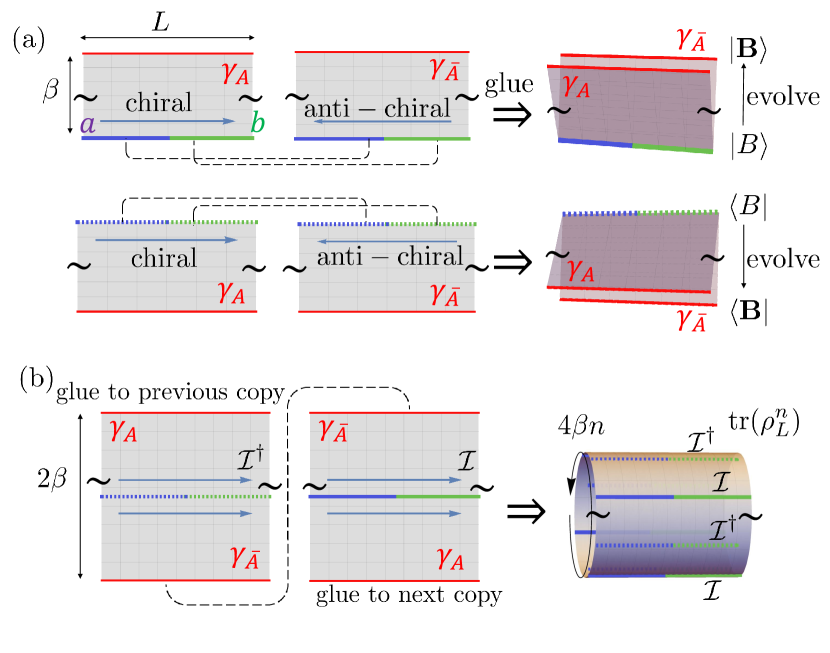
- Utilizes the bulk-boundary correspondence to map the entanglement structure of 2D topological ground states to boundary conformal field theory (CFT) on a Riemann surface with defects.
- Applies conformal interface techniques to compute entanglement measures in the vertex state, which encodes the boundary conditions at spatial junctions.
- Employs twist operator formalism in 1+1D CFT to compute moments of the reduced density matrix and extract entanglement entropy, mutual information, reflected entropy, and negativity.
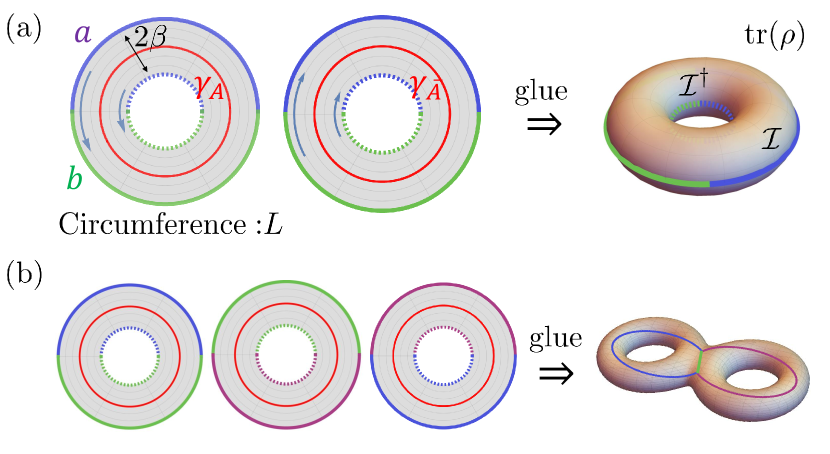
- Derives the genus of the replica manifold via the Riemann-Hurwitz formula to determine the topological dependence of OPE coefficients in correlation functions.
- Treats the OPE coefficient for reflected entropy as universal and analytically evaluates it as $ C_{n,m} = (2m)^{-4h_n} $, leading to the universal $ \frac{c}{3}\ln 2 $ Markov gap.
- Validates the analytic results through numerical simulations on lattice models, showing precise agreement with the predicted universal behavior.
Experimental results
Research questions
- RQ1Can the universal Markov gap $ h = \frac{c}{3}\ln 2 $, observed in free fermion topological phases, be analytically derived for general chiral topological liquids?
- RQ2How does the multipartite entanglement structure—specifically reflected entropy and entanglement negativity—depend on the topology of the spatial partition and the underlying CFT?
- RQ3What role do defect and interface CFT techniques play in computing entanglement measures in vertex states of 2D topological phases?
- RQ4Is the Markov gap a robust indicator of the chiral central charge $ c $, even beyond free fermion models and in interacting rational CFTs?
- RQ5Can the OPE coefficients in the replica trick for reflected entropy and negativity be computed analytically in a way that reveals universal topological contributions?
Key findings
- The Markov gap for the $ p $-vertex state in rational conformal field theories is analytically derived as $ h = \frac{c}{3}\ln 2 $, confirming the universality of this topological entanglement signature.
- The reflected entropy and mutual information are computed via three-point functions of twist operators, with the OPE coefficient yielding the universal $ \frac{c}{3}\ln 2 $ contribution to the Markov gap.
- The entanglement negativity does not yield a universal logarithmic term due to non-universal OPE coefficients on higher-genus Riemann surfaces, distinguishing it from reflected entropy.
- Numerical simulations on lattice Chern insulators confirm the analytic prediction, showing the Markov gap is bounded below by $ \frac{c}{3}\ln 2 $, with equality in the ideal CFT limit.
- The vertex state formalism, derived from bulk-boundary correspondence, allows exact computation of multipartite entanglement in topological phases via CFT techniques.
- The result establishes the Markov gap as a universal probe of the chiral central charge $ c $, indicating the presence of stable, ungappable edge modes in 2D topological liquids.
Read this paper
Open the full text in the Nubint reader and ask about any passage as you read.
Read this paper on NubintThis review was generated by AI from the original paper. Please check the paper before citing it.