
[Paper Review] On the Need for a Near-Earth Object Characterization Constellation in Low-Earth Orbit
The paper proposes a constellation of small satellites in low-Earth orbit (LEO) equipped with visible and near-infrared (NIR) sensors to enable timely characterization of near-Earth objects (NEOs) detected by major surveys. By providing rapid, flexible follow-up coverage across multiple wavelengths and cadences, the constellation would close critical gaps in planetary defense, ensuring timely orbit refinement and material property assessment for potentially hazardous objects.
In 2005, the United States Congress passed a bill mandating the detection, tracking, cataloguing and characterization of 90\% of the 140 meter and larger near-Earth objects (NEOs) by 2020. At the deadline $\sim$35\% were detected, tracked and catalogued, but only a small fraction were characterized. At the present rate, it will take 40 years to meet the detection mandate, and there are insufficient global facilities dedicated to NEO characterization to come close to the characterization threshold. The major surveys focus mainly on detection and initial orbit determination, which must be refined in order to fully be tracked and catalogued. Characterization requires observations spanning multiple wavelengths, cadences, and instruments, so it is challenging for observers to acquire the requisite data in a timely manner for planetary defense. Two upcoming surveys will easily meet the 90\% threshold for detection, but each will require separate facilities to tip and queue to refine orbits and characterize new discoveries, and they will provide too many discoveries for ground and space-based assets to keep up with. Here, I argue for a constellation of proliferating small satellites carrying visible and infrared sensors that would offer the needed coverage and flexibility to follow up detections from current and upcoming surveys in a timely manner. Such a constellation would enable NASA to move beyond the detection focused investments and fully meet the 2005 Congressional mandate.
Motivation & Objective
- Address the critical gap in near-Earth object (NEO) characterization despite progress in detection, as mandated by the 2005 NEO Survey Act.
- Highlight that current ground-based and space-based assets are insufficient to keep pace with the anticipated deluge of NEO discoveries from upcoming surveys like Rubin/LSST and NEO Surveyor.
- Demonstrate that only ~15% of NEOs have had spectra measured and fewer than 1% imaged with radar, underscoring the lack of characterization infrastructure.
- Argue that timely characterization is essential for planetary defense, especially given the risk of high-impact objects like 99942 Apophis being discovered with short warning timelines.
- Advocate for a scalable, cost-effective solution using proliferated small satellites in LEO to provide persistent, responsive coverage for follow-up observations.
Proposed method
- Model the current and projected NEO detection rates from major surveys (CSS, Pan-STARRS, Rubin/LSST, NEO Surveyor) and assess the resulting follow-up burden.
- Analyze the limitations of ground-based tracking and characterization, particularly for faint, fast-moving, or high-solar-elongation objects like Atens and Atira asteroids.
- Propose a constellation of small satellites in LEO equipped with visible and near-infrared (NIR) sensors, using broad-band filters to enable photometric classification and spectral characterization.
- Design the constellation to tip and queue rapidly in response to new detections, enabling coverage across diverse orbital phase spaces and cadences.
- Use existing data from missions like GEOStare2 and Goldstone radar to validate the feasibility of photometric period estimation and spectral classification from LEO.
- Leverage advances in small satellite platforms and commercial launch rideshares to reduce cost and enable rapid deployment and scalability.
Experimental results
Research questions
- RQ1Why is the current planetary defense infrastructure insufficient to meet the 2005 Congressional mandate for NEO characterization, despite progress in detection?
- RQ2How will the increased discovery rate from upcoming surveys like Rubin/LSST and NEO Surveyor overwhelm existing ground-based follow-up capabilities?
- RQ3What role do visible and near-infrared photometry play in enabling material characterization of NEOs when radar and spectroscopy are unavailable?
- RQ4Can a constellation of small, low-cost satellites in LEO provide timely, flexible, and comprehensive follow-up for NEOs across diverse orbital geometries and brightness levels?
- RQ5What specific filter set and observational cadence would maximize characterization potential from photometric data alone?
Key findings
- Only ~35% of the 140-meter-and-larger NEOs mandated to be detected by 2020 were actually detected, and an even smaller fraction were characterized, indicating a systemic gap in characterization capacity.
- Current ground-based assets cannot keep pace with the projected discovery rate from Rubin/LSST and NEO Surveyor, which will detect far more faint and fast-moving objects than previous surveys.
- Less than 15% of all known NEOs have had spectra measured, and fewer than 1% have been imaged with radar, underscoring the extreme scarcity of characterization data.
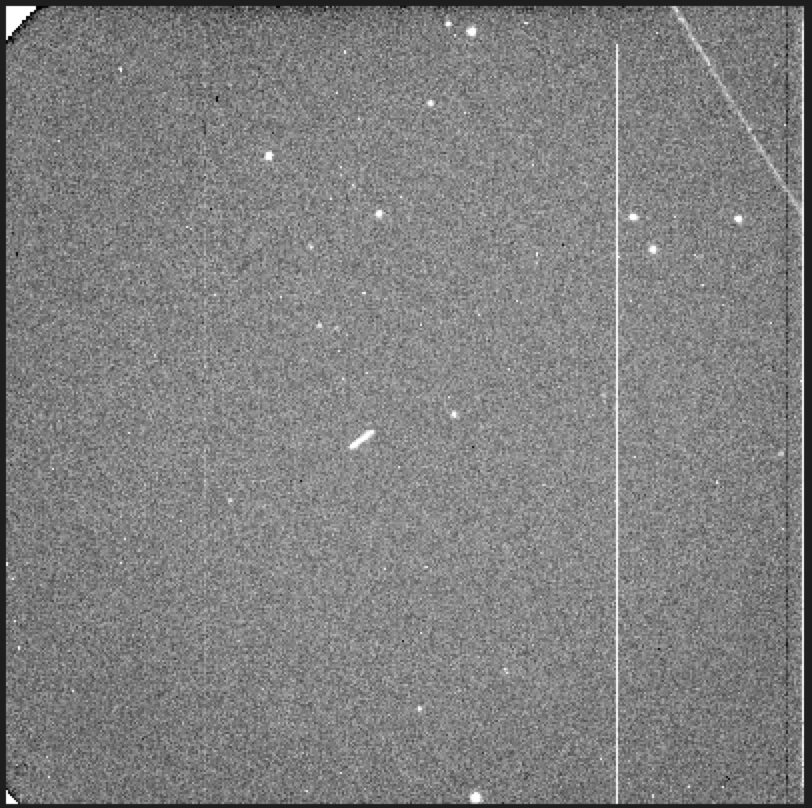
- The 2005 LW 3 flyby observation by GEOStare2 demonstrated that a ~200-minute rotation period could be reliably estimated from LEO-based photometry, validating the feasibility of such measurements.
- A constellation of small satellites with visible and NIR sensors could enable near real-time characterization of all NEOs discovered by Rubin/LSST and NEO Surveyor, filling the current observational void.
- The use of broad-band filters in visible and NIR ranges can enable photometric classification that correlates with spectral types, allowing inference of material properties without requiring full spectroscopy.
Read this paper
Open the full text in the Nubint reader and ask about any passage as you read.
Read this paper on NubintThis review was generated by AI from the original paper. Please check the paper before citing it.