
[Paper Review] Optimal, hardware native decomposition of parameterized multi-qubit Pauli gates
This paper presents an optimal, hardware-native decomposition of parameterized multi-qubit Pauli (PMQP) gates into parameterized two-qubit Pauli (P2QP) gates, minimizing circuit depth and gate count. The method uses recursive decomposition on path and star topologies, generalizes to arbitrary hardware graphs, and enables gate cancellations in combinatorial optimization circuits, achieving a constant depth of 6 for LHZ-mapped problems regardless of system size.
We show how to efficiently decompose a parameterized multi-qubit Pauli (PMQP) gate into native parameterized two-qubit Pauli (P2QP) gates minimizing both the circuit depth and the number of P2QP gates. Given a realistic quantum computational model, we argue that the technique is optimal in terms of the number of hardware native gates and the overall depth of the decomposition. Starting from PMQP gate decompositions for the path and star hardware graph, we generalize the procedure to any generic hardware graph and provide exact expressions for the depth and number of P2QP gates of the decomposition. Furthermore, we show how to efficiently combine the decomposition of multiple PMQP gates to further reduce the depth as well as the number of P2QP gates for a combinatorial optimization problem using the Lechner-Hauke-Zoller (LHZ) mapping.
Motivation & Objective
- To develop a systematic, optimal decomposition of parameterized multi-qubit Pauli (PMQP) gates into hardware-native two-qubit gates.
- To minimize both circuit depth and number of P2QP gates in realistic quantum hardware models.
- To generalize the decomposition method to arbitrary hardware graphs based on path and star topologies.
- To enable gate cancellations between consecutive PMQP gate decompositions in combinatorial optimization circuits.
- To demonstrate the method's effectiveness on the parity-encoded Quantum Approximate Optimization Algorithm (QAOA) using the Lechner-Hauke-Zoller (LHZ) mapping.
Proposed method
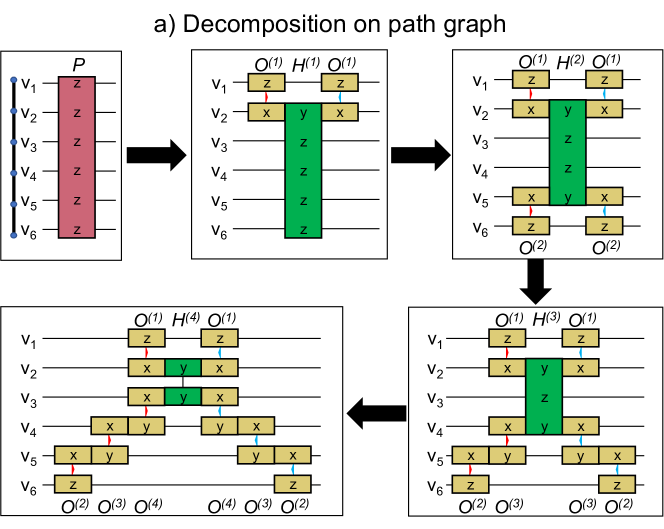
- The method recursively decomposes PMQP gates using parameterized two-qubit Pauli (P2QP) gates via a systematic procedure based on the hardware graph structure.
- For path and star graphs, exact expressions for depth and gate count are derived, proving optimality in both metrics.
- A generalized strategy is developed to decompose PMQP gates on any arbitrary hardware graph using the same recursive framework.
- The approach enables parallel execution of commuting P2QP gates and exploits sign-opposite coupling cancellations between adjacent plaquettes in optimization circuits.
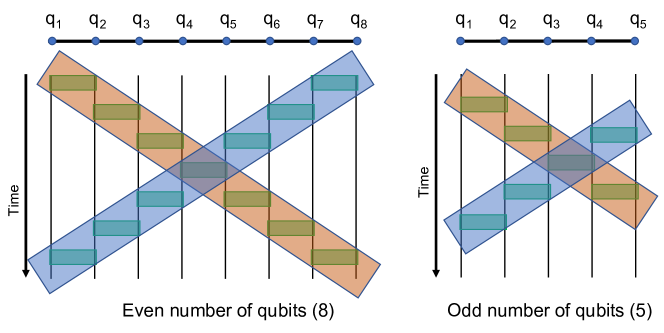
- The decomposition is applied to four-qubit plaquette terms in the LHZ-mapped QAOA, where central gates are executed in parallel to reduce depth.
- The method ensures minimal depth by aligning gate sequences with the correlation structure of the multi-qubit gate, achieving a lower bound on circuit depth.
Experimental results
Research questions
- RQ1Can PMQP gates be optimally decomposed into hardware-native P2QP gates in terms of both gate count and circuit depth?
- RQ2What is the minimal achievable depth for decomposing PMQP gates on a given hardware graph, and can it be reached?
- RQ3How can multiple PMQP gate decompositions be combined to enable gate cancellations and further reduce depth?
- RQ4Can the decomposition method be generalized to arbitrary hardware graphs beyond path and star topologies?
- RQ5What is the circuit depth scaling for LHZ-mapped optimization problems using this decomposition technique?
Key findings
- The decomposition achieves optimal gate count and circuit depth for PMQP gates on path and star graphs, with depth scaling linearly for paths and constantly for stars.
- For the four-qubit plaquette term in the LHZ-mapped QAOA, the circuit depth is reduced to 3 when decomposing alternate rows, compared to 5 using previous x-shaped CNOT structures.
- By executing central two-qubit gates in parallel and canceling opposite-sign coupling gates, the total circuit depth for the entire square lattice is reduced to 5, with a constant runtime independent of system size.
- The method enables a minimal depth of 6 for the full LHZ-mapped optimization problem, regardless of system size, due to optimal parallelization and cancellation strategies.
- The decomposition is universal and can be applied to long-range multi-qubit interactions, significantly reducing error-prone circuit depth in near-term quantum applications.
- The technique facilitates improved noise mitigation by minimizing circuit depth and enabling efficient gate cancellation in fermionic and optimization circuits.
Read this paper
Open the full text in the Nubint reader and ask about any passage as you read.
Read this paper on NubintThis review was generated by AI from the original paper. Please check the paper before citing it.