
[Paper Review] Parameter Setting in Quantum Approximate Optimization of Weighted Problems
This paper proposes analytically grounded parameter-setting heuristics for Quantum Approximate Optimization Algorithm (QAOA) applied to weighted combinatorial optimization problems, particularly weighted MaxCut. It proves that for p=1, the globally optimal parameters are small and near zero in the average case, and for p≥1, rescaling unweighted QAOA parameters by the inverse square root of the second moment of edge weights yields near-optimal results for weighted problems, reducing optimization iterations by 7.4x on average in numerical tests.
Quantum Approximate Optimization Algorithm (QAOA) is a leading candidate algorithm for solving combinatorial optimization problems on quantum computers. However, in many cases QAOA requires computationally intensive parameter optimization. The challenge of parameter optimization is particularly acute in the case of weighted problems, for which the eigenvalues of the phase operator are non-integer and the QAOA energy landscape is not periodic. In this work, we develop parameter setting heuristics for QAOA applied to a general class of weighted problems. First, we derive optimal parameters for QAOA with depth $p=1$ applied to the weighted MaxCut problem under different assumptions on the weights. In particular, we rigorously prove the conventional wisdom that in the average case the first local optimum near zero gives globally-optimal QAOA parameters. Second, for $p\geq 1$ we prove that the QAOA energy landscape for weighted MaxCut approaches that for the unweighted case under a simple rescaling of parameters. Therefore, we can use parameters previously obtained for unweighted MaxCut for weighted problems. Finally, we prove that for $p=1$ the QAOA objective sharply concentrates around its expectation, which means that our parameter setting rules hold with high probability for a random weighted instance. We numerically validate this approach on general weighted graphs and show that on average the QAOA energy with the proposed fixed parameters is only $1.1$ percentage points away from that with optimized parameters. Third, we propose a general heuristic rescaling scheme inspired by the analytical results for weighted MaxCut and demonstrate its effectiveness using QAOA with the XY Hamming-weight-preserving mixer applied to the portfolio optimization problem. Our heuristic improves the convergence of local optimizers, reducing the number of iterations by 7.4x on average.
Motivation & Objective
- Address the challenge of computationally intensive parameter optimization in QAOA for weighted combinatorial problems with non-integer eigenvalues.
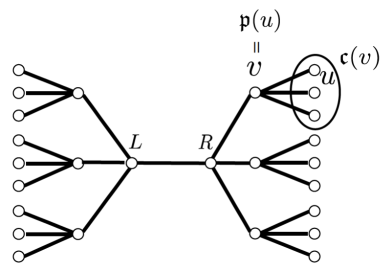
- Provide analytically justified parameter-setting rules for QAOA applied to weighted MaxCut on large-girth regular graphs.
- Establish a formal connection between weighted and unweighted MaxCut QAOA energy landscapes to enable reuse of known unweighted parameters.
- Demonstrate that the QAOA objective concentrates sharply around its expectation for p=1, ensuring robustness across random weighted instances.
- Extend the framework to general weighted problems via a heuristic rescaling scheme, validated on portfolio optimization with the XY mixer.
Proposed method
- Derive analytically optimal QAOA parameters for p=1 on weighted MaxCut with i.i.d. exponential edge weights and in the infinite-size limit under arbitrary weight distributions.
- Prove that the QAOA energy landscape for weighted MaxCut asymptotically approaches that of unweighted MaxCut when parameters are rescaled by 1/√𝔼[w²], enabling reuse of known unweighted optimal parameters.
- Establish concentration of the QAOA objective around its expectation for p=1, showing that proposed parameters are effective with high probability on random weighted instances.
- Propose a general rescaling heuristic for QAOA with the XY mixer on portfolio optimization, using both quadratic and linear terms in the cost function.
- Validate the approach numerically on random weighted graphs and portfolio instances using NLopt’s BOBYQA optimizer, comparing convergence with and without proper rescaling.
- Use the Sherrington-Kirkpatrick (SK) model and its biased variant as theoretical benchmarks to analyze parameter scaling and convergence behavior.
Experimental results
Research questions
- RQ1For p=1, what are the analytically optimal QAOA parameters in the average case for weighted MaxCut with i.i.d. edge weights?
- RQ2How does the QAOA energy landscape for weighted MaxCut relate to that of unweighted MaxCut under parameter rescaling?
- RQ3Can the optimal parameters for unweighted MaxCut be adapted to weighted MaxCut via a simple rescaling rule, and how accurate is this approximation?
- RQ4Does the QAOA objective for p=1 concentrate sharply around its expectation in random weighted instances, ensuring robustness of the parameter rule?
- RQ5How effective is the proposed rescaling heuristic in improving convergence of local optimizers for QAOA with non-trivial mixers, such as the XY mixer in portfolio optimization?
Key findings
- For p=1, the globally optimal QAOA parameters for weighted MaxCut are small and located near zero in the average case, rigorously validating a widely used heuristic.
- The QAOA energy landscape for weighted MaxCut asymptotically converges to that of unweighted MaxCut when parameters are rescaled by 1/√𝔼[w²], enabling direct reuse of unweighted optimal parameters.
- The QAOA objective for p=1 concentrates sharply around its expectation, meaning the proposed parameter rules are effective with high probability across random weighted instances.
- Numerical validation shows that QAOA with the proposed fixed parameters achieves an energy within 1.1 percentage points of the optimized energy on average across random weighted graphs.
- The heuristic rescaling scheme improves convergence of local optimizers in portfolio optimization by reducing the number of iterations by 7.4x on average compared to unrescaled optimization.
- Ignoring the linear terms (μⱼ) in the rescaling process leads to incorrect parameter initialization and failure to recover the optimum in most cases, highlighting the importance of including all terms in the cost function.

Read this paper
Open the full text in the Nubint reader and ask about any passage as you read.
Read this paper on NubintThis review was generated by AI from the original paper. Please check the paper before citing it.