
[Paper Review] PlanFitting: Personalized Exercise Planning with Large Language Model-driven Conversational Agent
PlanFitting is a conversational AI system that uses large language models (LLMs) to generate personalized, evidence-based weekly exercise plans through natural language interaction. By collecting user constraints via dialogue and expressing plans as IF-THEN implementation intentions, it produces actionable, adaptable plans that experts rated as comparable to those created by human planners.
Creating personalized and actionable exercise plans often requires iteration with experts, which can be costly and inaccessible to many individuals. This work explores the capabilities of Large Language Models (LLMs) in addressing these challenges. We present PlanFitting, an LLM-driven conversational agent that assists users in creating and refining personalized weekly exercise plans. By engaging users in free-form conversations, PlanFitting helps elicit users' goals, availabilities, and potential obstacles, and enables individuals to generate personalized exercise plans aligned with established exercise guidelines. Our study -- involving a user study, intrinsic evaluation, and expert evaluation -- demonstrated PlanFitting's ability to guide users to create tailored, actionable, and evidence-based plans. We discuss future design opportunities for LLM-driven conversational agents to create plans that better comply with exercise principles and accommodate personal constraints.
Motivation & Objective
- To address the challenge of creating personalized exercise plans that align with individual schedules, goals, and constraints.
- To reduce reliance on costly or inaccessible expert planners by leveraging LLMs for iterative, user-driven planning.
- To improve plan adherence by expressing plans as implementation intentions (IF-THEN rules) that are context-specific and easy to follow.
- To explore how LLMs can assist users in identifying overlooked constraints or risks during plan creation.
- To evaluate the feasibility and quality of LLM-generated plans through user studies and expert evaluation.
Proposed method
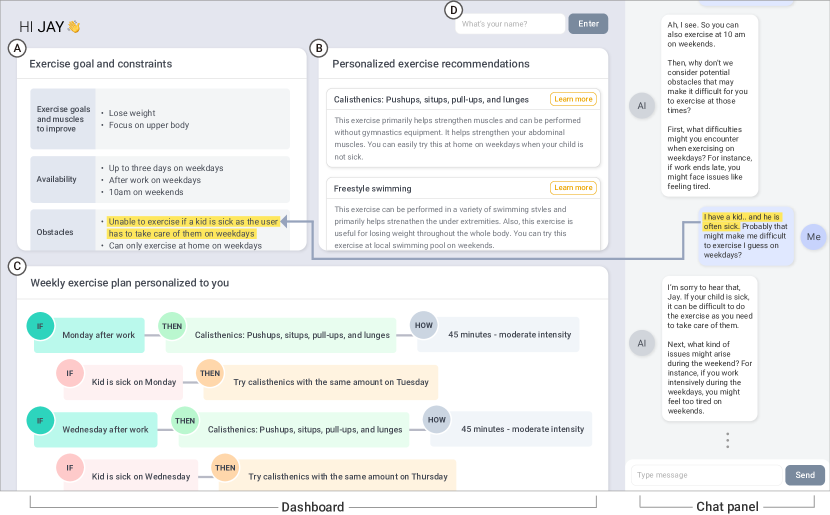
- The system uses a web-based conversational interface where users interact with an LLM-driven agent to describe their goals, availability, and potential obstacles.
- The LLM dynamically collects and interprets user constraints through natural language dialogue, guiding the user toward comprehensive input.
- Plans are generated in the form of implementation intentions (e.g., IF I have time on Tuesday at 6 PM, THEN I will do 30 minutes of strength training), enhancing adherence through context-specific cues.
- The system integrates exercise knowledge from expert guidelines and a curated dataset to ensure plans are evidence-based and safe.
- User input is validated and refined iteratively through conversation, allowing for real-time adaptation.
- Expert planners evaluated the final plans for clinical soundness, personalization, and feasibility.
Experimental results
Research questions
- RQ1Can an LLM-powered conversational agent effectively elicit comprehensive personal constraints (goals, availability, obstacles) for exercise planning through natural language?
- RQ2How do users perceive the clarity, personalization, and actionability of plans generated by the LLM agent compared to expert-created plans?
- RQ3To what extent can LLM-generated plans match the quality and safety standards of plans created by human experts?
- RQ4Can the use of implementation intentions (IF-THEN rules) improve plan adherence and user comprehension?
- RQ5What role can LLMs play in proactively identifying overlooked risks or overambitious plans during the planning process?
Key findings
- Expert planners rated the exercise plans generated by PlanFitting as comparable in quality and feasibility to those created by human experts, indicating strong alignment with clinical guidelines.
- Participants found the IF-THEN implementation intention format highly comprehensible and adaptable, especially compared to vague or rigid time-based instructions.
- The conversational interface enabled users to express complex constraints naturally, reducing the burden of upfront specification and supporting iterative refinement.
- The LLM demonstrated the ability to generate personalized, actionable, and evidence-based plans without requiring users to have prior knowledge of exercise science.
- Instances were observed where the LLM’s strict adherence to user-specified availability led to potentially overambitious plans, highlighting the need for future AI-driven risk-checking features.
- The system showed potential for identifying overlooked constraints through post-hoc AI-generated checklists, suggesting a path for enhancing safety and sustainability.
Read this paper
Open the full text in the Nubint reader and ask about any passage as you read.
Read this paper on NubintThis review was generated by AI from the original paper. Please check the paper before citing it.