
[Paper Review] Probing multi-mobility edges in quasiperiodic mosaic lattices
The paper experimentally demonstrates multiple mobility edges in quasiperiodic mosaic lattices built with integrated photonics, showing energy-dependent coexistence of localized and extended states and breaking self-duality.
The mobility edge (ME) is a crucial concept in understanding localization physics, marking the critical transition between extended and localized states in the energy spectrum. Anderson localization scaling theory predicts the absence of ME in lower dimensional systems. Hence, the search for exact MEs, particularly for single particles in lower dimensions, has recently garnered significant interest in both theoretical and experimental studies, resulting in notable progress. However, several open questions remain, including the possibility of a single system exhibiting multiple MEs and the continual existence of extended states, even within the strong disorder domain. Here, we provide experimental evidence to address these questions by utilizing a quasiperiodic mosaic lattice with meticulously designed nanophotonic circuits. Our observations demonstrate the coexistence of both extended and localized states in lattices with broken duality symmetry and varying modulation periods. By single site injection and scanning the disorder level, we could approximately probe the ME of the modulated lattice. These results corroborate recent theoretical predictions, introduce a new avenue for investigating ME physics, and offer inspiration for further exploration of ME physics in the quantum regime using hybrid integrated photonic devices.
Motivation & Objective
- Investigate mobility edges (MEs) in 1D quasiperiodic systems beyond the Aubry–André model.
- Realize mosaic lattices with broken duality symmetry to host multiple MEs.
- Probe energy-dependent localization by single-site excitation and disorder tuning in integrated photonics.
- Show coexistence of localized and extended states at strong quasiperiodic modulation.
- Demonstrate scalability and controllability of photonic platforms for ME physics.
Proposed method
- Use integrated Si3N4 photonic circuits to implement quasiperiodic mosaic lattices with uniform hopping J.
- Engineer on-site quasiperiodic modulation lambda_j according to lambda_j = lambda cos[2π(ω j + θ)] for modulated sites (j = κ m), and zero otherwise.
- Investigate mosaic lattices with modulation period κ to break self-duality and generate 2(κ−1) mobility edges, predicted by Avila’s global theory.
- Characterize states via fractal dimension D2 derived from IPR, D2 = −lim_L→∞ log⟨IPR⟩/log L, distinguishing localized (D2→0) and extended (D2→1) states.
- Probe ME by single-site injections and scanning disorder strength λ, tracking energy- and state-dependent localization.
- Correlate experimental observations with theoretical ME expressions E_c and Lyapunov exponent relations.
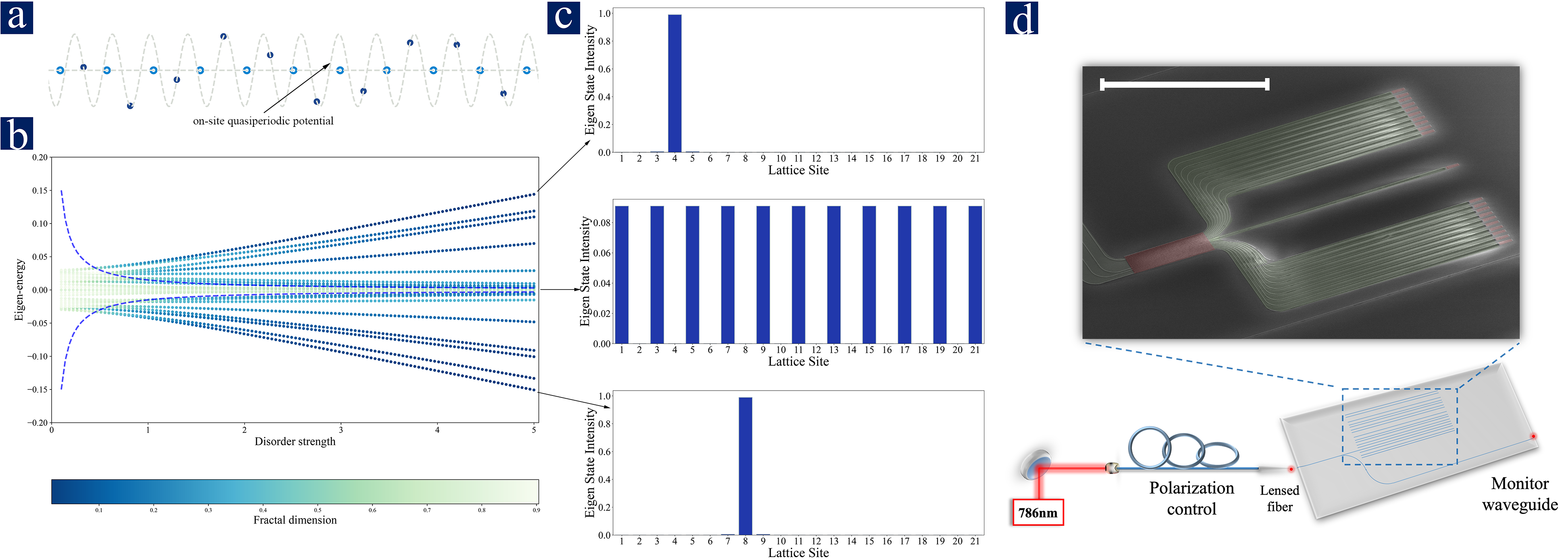
Experimental results
Research questions
- RQ1Do quasiperiodic mosaic lattices support multiple mobility edges in 1D, and how do they depend on the mosaic period κ?
- RQ2Can self-duality-breaking mosaic lattices sustain extended states at arbitrary disorder strengths, and how do localized and extended states coexist as λ is varied?
- RQ3Can single-site excitation reveal energy-dependent localization transitions and identify the mobility edges experimentally?
- RQ4How do experimental photonic realizations align with Avila’s global theory predictions for mosaic models?
Key findings
- Demonstrate coexistence of extended and localized states in κ=2 mosaic lattice, with two mobility edges at E_c = ±J/λ.
- Observe and map energy-dependent localization transitions by single-site injections and varying λ in photonic mosaics.
- Show in κ=3 lattice that four mobility edges create multiple localization regimes with extended states surviving at strong modulation.
- Provide experimental evidence that supports theoretical predictions of mobility edges arising from mosaic lattice structure independent of self-duality.
- Illustrate that integrated photonic platforms enable scalable probing of ME physics and potential quantum regime explorations.
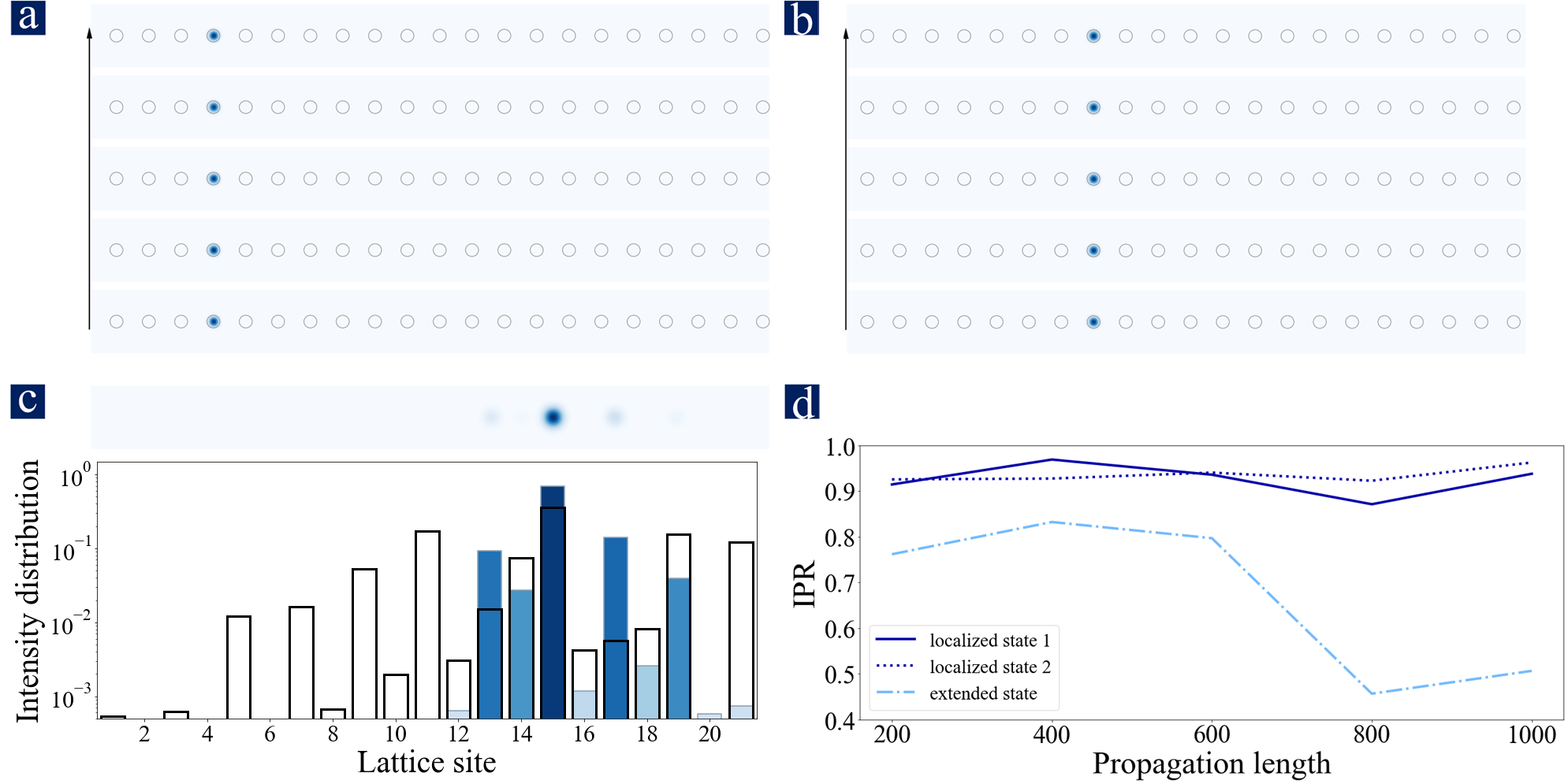
Read this paper
Open the full text in the Nubint reader and ask about any passage as you read.
Read this paper on NubintThis review was generated by AI from the original paper. Please check the paper before citing it.