
[Paper Review] Stabilizer entropy dynamics after a quantum quench
This paper investigates stabilizer entropy (SE) dynamics in an integrable 1D transverse-field Ising model after a quantum quench. It analytically demonstrates that SE equilibrates within a time scaling linearly with subsystem size and that the SE length grows ballistically at a velocity proportional to the Lieb-Robinson speed, indicating delocalization of nonstabilizerness within a light-cone structure.
Stabilizer entropies (SE) measure deviations from stabilizer resources and as such are a fundamental ingredient for quantum advantage. In particular, the interplay of SE and entanglement is at the root of the complexity of classically simulating quantum many-body systems. In this paper, we study the dynamics of SE in a quantum many-body system away from the equilibrium after a quantum quench in an integrable system. We obtain two main results: (i) we show that SE, despite being an L-extensive quantity, equilibrates in a time that scales at most linearly with the subsystem size; and (ii) we show that there is a SE length increasing linearly in time, akin to correlations and entanglement spreading.
Motivation & Objective
- To understand the non-equilibrium dynamics of stabilizer entropy (SE) in quantum many-body systems after a quantum quench.
- To determine whether SE, an extensive quantity, equilibrates in finite time and how the equilibration time scales with subsystem size.
- To characterize the spatiotemporal spreading of nonstabilizerness via the SE length and its relation to causal light-cone dynamics.
- To establish a connection between SE dynamics and the Lieb-Robinson velocity in integrable systems.
Proposed method
- The study employs analytical techniques to compute the time evolution of SE (order-two) for contiguous subsystems in the 1D transverse-field Ising model after a quench.
- It defines the SE length as the maximal extent over which SE remains significant, using the second spatial derivative of the SE to detect delocalization.
- The authors derive upper bounds on the SE length using error propagation in tensor network approximations, showing it grows as $ L_t \leq L_0 + v_s t $, with $ v_s $ proportional to the Lieb-Robinson speed.
- Numerical data from quenched systems are analyzed to confirm exponential decay of corrections to linear SE behavior, indicating definitive asymptotic trends.
- The Lieb-Robinson speed is reconstructed from revivals in the local expectation value, validating the velocity used in the SE length bound.
- The infinite-time average of SE is computed and compared to the equilibrated value, confirming equilibration to the dephased state.
Experimental results
Research questions
- RQ1Does stabilizer entropy equilibrate after a quantum quench in an integrable system, and if so, how fast does equilibration occur with respect to subsystem size?
- RQ2How does the spatial extent of nonstabilizerness—quantified by the SE length—dynamically evolve in time?
- RQ3Is the spreading of SE bounded by a velocity, and does this velocity match the Lieb-Robinson speed of the system?
- RQ4What is the relationship between the SE dynamics and the underlying causal structure of the system?
Key findings
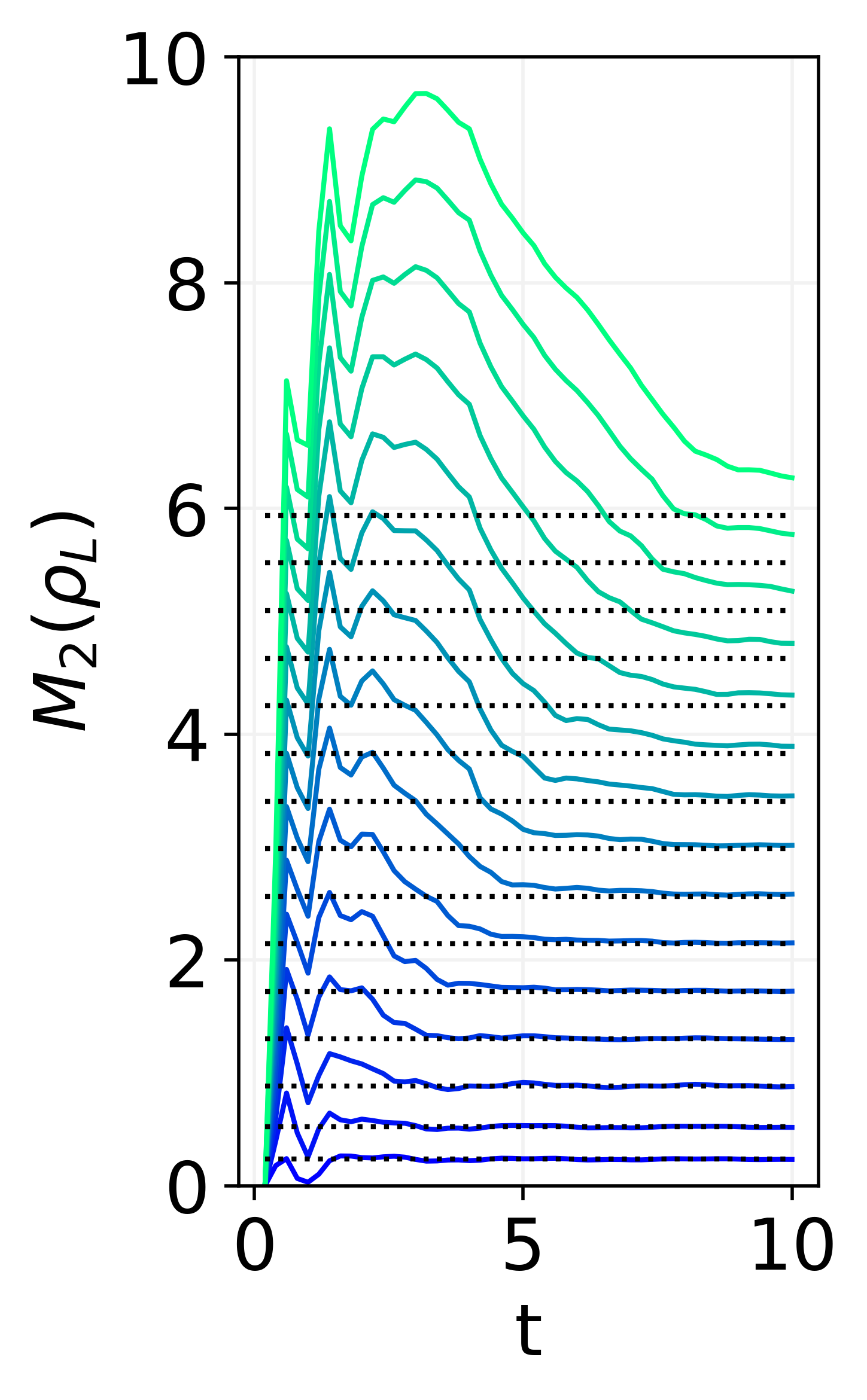
- Stabilizer entropy equilibrates to the infinite-time average value within a time that scales at most linearly with subsystem size $ L $, with equilibration time $ \sim L / v_{\text{LR}} $.
- The SE length increases ballistically over time, growing linearly with a velocity proportional to the Lieb-Robinson speed of the system.
- The upper bound on the SE length is $ L_t \leq L_0 + v_s t $, where $ v_s = \max\{4v\chi^{(1)}, 8v\chi^{(2)}\} $, and $ v_s $ is $ O(1) $ in system size.
- Numerical results confirm that corrections to the linear SE behavior decay exponentially, indicating definitive asymptotic behavior for sufficiently large systems.
- The Lieb-Robinson speed is reconstructed from revival patterns in the local expectation value, yielding $ v_{\text{LR}} = 2 $ for $ \lambda' > 1 $ and $ v_{\text{LR}} = 2\lambda' $ for $ \lambda' < 1 $.
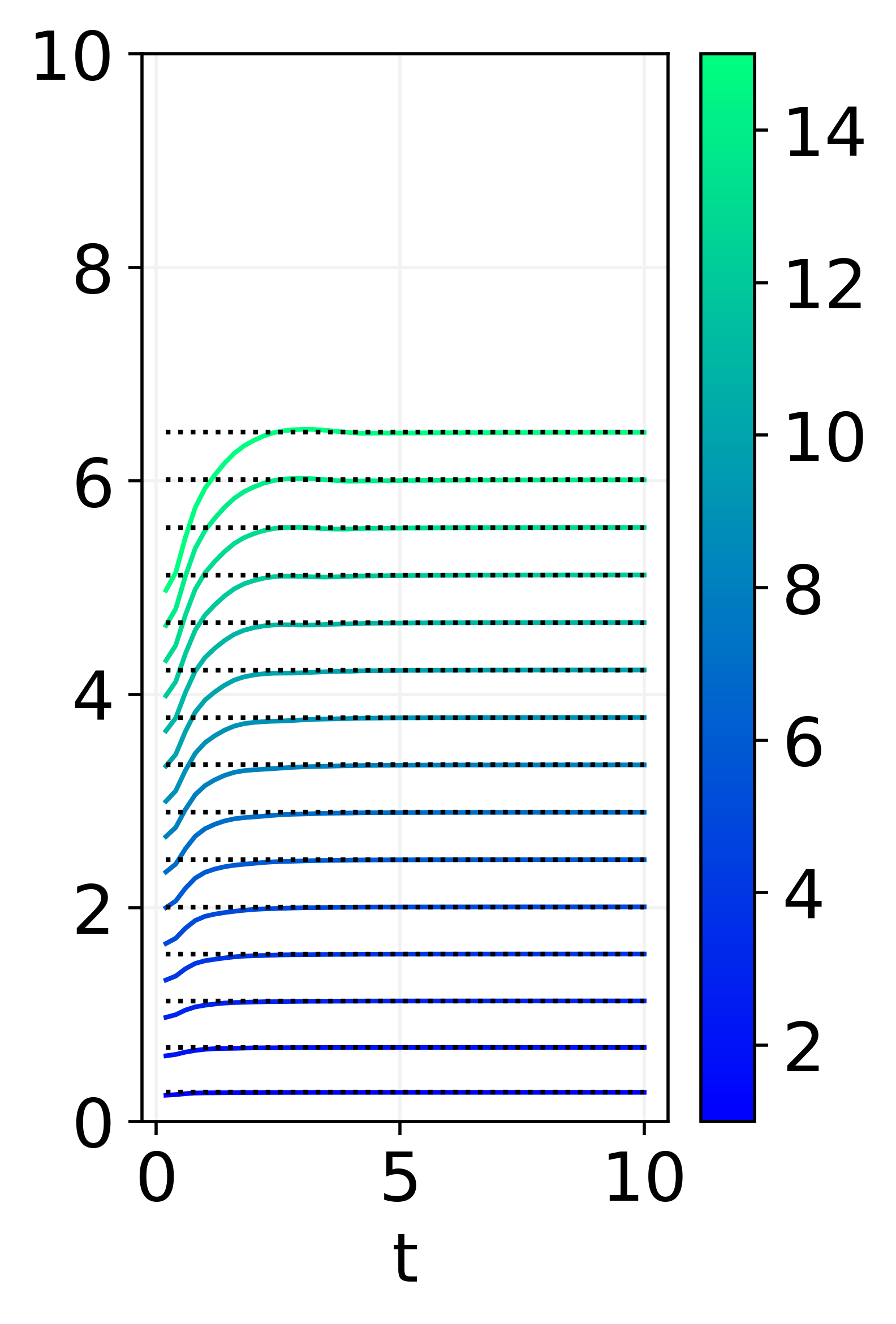
- The equilibrated SE value matches the dephased state, confirming that the system reaches a stationary state with respect to SE after the transient.
Read this paper
Open the full text in the Nubint reader and ask about any passage as you read.
Read this paper on NubintThis review was generated by AI from the original paper. Please check the paper before citing it.