
[Paper Review] Structural phase transition, $s_{\pm}$-wave pairing and magnetic stripe order in the bilayered nickelate superconductor La$_3$Ni$_2$O$_7$ under pressure
The paper uses DFT and RPA to show that La3Ni2O7 undergoes a structural transition under pressure, hosts an s±-wave pairing mediated by spin fluctuations in the Fmmm phase, and exhibits a magnetic stripe order; it also links superconductivity to the presence of a gamma pocket and predicts higher Tc if the Fmmm phase is stabilized at lower pressure.
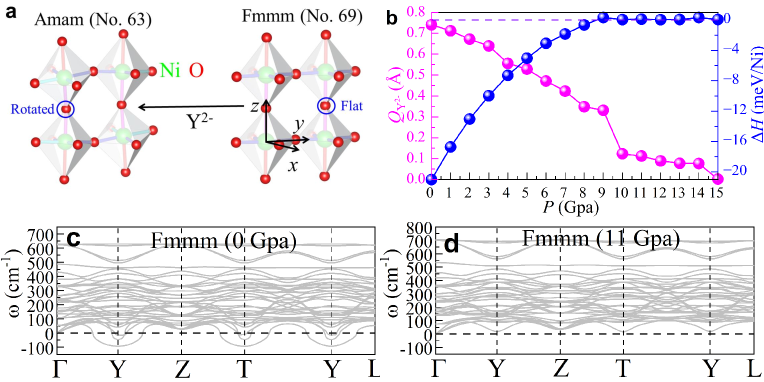
Motivated by the recently discovered high-$T_c$ superconductor La$_3$Ni$_2$O$_7$, we comprehensively study this system using density functional theory and random phase approximation calculations. At low pressures, the Amam phase is stable, containing the Y$^{2-}$ mode distortion from the Fmmm phase, while the Fmmm phase is unstable. Because of small differences in enthalpy and a considerable Y$^{2-}$ mode amplitude, the two phases may coexist in the range between 10.6 and 14 GPa, beyond which the Fmmm phase dominates. In addition, the magnetic stripe-type spin order with wavevector ($π$, 0) was stable at the intermediate region. Pairing is induced in the $s_{\pm}$-wave channel due to partial nesting between the {\bf M}=$(π, π)$ centered pockets and portions of the Fermi surface centered at the {\bf X}=$(π, 0)$ and {\bf Y}=$(0, π)$ points. This resembles results for iron-based superconductors but has a fundamental difference with iron pnictides and selenides. Moreover, our present efforts also suggest that La$_3$Ni$_2$O$_7$ is qualitatively different from infinite-layer nickelates and cuprate superconductors.
Motivation & Objective
- Determine structural stability and phase transitions of La3Ni2O7 under pressure (Amam vs Fmmm).
- Identify electronic structure changes, Fermi surface pockets, and orbital contributions under pressure.
- Investigate magnetic tendencies and possible stripe order from DFT+U and RPA.
- Determine pairing symmetry, especially s±, and its dependence on pressure and Fermi surface topology.
- Assess implications for Tc and how phase stabilization might enhance superconductivity.
Proposed method
- Perform DFT calculations (VASP, PAW, GGA) with U_eff=4 eV to model correlated Ni 3d states.
- Compute phonon spectra to assess dynamical stability via density functional perturbation theory and PHONONPY.
- Fit Ni e_g bands with maximally localized Wannier functions to obtain a four-band bilayer tight-binding model.
- Apply multi-orbital RPA to the TB model to compute spin susceptibilities and superconducting pairing interactions.
- Solve the linearized gap equation to obtain leading pairing eigenvalues and gap structures (g_alpha(k)).
- Analyze pressure-dependent evolution of Fermi surface pockets and orbital characters (d_{3z^2-r^2}, d_{x^2-y^2}).
Experimental results
Research questions
- RQ1Does La3Ni2O7 undergo a pressure-driven Amam to Fmmm structural transition, and is there coexistence in the 10–14 GPa range?
- RQ2What is the orbital and Fermi-surface topology under pressure, and how does it influence magnetic and superconducting tendencies?
- RQ3Is a stripe magnetic order (π,0) favored by correlations, and how does Hund coupling affect its stability?
- RQ4What pairing symmetry is favored by spin fluctuations in the Fmmm phase, and how does it depend on pressure?
- RQ5How might stabilizing the Fmmm phase at lower pressure affect Tc, and what role does the γ pocket play?
Key findings
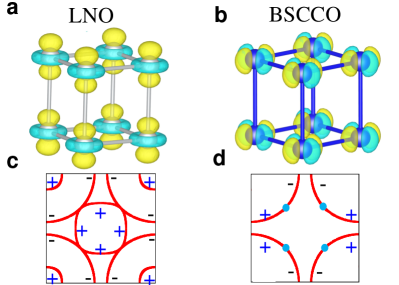
- The Amam phase is stable at low pressure; Fmmm is unstable until ~10.6 GPa, where it becomes stable, with coexistence possible between 9–14 GPa due to small enthalpy differences and a sizable Y2- distortion.
- The Fermi surface comprises two electron pockets (α, β) with mixed d_{3z^2−r^2} and d_{x^2−y^2} character, and a γ hole pocket dominated by d_{3z^2−r^2}, with γ growing and β shrinking under pressure.
- A stripe magnetic order with wavevector (π,0) is energetically favored within DFT+U across intermediate Hubbard/Hund couplings, with the order sensitivity to J.
- RPA analysis shows leading s± pairing symmetry, with sign changes between α, β and between β, γ pockets, driven by intra-orbital (π,0) scattering involving the d_{3z^2−r^2} orbital.
- The pairing strength λ(s±) decreases with pressure due to reduced (π,0) spin scattering, implying higher Tc if the Fmmm phase (and γ pocket) are stabilized at lower pressure; absence of γ pocket in Amam correlates with suppressed superconductivity.
- The study predicts nematic tendencies (degenerate stripe (π,0) and (0,π)) and highlights the crucial role of the d_{3z^2−r^2} orbital in LNO, contrasting with cuprates where d_{x^2−y^2} dominates.
Read this paper
Open the full text in the Nubint reader and ask about any passage as you read.
Read this paper on NubintThis review was generated by AI from the original paper. Please check the paper before citing it.