
[Paper Review] Tensor Network Message Passing
This paper proposes Tensor Network Message Passing (TNMP), a hybrid algorithm that combines tensor network contraction for local subgraphs with message-passing iteration over long-range dependencies. It achieves exact computation for tree-like systems with locally dense, low-treewidth structures and outperforms belief propagation and loopy message-passing in convergence and accuracy on Ising models and spin glasses.
When studying interacting systems, computing their statistical properties is a fundamental problem in various fields such as physics, applied mathematics, and machine learning. However, this task can be quite challenging due to the exponential growth of the state space as the system size increases. Many standard methods have significant weaknesses. For instance, message-passing algorithms can be inaccurate and even fail to converge due to short loops. At the same time, tensor network methods can have exponential computational complexity in large graphs due to long loops. This work proposes a new method called ``tensor network message passing.'' This approach allows us to compute local observables like marginal probabilities and correlations by combining the strengths of tensor networks in contracting small sub-graphs with many short loops and the strengths of message-passing methods in globally sparse graphs, thus addressing the crucial weaknesses of both approaches. Our algorithm is exact for systems that are globally tree-like and locally dense-connected when the dense local graphs have limited treewidth. We have conducted numerical experiments on synthetic and real-world graphs to compute magnetizations of Ising models and spin glasses, to demonstrate the superiority of our approach over standard belief propagation and the recently proposed loopy message-passing algorithm. In addition, we discuss the potential applications of our method in inference problems in networks, combinatorial optimization problems, and decoding problems in quantum error correction.
Motivation & Objective
- Address the limitations of traditional message-passing algorithms, which fail to converge on graphs with short loops.
- Overcome the exponential complexity of tensor network methods in large graphs with long loops.
- Develop a unified framework that leverages local tensor contraction for dense subgraphs and global message-passing for sparse connectivity.
- Enable exact computation of local observables such as magnetizations and correlations in systems with mixed topological features.
- Provide a scalable and convergent method for inference, optimization, and quantum error correction applications.
Proposed method
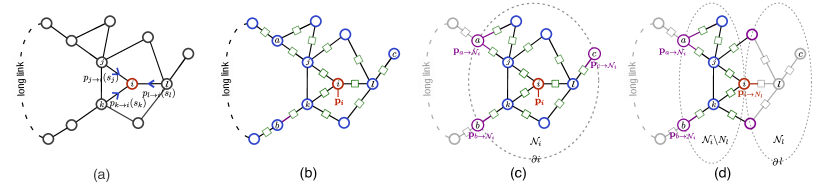
- Define a neighborhood structure $\mathcal{N}_i$ around each node $i$, with a tunable radius $R$ to control the size of the local tensor network.
- Contract tensors within $\mathcal{N}_i \setminus \mathcal{N}_l$ to compute effective cavity messages $p_{i \to \mathcal{N}_l}$, reducing the problem to a smaller, manageable subgraph.
- Use iterative message updates based on tensor contractions, abstracted as linear systems, to propagate information across the graph.
- Apply linear stability analysis to study convergence, linking the method to generalized nonbacktracking operators.
- Leverage arbitrary tensor network contraction techniques with complexity scaling with treewidth of the neighborhood graph, not the full system.
- Integrate both local exactness (via tensor contraction) and global iterative refinement (via message-passing) in a single framework.
Experimental results
Research questions
- RQ1Can a hybrid method combining tensor networks and message-passing achieve exact results in systems with both dense local structures and long-range dependencies?
- RQ2How does the size of the local neighborhood $\mathcal{N}_i$ affect the convergence and accuracy of the algorithm?
- RQ3Does TNMP outperform standard belief propagation and loopy message-passing in systems with short loops and complex energy landscapes?
- RQ4What is the relationship between the treewidth of the neighborhood graph and the computational complexity of TNMP?
- RQ5Can TNMP be applied effectively to real-world networks and complex models like the Edwards-Anderson spin glass?
Key findings
- TNMP achieves exact computation for globally tree-like systems with locally dense, low-treewidth subgraphs.
- On a 16×16 Edwards-Anderson spin glass model, TNMP converges over a broader range of inverse temperatures $\beta$ than belief propagation and generalized belief propagation.
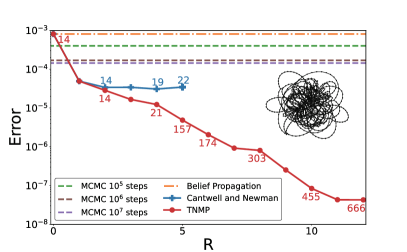
- For the real-world bus power system network, TNMP with $R=5$ achieves magnetization estimates nearly indistinguishable from exact results, with error decreasing as neighborhood size increases.
- Increasing the neighborhood radius $R$ reduces boundary correlations and improves convergence, requiring fewer iterations at lower temperatures.
- Numerical experiments show TNMP outperforms belief propagation and MCMC in accuracy and convergence speed on both synthetic and real-world graphs.
- The method demonstrates strong potential for applications in inference, combinatorial optimization, and quantum error correction decoding.
Read this paper
Open the full text in the Nubint reader and ask about any passage as you read.
Read this paper on NubintThis review was generated by AI from the original paper. Please check the paper before citing it.