
[Paper Review] Unifying Chance-Constrained and Robust Optimal Power Flow for Resilient Network Operations
This paper proposes a novel joint chance-constrained optimal power flow formulation that distinguishes between normal operation (managed via automatic generation control) and adverse operation (requiring manual redispatch), significantly reducing costs by 18% while maintaining high reliability. The method models manual reserve deployment using a heuristic to balance computational efficiency and security.
Uncertainty in renewable energy generation has the potential to adversely impact the operation of electric networks. Numerous approaches to manage this impact have been proposed, ranging from stochastic and chance-constrained programming to robust optimization. However, these approaches either tend to be conservative or leave the system vulnerable to low probability, high impact uncertainty realizations. To address this issue, we propose a new formulation for stochastic optimal power flow that explicitly distinguishes between "normal operation", in which automatic generation control (AGC) is sufficient to guarantee system security, and "adverse operation", in which the system operator is required to take additional actions, e.g., manual reserve deployment. The new formulation has been compared with the classical ones in a case study on the IEEE-118 and IEEE-300 bus systems. We observe that our consideration of extreme scenarios enables solutions that are more secure than typical chance-constrained formulations, yet less costly than solutions that guarantee robust feasibility with only AGC.
Motivation & Objective
- Address the trade-off between cost and security in stochastic optimal power flow under high renewable uncertainty.
- Overcome limitations of purely chance-constrained or robust OPF methods that are either too costly or too vulnerable to rare high-impact events.
- Introduce a two-mode operational model: normal operation with AGC only, and adverse operation with manual redispatch actions.
- Develop a computationally tractable formulation that enables efficient deployment of both automatic and manual reserves under uncertainty.
- Ensure system reliability while minimizing expected operational costs in the presence of wind power forecast errors.
Proposed method
- Formulate a joint chance-constrained program that limits the probability of requiring manual adjustments to a predefined threshold.
- Model automatic generation control (AGC) as an affine control policy for normal operation, where all generators participate proportionally.
- Introduce binary and continuous variables to represent manual redispatch actions, allowing selective re-dispatch of generators in adverse scenarios.
- Use a heuristic algorithm to reduce computational time by approximating the full solution of the mixed-integer program, improving scalability.
- Integrate wind forecast errors as random variables with known distributions, and enforce constraint violations only in extreme scenarios.
- Apply the formulation to the IEEE-118 bus system to evaluate performance across multiple uncertainty realizations.
Experimental results
Research questions
- RQ1Can a unified framework combine the benefits of chance-constrained and robust optimization in optimal power flow to reduce cost without sacrificing reliability?
- RQ2How does explicitly modeling manual reserve deployment improve system security and cost efficiency compared to relying solely on AGC?
- RQ3What is the trade-off between computational complexity and solution quality when including manual redispatch in stochastic OPF?
- RQ4To what extent can a heuristic approach reduce solution time for the proposed mixed-integer chance-constrained program without degrading performance?
- RQ5How do the proposed methods compare in terms of expected cost and worst-case deviation levels across different uncertainty realizations?
Key findings
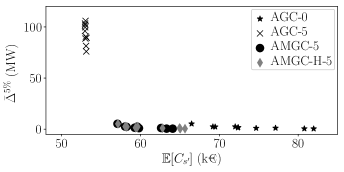
- The proposed AMGC-5 formulation reduces expected operational cost by 18% compared to AGC-0, while maintaining similar reliability levels.
- The AMGC-5 method achieves lower average deviation in the 5% worst-case scenarios than AGC-0, indicating better resilience to extreme events.
- The AMGC-H-5 variant, which includes a heuristic, reduces computational time from 4648 seconds to 60 seconds with minimal performance degradation.
- Unlike AGC-5, which disables expensive generators from providing reserves, AMGC-5 and AMGC-H-5 retain their capacity for manual redispatch, improving security.
- The AGC-0 method is overly conservative, allocating reserves to both cheap and expensive generators, leading to higher costs.
- The results confirm that modeling manual adjustments enables a more efficient and secure dispatch strategy than relying solely on AGC under all uncertainty realizations.
Read this paper
Open the full text in the Nubint reader and ask about any passage as you read.
Read this paper on NubintThis review was generated by AI from the original paper. Please check the paper before citing it.