
[論文レビュー] Control and Readout of a 13-level Trapped Ion Qudit
この研究は、Ba-137+の13レベルのトラップドイオン量子比特の状態準備と単一ショット読み出しを実証し、25レベルへの拡張の可能性を示すためのプロトコルに展開可能であることを示し、SPAM忠実度と誤り源を分析する。
To implement useful quantum algorithms which demonstrate quantum advantage, we must scale currently demonstrated quantum computers up significantly. Leading platforms such as trapped ions face physical challenges in including more information carriers. A less explored avenue for scaling up the computational space involves utilizing the rich energy level structure of a trapped ion to encode multi-level qudits rather than two-level qubits. Here we show control and single-shot readout of qudits with up to 13 computational states, using protocols which can be extended directly to manipulate qudits of up to 25 levels in our chosen information host, $^{137} ext{Ba}^{+}$. This represents more than twice as many computational states per qudit compared with prior work in trapped ions. In addition to the preparation and readout protocols we demonstrate, universal quantum computation requires other quantum logic primitives such as entangling gates. These primitives have been demonstrated for lower qudit dimensions and can be directly generalized to the higher dimensions we employ. Hence, our advance opens an avenue towards using high-dimensional qudits for large-scale quantum computation. We anticipate efficiently utilizing available energy states in a trapped ion to play a significant and complementary role in tackling the challenge in scaling up the computational space of a trapped ion quantum computer. A qudit architecture also offers other practical benefits, which include affording relaxed fault tolerance thresholds for quantum error correction, providing an avenue for efficient quantum simulation of higher spin systems, and more efficient qubit gates.
研究の動機と目的
- イオンごとの情報容量を増やすため、トラップイオン中の高次元クディットを用いて量子コンピュータのスケーリングを促進する。
- Ba-137+のエネルギーレベルにエンコードされた13レベルのクディットに対する状態準備と測定(SPAM)を示す。
- 高次元クディットエンコーディングにおいてSPAM忠実度が達成可能であることを示し、主要な誤り源を特定する。
- Ba-137+における13レベルを超える25レベルへのクディットエンコーディングの拡張への道筋を提供する。
提案手法
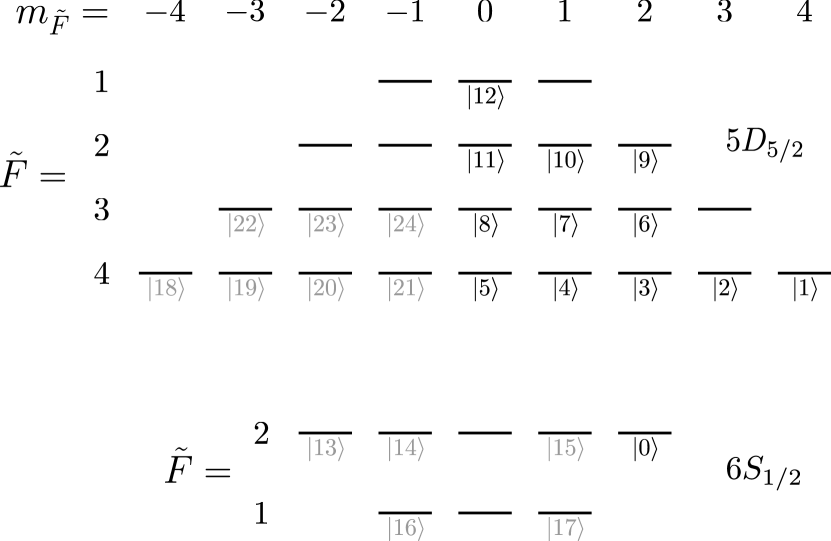
- 6S1/2 F=2,mF=2 および選択された 5D5/2 metastable states を用いて、1762 nm 遷移でBa-137+に13レベルのクディットをエンコードする。
- 非標的状態を5D5/2へ棚上げして単一ショットSPAMを実行し、その後棚上げを解除して蛍光を用いて作成状態を識別する。
- 事後選択測定でSPAM忠実度を特性化し、磁場ノイズやπパルス誤差を通じて誤差をモデル化する。
- 中間磁場で遷移周波数を経験的に較正し、遷移強度をモデル化する。
- フィルター関数理論を用いて誤差寄与を推定し、SPAM誤差と磁場ノイズおよびπパルス継続時間の関係を説明する。
実験結果
リサーチクエスチョン
- RQ1高忠実度で13レベルのクディットに対して、拘束されたBa-137+イオンは信頼性の高いSPAMを提供できるか。
- RQ2高次元クディットのSPAMにおける主要な誤り源は何か、そしてそれらはクディット次元とどのようにスケールするか。
- RQ3提示されたプロトコルを用いてBa-137+内で13レベルを超えるクディットエンコーディングを拡張することは実現可能か。
- RQ4有限磁場における遷移強度とエネルギーレベル混合が高次元クディットの制御にどのように影響するか。
主な発見
- 13レベルのクディットに対して、事後選択平均SPAM忠実度を91.7±0.3%を達成。
- 13レベルのクディットで、事後選択の平均SPAM誤差は8.3±0.3%、生データのSPAM誤差は13.1±0.3%を観測。
- 磁場ノイズをSPAM誤差の主要源として特定し、誤差は彼らのモデルに従い κ^2 τ_π^2 に比例してスケールする。
- SPAMパラメータの較正時間が、特定のプロトコルでクディット次元とともに増加しないことを示した。
- 磁場ノイズの制御を改善すれば、提示された制御・読み出し方式でBa-137+における最大25レベルまでのエンコードが実現可能であると論じる。
- 最適なクディット状態の選択を用いれば、クディット次元のスケーリングはSPAM忠実度を本質的に制限しないことを示した。
この論文を読む
Nubintのビューアで原文を開き、読みながら気になる箇所をすぐに質問できます。
Nubintでこの論文を読むこのレビューはAIが論文の原文をもとに作成しました。引用する前に原文をご確認ください。