
[論文レビュー] Discovery of Optimal Quantum Error Correcting Codes via Reinforcement Learning
本稿では、量子レゴモジュラー符号構成を用いた強化学習(RL)フレームワークを紹介し、最適な量子誤り訂正符号(QECC)を発見する。コード距離を最大化するか、偏りのあるノイズ下での論理エラーを最小化するようにエージェントを訓練することで、既知の符号(表面コードやXZZXコードを含む)よりも優れたノイズ耐性を示す新しい[[17,1,3]]CSS符号を発見した。これは、RLが特定のノイズモデルに適合したカスタムQECCの設計に有効であることを示している。
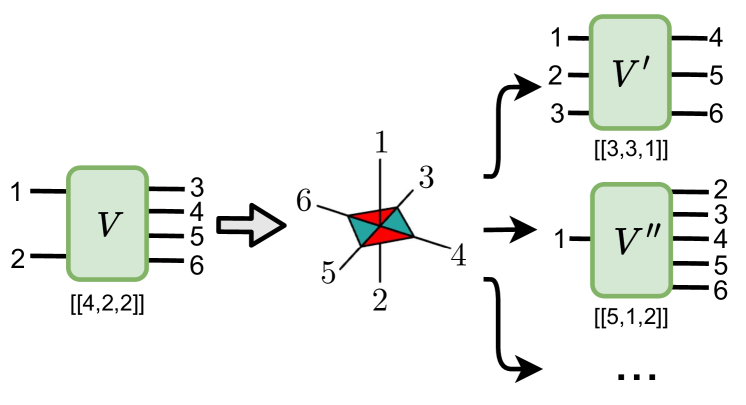
The recently introduced Quantum Lego framework provides a powerful method for generating complex quantum error correcting codes (QECCs) out of simple ones. We gamify this process and unlock a new avenue for code design and discovery using reinforcement learning (RL). One benefit of RL is that we can specify extit{arbitrary} properties of the code to be optimized. We train on two such properties, maximizing the code distance, and minimizing the probability of logical error under biased Pauli noise. For the first, we show that the trained agent identifies ways to increase code distance beyond naive concatenation, saturating the linear programming bound for CSS codes on 13 qubits. With a learning objective to minimize the logical error probability under biased Pauli noise, we find the best known CSS code at this task for $\lesssim 20$ qubits. Compared to other (locally deformed) CSS codes, including Surface, XZZX, and 2D Color codes, our $[[17,1,3]]$ code construction actually has extit{lower} adversarial distance, yet better protects the logical information, highlighting the importance of QECC desiderata. Lastly, we comment on how this RL framework can be used in conjunction with physical quantum devices to tailor a code without explicit characterization of the noise model.
研究の動機と目的
- 特定のノイズモデルに適合したスケーラブルでカスタマイズ可能な量子誤り訂正符号の設計手法を開発すること。
- 手動または全探索による符号設計の限界を乗り越えるために強化学習を活用すること。
- RLが偏りのあるパウリノイズ下でコード距離と論理エラー抑制の両面で優れた性能を示す符号を発見できるかどうかを検証すること。
- 完全なノイズモデルの知識がなくても、物理的量子デバイスからのフィードバックを統合することで符号発見を可能にすること。
- ハイブリッドVQA-RLアプローチを用いて、非安定化子符号の統合とスケーラビリティの向上を図るために量子レゴフレームワークを拡張すること。
提案手法
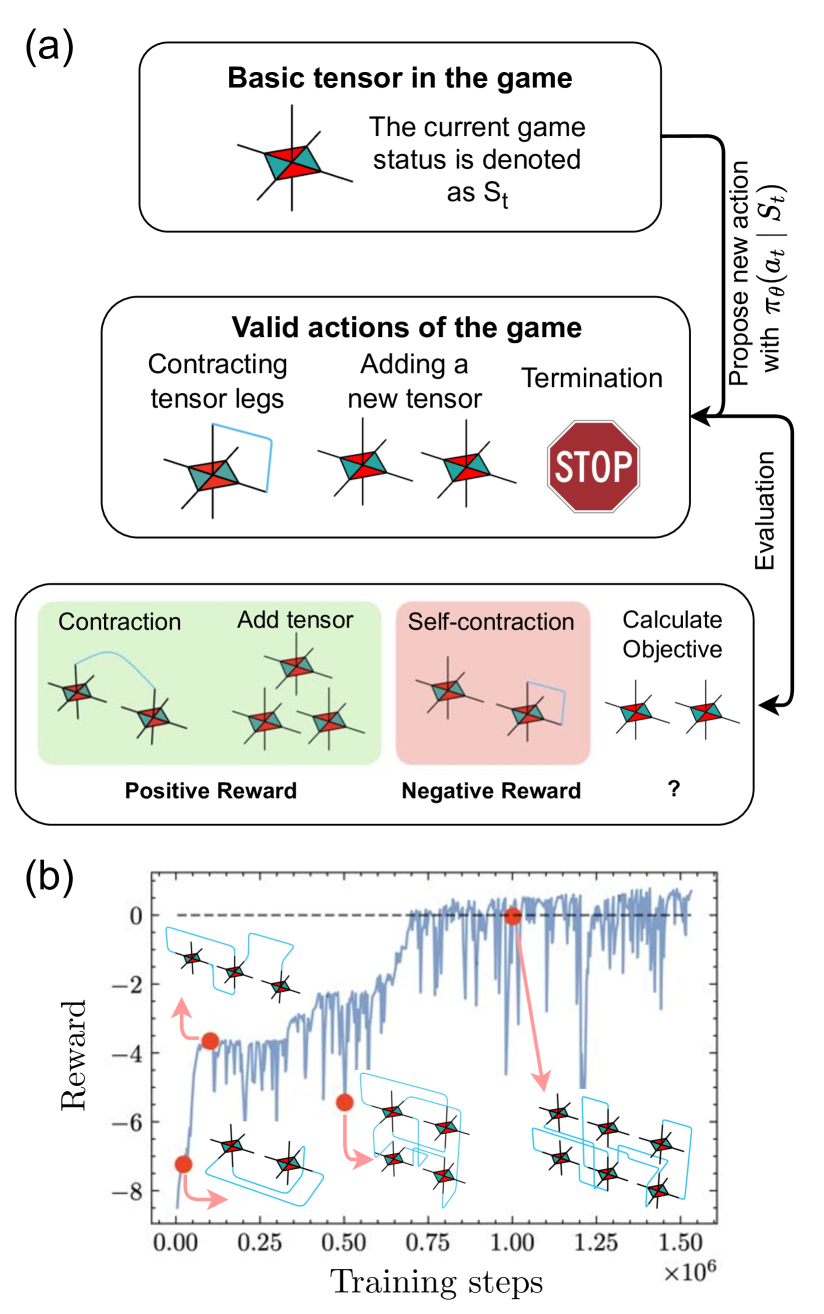
- 著者らは量子レゴフレームワークをゲーム化し、符号構築を段階的決定のゲームとして扱い、RLエージェントが「レゴの追加」「脚の縮約」「終了」のアクションを選択するようにした。
- エージェントは、偏りのあるパウリノイズ下でコード距離を最大化するか、論理エラー確率を最小化するよう報酬関数に基づいて訓練された。
- ゲーム終了後に、正確または近似手法を用いたテンソルネットワークの縮約により、コードの性質(距離や重み列挙子)が計算された。
- 訓練の安定化と収束の向上を図るため、深層Qネットワーク(DQN)エージェントに経験再生とターゲットネットワークを適用した。
- スケーラビリティを向上させるために、モンテカルロサンプルやMPOベースのテンソル縮約に基づく近似コスト関数を提案し、計算コストをO(exp(d))からO(n log n)に削減した。
- ハイブリッドトレーニングが可能で、まず古典的ノイズモデルで事前学習し、その後実デバイスからのフィードバックで微調整することで、未知のノイズ特性に適応できる。
実験結果
リサーチクエスチョン
- RQ1強化学習は、標準的な連結符号よりも高いコード距離を持つ量子誤り訂正符号を発見できるか?
- RQ2既存の符号よりも、偏りのあるパウリノイズ下で論理エラー抑制をより効果的に最適化できるか?
- RQ3敵対的ノイズ環境下でも、RLで最適化された符号は、表面コード、XZZXコード、カラーデザインコードなど既知の符号を上回る性能を示すか?
- RQ4完全なノイズモデルの特定がなくても、実量子ハードウェアと連携して動作するRLフレームワークは構築可能か?
- RQ5VQAが生成するレゴを用いて、非安定化子符号を含むフレームワークを拡張し、VQA-生成レゴによるスケーラブルな符号設計を可能にできるか?
主な発見
- RLエージェントは、表面コードよりも低い敵対的距離を示すが、偏りのあるパウリノイズ下で論理エラー抑制において既知の符号を上回る[[17,1,3]]CSS符号を発見した。
- 13量子ビットの状態で、CSS符号の線形計画法の境界に到達し、この符号サイズにおける理論的最大距離を達成した。
- 論理エラー最小化の目的関数に対して、偏りのあるノイズ下で20量子ビット未満の範囲で、表面コード、XZZXコード、2次元カラーコードを上回る最良の既知のCSS符号を発見した。
- 微調整段階で物理デバイスからのフィードバックを活用することで、ノイズモデルの明示的知識がなくても符号発見が可能になった。
- MPOベースのテンソル縮約を用いた近似コスト関数により、計算コストをO(exp(d))からO(n log n)に削減し、より大きな系へのスケーリングを可能にした。
- VQAが生成する非安定化子符号と互換性があり、効率的なテンソルネットワーク評価を介して、量子レゴフレームワークを非パウリ安定化子符号へ拡張した。
この論文を読む
Nubintのビューアで原文を開き、読みながら気になる箇所をすぐに質問できます。
Nubintでこの論文を読むこのレビューはAIが論文の原文をもとに作成しました。引用する前に原文をご確認ください。