
[論文レビュー] Exploring Large-Scale Entanglement in Quantum Simulation
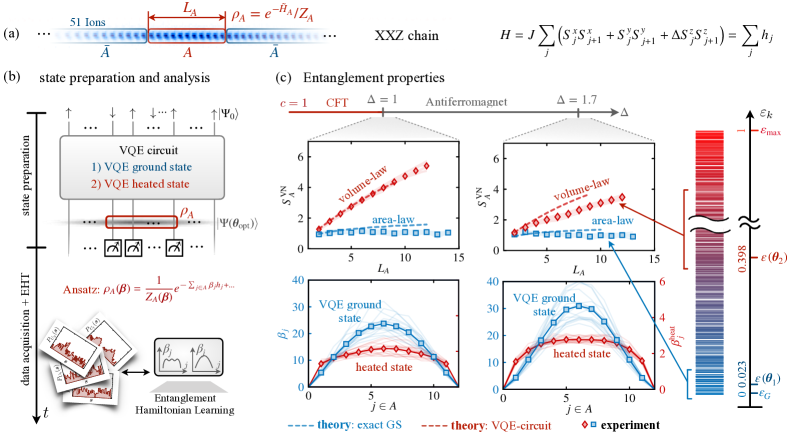
本論文は、1D XXZヘイゼンベルグ鎖の基底状態および励起状態におけるエンタングルメント構造の局所的性質を明らかにした51イオン量子シミュレータを用いて、エンタングルメントハミルトニアンの実験的学習を実現した。主な結果は、エンタングルメントが主に部分系の境界付近に局在しているという強力な証拠であり、大規模な量子系において局所的エンタングルメントハミルトニアンが成り立つことを確認した。
Entanglement is a distinguishing feature of quantum many-body systems, and uncovering the entanglement structure for large particle numbers in quantum simulation experiments is a fundamental challenge in quantum information science. Here we perform experimental investigations of entanglement based on the entanglement Hamiltonian, as an effective description of the reduced density operator for large subsystems. We prepare ground and excited states of a 1D XXZ Heisenberg chain on a 51-ion programmable quantum simulator and perform sample-efficient `learning' of the entanglement Hamiltonian for subsystems of up to 20 lattice sites. Our experiments provide compelling evidence for a local structure of the entanglement Hamiltonian. This observation marks the first instance of confirming the fundamental predictions of quantum field theory by Bisognano and Wichmann, adapted to lattice models that represent correlated quantum matter. The reduced state takes the form of a Gibbs ensemble, with a spatially-varying temperature profile as a signature of entanglement. Our results also show the transition from area to volume-law scaling of Von Neumann entanglement entropies from ground to excited states. As we venture towards achieving quantum advantage, we anticipate that our findings and methods have wide-ranging applicability to revealing and understanding entanglement in many-body problems with local interactions including higher spatial dimensions.
研究の動機と目的
- 大規模な量子多体系におけるエンタングルメント構造を、量子シミュレーションを用いて調査すること。
- 1次元XXZヘイゼンベルグ鎖において、最大20サイトの部分系について、実験的にエンタングルメントハミルトニアンを学習すること。
- エンタングルメントハミルトニアンが局所的構造を示すという仮説を検証すること、特に部分系の境界付近で顕著であることを確認すること。
- エンタングルメントハミルトニアンのパラメータβ_jが局所的逆温度として物理的に解釈可能であることを確認すること。
- エンタングルメント寄与の主な寄与がエンタングルメントカット付近に局在している証拠を提供すること。
提案手法
- 本研究では、プログラマブルな51イオン量子シミュレータを用いて、1次元XXZヘイゼンベルグ鎖の基底状態および励起状態を準備した。
- 部分系が最大20サイトに達するまで、標本効率の良い量子状態トモグラフィーと最適化技術を用いてエンタングルメントハミルトニアンを学習した。
- 部分系の混合密度行列は、全鎖をカバーするパウリスリングの期待値を用いて再構成され、特にそのスパンに注目した。
- 理論的モデリングでは、ギブス状態の形 ρ_A ∝ exp(−Ĥ_EH) を仮定し、Ĥ_EH はサイト依存のパラメータ β_j を持つエンタングルメントハミルトニアンである。
- エンタングルメント固有状態の空間的構造は、スチェルム固有ベクトルと基底状態との間のエネルギー密度差を計算することで分析した。
- 数値的および実験的分析により、大規模系の極限において非対角項のコherーが消えることが確認され、非干渉混合近似の妥当性が裏付けられた。
実験結果
リサーチクエスチョン
- RQ1量子スピン鎖における大規模部分系のエンタングルメントハミルトニアンは、局所的構造を示すか?
- RQ2エンタングルメントの主な寄与は、部分系の境界付近に局在しているか?
- RQ3エンタングルメントハミルトニアンのパラメータβ_jは、局所的逆温度として解釈可能か?
- RQ4エンタングルメントスペクトルおよびスチェルムベクトルは、エンタングルメント構造の空間的非一様性をどのように反映するか?
- RQ5多数体波動関数の非対角項のコヒーレンスは、大規模系における混合密度行列にどの程度の影響を及ぼすか?
主な発見
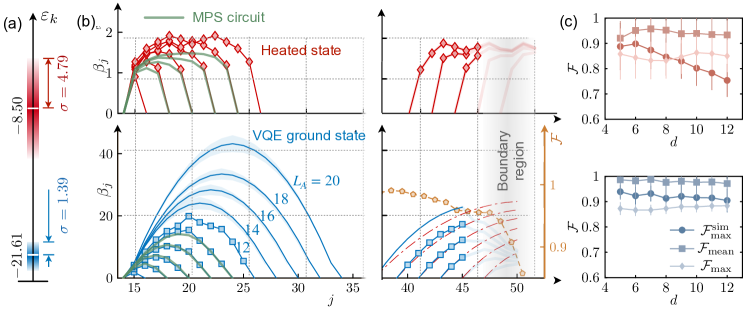
- 1次元XXZ鎖における最大20サイトの部分系について、エンタングルメントハミルトニアンは局所的構造を示しており、パラメータβ_jは中央で最大、エンタングルメントカット付近で最小である。
- 系サイズ L ∼ 10^3 に達する段階で、部分系の混合密度行列はギブス状態 ρ_A ∝ exp(−Ĥ_EH) と区別できず、多数体波動関数における非対角コヒーレンスが消えることを示唆している。
- エンタングルメントスペクトルの主要なスチェルム固有ベクトルは、エンタングルメントカット付近に局在する励起状態に対応しており、低エネルギーのエンタングルメント固有状態におけるエネルギー密度差のピークとして示された。
- エンタングルメントスペクトルの空間的非一様性は、β_j を局所的逆(エンタングルメント)温度として解釈する根拠を支持している。
- 数値的検証により、長大なパウリスリングの期待値が大規模系の極限で消えることが確認され、局所的エンタングルメントハミルトニアンモデルの妥当性が裏付けられた。
- 本研究の結果は、トポロジカル秩序のLi-Haldane像を一般の量子多体系へ拡張し、境界局在型エンタングルメントが普遍的な特徴であることを示した。
この論文を読む
Nubintのビューアで原文を開き、読みながら気になる箇所をすぐに質問できます。
Nubintでこの論文を読むこのレビューはAIが論文の原文をもとに作成しました。引用する前に原文をご確認ください。