
[論文レビュー] Highly nonperturbative nature of the Mott metal-insulator transition: Two-particle vertex divergences in the coexistence region
本論文は、半分満たされた Hubbard モデルにおける Mott 金属絶縁体転移 (MIT) が、絶対零度に近づくにつれて絶縁相において2粒子頂点発散線の無限大の蓄積を示す、極めて非摂動的な性質を示していることを示している。系統的な動的平均場理論 (DMFT) 計算を通じて、著者らは逆温度 β が増加するにつれて発散線の数が増加することを示しており、これは T=0 における臨界蓄積点を示しており、MIT における摂動論の崩壊を裏付けている。
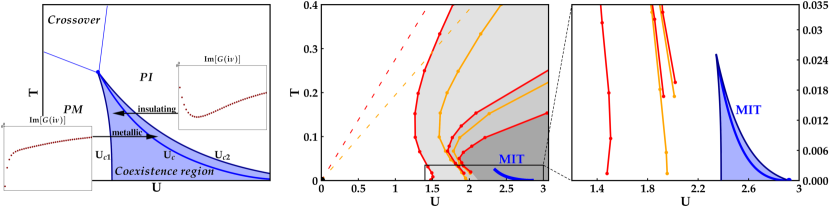
We thoroughly analyze the divergences of the irreducible vertex functions occurring in the charge channel of the half-filled Hubbard model in close proximity to the Mott metal-insulator transition (MIT). In particular, by systematically performing dynamical mean-field theory (DMFT) calculations on the two-particle level, we determine the location and the number of the vertex divergences across the whole coexistence region adjacent to the first-order metal-to-insulator transition. We find that the lines in the parameter space, along which the vertex divergences occur, display a qualitatively different shape in the coexisting metallic and insulating phase, which is also associated to an abrupt jump of the number of divergences across the MIT. Physically, the systematically larger number of divergences on the insulating side of the transition reflects the sudden suppression of local charge fluctuation at the MIT. Further, a systematic analysis of the results demonstrates that the number of divergence lines increases as a function of the inverse temperature ${β\!=\!(k_\mathrm{B} T)^{-1}}$ by approaching the Mott transition in the zero temperature limit. This makes it possible to identify the zero-temperature MIT as an accumulation point of an infinite number of vertex divergence lines, unveiling the highly nonperturbative nature of the underlying transition.
研究の動機と目的
- 摂動論の破綻と Mott 金属絶縁体転移 (MIT) の間の未解決な関係、特に共存領域における関係を解明すること。
- 金属相と絶縁相の両方において、Mott 転移付近における電荷チャネルの不変2粒子頂点関数の挙動を調査し、発散線の性質に注目すること。
- 1次相転移を越えて、絶対零度極限における発散線の数と構造がどのように変化するかを特定すること。
- 絶対零度における MIT が無限に多くの発散線の蓄積点であることを確立し、非摂動的性質を明らかにすること。
提案手法
- 無限大の連結性を持つ Bethe 格子上の半分満たされた Hubbard モデルに対して、2粒子レベルにおける系統的な動的平均場理論 (DMFT) 計算を実施すること。
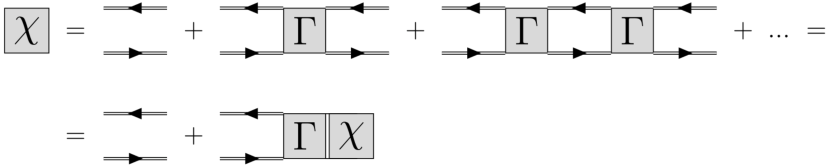
- 電荷チャネルにおける不変2粒子頂点関数を計算し、Bethe-Salpeter 方程式の核を用いて発散線を同定すること。
- 共存領域全域にわたり、頂点核の負の固有値の数 $N_{\nu<0}$ を発散線の数の代理として追跡すること。
- 逆温度 $\beta = (k_B T)^{-1}$ を増加させることで、絶対零度への外挿を実施し、$\beta$ の値を最大200まで用いること。
- 遷移線 ($U_{c1}(T)$, $U_c(T)$, $U_{c2}(T)$) および中間線の多項式フィットを用いて、パラメータ空間における発散挙動をマッピングすること。
- 絶縁相の発散構造を近似するための有効な Hubbard 原子モデル $U_{\text{eff}}(U) = U^2 / (U + U_{c1}^{T=0}((\theta_0 - 1)))$ を構築し、$\theta_0$ を $N_{\nu<0}(\beta)$ の傾き比からキャリブレーションすること。
実験結果
リサーチクエスチョン
- RQ1Mott MIT の共存領域全域にわたり、2粒子頂点発散の位置と数はどのように変化するか?
- RQ2発散線の数と、MIT に近い金属相と絶縁相の性質との間にはどのような関係があるか?
- RQ3T \to 0 のとき、発散線の数は逆温度 $\beta$ に対してどのようにスケーリングするか?
- RQ4絶対零度における Mott 転移が、発散線の蓄積点として理解され、非摂動的臨界定常点を示しているとみなせるか?
- RQ5有効な Hubbard 原子モデルに再スケーリングされた相互作用 $U_{\text{eff}}$ を用いることで、絶縁相の発散構造はどの程度正確に再現できるか?
主な発見
- 発散線の数 $N_{\nu<0}$ は逆温度 $\beta$ に従って増加し、$\beta \leq 75$ の範囲では $p(U) \propto U$、$\beta = 100, 133$ のとき $\propto U^2$、$\beta = 200$ のとき $\propto U^3$ とスケーリングする。これは発散蓄積における強い非線形性を示している。
- 金属相と絶縁相では、発散線の形状が本質的に異なる。1次相転移を越えて、発散線の数に不連続なジャンプが観測される。
- 絶縁相は金属相よりも系統的に多くの発散線を有しており、これは MIT における局所的電荷フラクチュエーションの急激な抑制を反映している。
- 絶対零度における Mott 転移は、無限に多くの発散線の蓄積点として特定され、その極めて非摂動的な性質が確認された。
- 有効な Hubbard 原子モデル $U_{\text{eff}} = U^2 / (U + U_{c1}^{T=0}((\theta_0 - 1)))$ と $\theta_0 \approx 1.19$ は、絶縁相における発散数を良好に定量的に近似しており、$\theta_0^{\text{slope}} = 1.22$ は $N_{\nu<0}(\beta)$ の傾き比から導出された値である。
- \beta = 40 のとき、$\theta_0^{\text{slope}} = 1.22$ の有効モデルは、Hubbard モデルの正確な $N_{\nu<0}$ 値を $U = 3.1$ および $U = 3.5$ において1〜3%の誤差の範囲で再現している。
この論文を読む
Nubintのビューアで原文を開き、読みながら気になる箇所をすぐに質問できます。
Nubintでこの論文を読むこのレビューはAIが論文の原文をもとに作成しました。引用する前に原文をご確認ください。