
[論文レビュー] Incompressible Navier-Stokes solve on noisy quantum hardware via a hybrid quantum-classical scheme
この論文は、ノイジィな中規模量子(NISQ)ハードウェア上で非圧縮性ナビエ=ストークス方程式を解くためのハイブリッド量子古典アルゴリズムを提案する。圧力ポアソン方程式に対して変分量子線形ソルバ(VQLS)を用い、同時に古典的圧力投影法と組み合わせることで、HTreeトモグラフィーと多重グリッドプリコンディショニングを適用し、IBMの超伝導量子プロセッサ上で高精度な解を得た。これは、ハードウェアのノイズとリソース制限があるにもかかわらず、近い将来の量子流体力学シミュレーションの実現可能性を示している。
Partial differential equation solvers are required to solve the Navier-Stokes equations for fluid flow. Recently, algorithms have been proposed to simulate fluid dynamics on quantum computers. Fault-tolerant quantum devices might enable exponential speedups over algorithms on classical computers. However, current and foreseeable quantum hardware introduce noise into computations, requiring algorithms that make judicious use of quantum resources: shallower circuit depths and fewer qubits. Under these restrictions, variational algorithms are more appropriate and robust. This work presents a hybrid quantum-classical algorithm for the incompressible Navier--Stokes equations. A classical device performs nonlinear computations, and a quantum one uses a variational solver for the pressure Poisson equation. A lid-driven cavity problem benchmarks the method. We verify the algorithm via noise-free simulation and test it on noisy IBM superconducting quantum hardware. Results show that high-fidelity results can be achieved via this approach, even on current quantum devices. Multigrid preconditioning of the Poisson problem helps avoid local minima and reduces resource requirements for the quantum device. A quantum state readout technique called HTree is used for the first time on a physical problem. Htree is appropriate for real-valued problems and achieves linear complexity in the qubit count, making the Navier-Stokes solve further tractable on current quantum devices. We compare the quantum resources required for near-term and fault-tolerant solvers to determine quantum hardware requirements for fluid simulations with complexity improvements.
研究の動機と目的
- 現在のノイジィな量子ハードウェア上で非圧縮性流体の流れをシミュレートする実用的な量子アルゴリズムを開発すること。
- 効率的なトモグラフィーを用いて、近い将来のデバイスにおける高精度な量子状態読み出しを達成すること。
- 多重グリッドプリコンディショニングを用いて、変分量子アルゴリズムの収束性とトレーニング可能性を向上させること。
- 流体力学的問題に対するVQLS、VQE、HHLソルバの量子リソース要件をベンチマークすること。
- 2次元のリードドキャビティフローに対して、実際のIBM量子プロセッサ上で本手法を実験的に検証すること。
提案手法
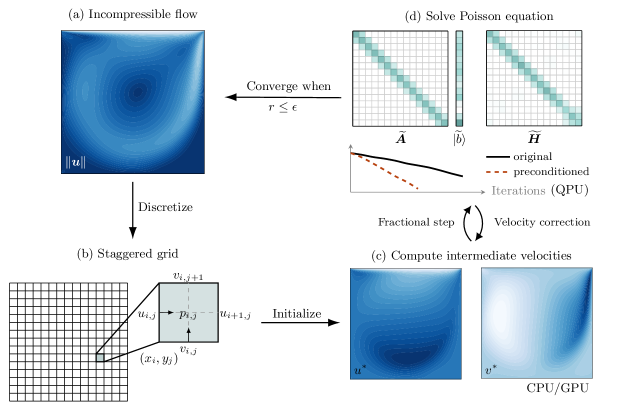
- 非線形項と時間ステップ処理には古典的圧力投影法を用い、圧力ポアソン方程式は変分量子線形ソルバ(VQLS)で解く。
- 線形系の残差に基づくコスト関数を最小化するために、古典的最適化器を用いて量子回路のパラメータをトレーニングする。
- 線形時間複雑度を有する量子状態トモグラフィー手法であるHTreeを用い、実数値の状態ベクトルを効率的に再構成することで、読み出し時間を短縮する。
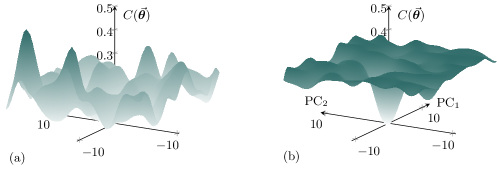
- 最適化中の局所解に陥るのを避けるために、線形系に多重グリッドプリコンディショニングを適用し、条件数を改善する。
- Qiskitを用い、高レベルの最適化を施した上で、ibm_kolkata、ibm_sherbrooke、ibm_torino量子プロセッサ上で本手法を実装・テストした。
- リソース推定では、VQE、VQLS、HHLの各手法について、キュービット数、2キュービットゲート数、回路深さ、および127キュービットのibm_sherbrookeプロセッサ上での推定実行時間を比較した。
実験結果
リサーチクエスチョン
- RQ1ハイブリッド量子古典アルゴリズムは、現在のノイジィな量子ハードウェア上で、高精度に非圧縮性ナビエ=ストークス方程式を解くことができるか?
- RQ2多重グリッドプリコンディショニングは、流体力学的問題における変分量子アルゴリズムのトレーニング可能性と収束性をどの程度向上させるか?
- RQ3近い将来の応用において、従来の方法と比較してHTreeトモグラフィーは、量子状態読み出し時間を顕著に短縮できるか?
- RQ4NISQデバイス上で流体の流れを解く際、VQLS、VQE、HHLの相対的な量子リソース要件は何か?
- RQ5本手法は、超伝導量子プロセッサで観測される現実的なノイズレベルに対しても、依然として頑健であるか?
主な発見
- ハイブリッドアルゴリズムは、実際のIBM量子プロセッサ上で2次元のリードドキャビティフローに対して高精度な解を効果的に計算でき、現在のハードウェア上での実現可能性が実証された。
- 多重グリッドプリコンディショニングは、VQLS最適化中の収束速度を顕著に向上させるとともに、局所解に陥る可能性を低減した。
- HTreeトモグラフィーは、実数値の状態ベクトルを線形時間で効率的に再構成でき、従来の量子状態トモグラフィーと比較して測定のオーバーヘッドを削減した。
- リソース推定の結果、5キュービット系においてVQLSは1,900の2キュービットゲートと8,700の回路深さを要し、ibm_sherbrookeプロセッサ上での推定実行時間は1.1 msであった。ただし、行列Aが単純なパウリ分解を有しない限り、多くのNISQデバイスでは依然として実行不可能である。
- HHLは、その高いリソース要件のためNISQハードウェア上で実行不可能であると判明した。2キュービットゲート数は370,000、回路深さは170万、推定実行時間は240 msに達した。
- 本研究の結論として、VQLSは問題行列Aが効率的なパウリ分解を有する場合に限り、NISQデバイスで実用可能であり、工学的問題への一般応用は限定的であるとされた。
この論文を読む
Nubintのビューアで原文を開き、読みながら気になる箇所をすぐに質問できます。
Nubintでこの論文を読むこのレビューはAIが論文の原文をもとに作成しました。引用する前に原文をご確認ください。