
[論文レビュー] Noisy Qudit vs Multiple Qubits : Conditions on Gate Efficiency for Enhancing Fidelity
本稿は、同一のヒルベルト空間次元およびノイズ環境下で、単一のクイッド系と複数のキュービット系のゲートfidelityを比較し、リンドブラッド形式における一次の平均ゲートfidelity(AGI)を用いて分析している。臨界曲線 $(d^2 - 1)/(3\log_2 d)$ を導出し、デ coherent 時間に対するゲート時間の比としてのゲート効率の閾値を定義しており、ゲート時間がデ coherent 時間に対して十分短い場合には、特定のクイッドプラットフォームが最新のキュービット系を上回るfidelityスケーリングを達成できることを示している。
Today, multiple new platforms are implementing qudits, $d$-level quantum bases of information, for Quantum Information Processing (QIP). It is therefore crucial to study their efficiencies for QIP compared to more traditional qubit platforms. We present a comparative study of the infidelity scalings of a qudit and $n$-qubit systems, both with identical Hilbert space dimensions and noisy environments. The first-order response of the Average Gate Infidelity (AGI) to the noise in the Lindblad formalism, which was found to be gate-independent, was calculated analytically in the two systems being compared. This yielded a critical curve $O(d^2/\log_2(d))$ of the ratio of their respective gate times in units of decoherence time. This quantity indicates how time-efficient operations on these systems are. The curve delineates regions where each system has a higher rate of increase of the AGI than the other. This condition on gate efficiency was applied to different existing platforms. It was found that specific qudit platforms possess gate efficiencies competitive with state-of-the-art qubit platforms. Numerical simulations complemented this work and allowed for discussion of the applicability and limits of the linear response formalism.
研究の動機と目的
- 同一のノイズ条件下で、単一クイッド系が同等のマルチキュービット系を上回る計算fidelityを示すかどうかを評価すること。
- クイッド系に増加するエラーチャネルが存在する条件下で、マルチキュービット系の平均ゲートfidelity(AGI)性能を維持または上回る条件を同定すること。
- ゲート効率をデ coherent 時間スケールと比較することで、クイッドプラットフォームの実用可能性を定量化するベンチマークを確立すること。
- 弱いノイズ下でのAGIの線形応答近似の妥当性を検証し、数値シミュレーションを用いてその限界を評価すること。
提案手法
- 同一のヒルベルト空間次元を持つ単一クイッド系およびnキュービット系について、リンドブラッド形式におけるノイズに対する平均ゲートfidelity(AGI)の一次応答を解析的に計算する。
- ハール測度を用いてすべてのユニタリゲートの平均化を行い、状態依存性のないfidelity指標を保証する。
- 次元$d$およびノイズ率$γ$を含むトレースに基づく表現を用いて、デコherenceノイズ下での単一クイッドのAGIスケーリングを導出する。
- 同じ形式を用いて、純粋なデコherenceノイズ下でのnキュービットの対応するAGIスケーリングを導出し、クイッド系と比較する。
- ゲート時間とデcoherence時間の比を指標として定義し、2つのシステム間で優れた性能を示す領域を分ける臨界曲線$ (d^2 - 1)/(3\log_2 d) $を導出する。
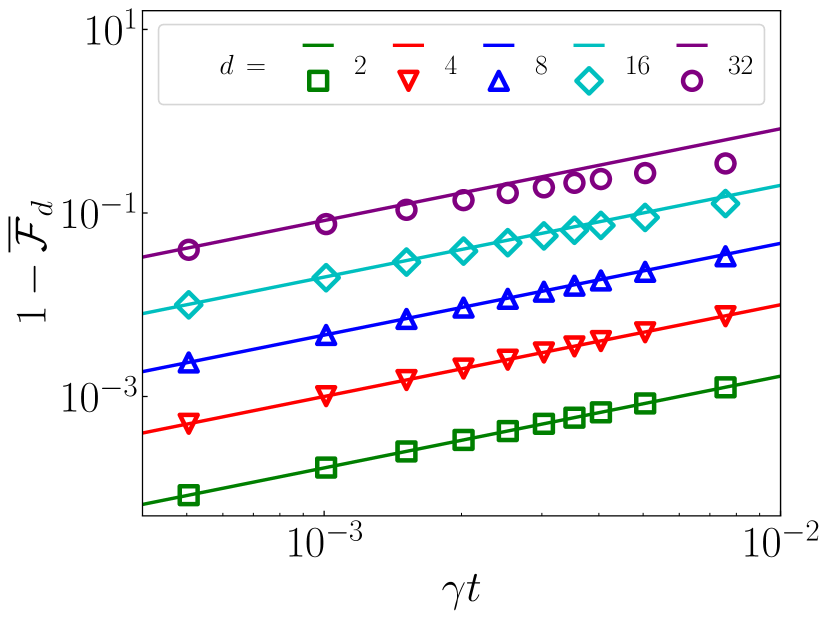
- $d=4$および$d=8$について$N_g = 4400$ゲートの数値シミュレーションを実施し、高ノイズレベルにおける線形AGIスケーリングからのずれおよびゲート依存性を評価する。
実験結果
リサーチクエスチョン
- RQ1ゲート効率がどの程度の条件下で、単一クイッド系が同等のマルチキュービット系よりも低い平均ゲートfidelityを維持できるか。
- RQ2同一のヒルベルト空間次元を持つ場合、クイッド系のエラーチャネル数がマルチキュービット系のfidelityスケーリングに与える影響は何か。
- RQ3弱いノイズ下で、クイッド系およびマルチキュービット系のAGIの線形応答近似はどの程度妥当か。
- RQ4ゲート時間とデcoherence時間の比の閾値は、どの程度の値でクイッド系とマルチキュービット系のfidelityスケーリングの優劣を決定づけるか。
- RQ5数値シミュレーションは、線形応答形式がAGIの増加を予測する限界をどのように明らかにするか。
主な発見
- 臨界曲線$ (d^2 - 1)/(3\log_2 d) $は、ゲート時間/デcoherence時間の比としてのゲート効率比の閾値を定義しており、クイッド系とマルチキュービット系が同等のAGIスケーリングを示す境界を示している。
- $d=4$ の場合、臨界比は約$ (16 - 1)/(3 \cdot 2) = 2.5 $であり、ゲート時間がデcoherence時間の2.5倍未満であれば、クイッド系がマルチキュービット系を上回る可能性がある。
- 数値シミュレーションでは、$\gamma t$が高くなるとAGIが線形挙動から逸脱し、$d$が大きいほど小さな$\gamma t$で顕著な非線形性が観察される。
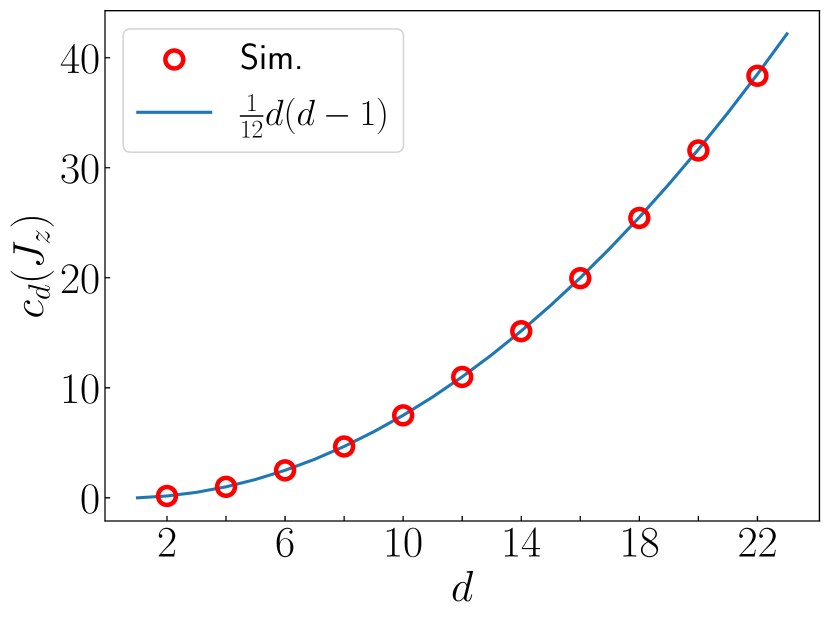
- 単一クイッドのAGIは$ \overline{\mathcal{F}}(\mathcal{E}_z) = \frac{d + d^2 - \frac{\gamma t}{12}d^2(d^2 - 1)}{d(d+1)} + o(\gamma t) $とスケーリングし、一次のノイズ項において$d^2$の二次的依存性を確認している。
- $n$キュービットの場合、AGIは$ \overline{\mathcal{F}}(\mathcal{E}_z) = \frac{2^n + 2^{2n} - \frac{\gamma t}{4}n2^{2n}}{2^n(2^n + 1)} + o(\gamma t) $とスケーリングし、ノイズ係数において$n$に対する線形依存性が示されている。
- 本研究は、ゲート時間がデcoherence時間に対して十分短い場合には、特定のクイッドプラットフォームが最新のキュービットプラットフォームと同等のゲート効率を達成できることを確認している。
この論文を読む
Nubintのビューアで原文を開き、読みながら気になる箇所をすぐに質問できます。
Nubintでこの論文を読むこのレビューはAIが論文の原文をもとに作成しました。引用する前に原文をご確認ください。