
[論文レビュー] Open Source Variational Quantum Eigensolver Extension of the Quantum Learning Machine (QLM) for Quantum Chemistry
この論文は、Atos Quantum Learning Machine (QLM) 用のオープンソース拡張であるOpenVQEを紹介する。OpenVQE は、量子化学における変分量子エイジェン値計算(VQE)アルゴリズムの効率的な開発とテストを可能にする。QLM に、適応的 UCC に基づくアーキテクチャ(ADAPT-VQE を含む)、フェルミオンの2次量子化、フェルミオン-スピン変換のツールを追加し、41量子ビットのノイズレスシミュレータを用いて最大24量子ビットの分子で化学的精度に到達した。
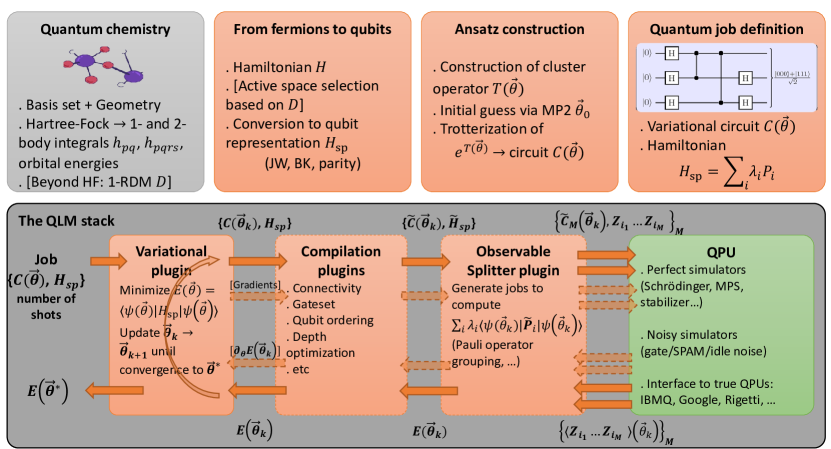
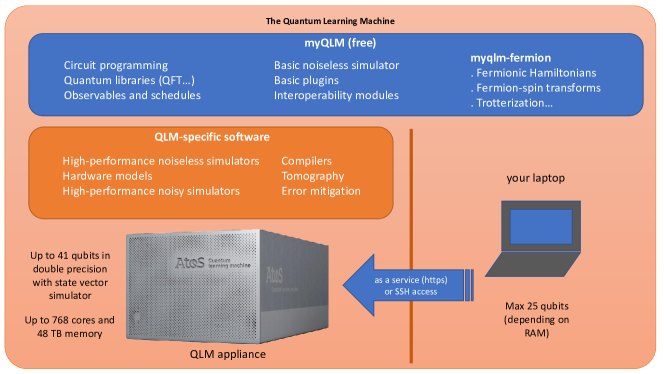
Quantum Chemistry (QC) is one of the most promising applications of Quantum Computing. However, present quantum processing units (QPUs) are still subject to large errors. Therefore, noisy intermediate-scale quantum (NISQ) hardware is limited in terms of qubits counts and circuit depths. Specific algorithms such as Variational Quantum Eigensolvers (VQEs) can potentially overcome such issues. We introduce here a novel open-source QC package, denoted Open-VQE, providing tools for using and developing chemically-inspired adaptive methods derived from Unitary Coupled Cluster (UCC). It facilitates the development and testing of VQE algorithms. It is able to use the Atos Quantum Learning Machine (QLM), a general quantum programming framework enabling to write, optimize and simulate quantum computing programs. Along with Open-VQE, we introduce myQLM-Fermion, a new open-source module (that includes the key QLM ressources that are important for QC developments (fermionic second quantization tools etc...). The Open-VQE package extends therefore QLM to QC providing: (i) the functions to generate the different types of excitations beyond the commonly used UCCSD ans{ä}tz;(ii) a new implementation of the "adaptive derivative assembled pseudo-Trotter method" (ADAPT-VQE), written in simple class structure python codes. Interoperability with other major quantum programming frameworks is ensured thanks to myQLM, which allows users to easily build their own code and execute it on existing QPUs. The combined Open-VQE/myQLM-Fermion quantum simulator facilitates the implementation, tests and developments of variational quantum algorithms towards choosing the best compromise to run QC computations on present quantum computers while offering the possibility to test large molecules. We provide extensive benchmarks for several molecules associated to qubit counts ranging from 4 up to 24.
研究の動機と目的
- 限られた量子ビット数と回路深さを有するノイズの影響を受ける中規模量子(NISQ)ハードウェア上で大規模分子系をシミュレートする課題に対処する。
- 変分量子アルゴリズムを活用して、フル配置相互作用(FCI)やカップルドクラスター法の指数的スケーリングを克服する。
- 量子化学におけるVQEアルゴリズムの実装、テスト、最適化を簡素化するオープンソースのソフトウェアスタックを開発する。
- myQLM-interop パッケージを通じて、主要な量子プログラミングフレームワークおよび実際の量子プロセッサとの相互運用性を実現する。
- ADAPT-VQE などの適応的アーキテクチャの実装と最適化されたゲートシーケンスによる回路深さの低減により、VQE分野の最先端技術を前進させる。
提案手法
- 量子化学シミュレーションのためのQLMフレームワークを拡張するPythonベースのオープンソースパッケージ「OpenVQE」を導入する。
- myQLM-fermionモジュールを介して、フェルミオンの2次量子化およびフェルミオンからキュービットへの写像(例:ジョルダン=ウィグナー、ブラヴィー=キタイエフ)をネイティブにサポートする。
- 最小限の回路深さで動的にアーキテクチャを構築するための、適応的導出疑似トロッター(ADAPT-VQE)法を実装する。
- UCCSD に加え、UCCGSD、スピン補完-GSD、k-UpCCGSD などのさまざまな励起タイプの生成を可能にし、相関の取り扱いを向上させる。
- 効率的なフェルミオンおよびキュービットの時間発展演算回路を用いて、CNOT ゲート数を最小限に抑えることで、量子回路を最適化する。
- myQLM-interop パッケージを通じて、IBM や Rigetti などの外部量子プロセッサ上で実行可能な相互運用性を確保する。
実験結果
リサーチクエスチョン
- RQ1ADAPT-VQE などの適応的VQE手法は、NISQデバイス上で分子系の基底状態エネルギー計算において化学的精度に到達できるか?
- RQ2VQEベースの分子系シミュレーションにおいて、精度を保持しつつ、量子回路ゲート数を最小限に抑える方法は何か?
- RQ3OpenVQEフレームワークは、標準的なUCCSDを越えた新規アーキテクチャの効率的な開発とテストをどの程度可能にするか?
- RQ4QLM と統合された myQLM-fermion は、どのようにして古典的ハードウェア上で最大41量子ビットの分子のスケーラブルなシミュレーションを可能にするか?
- RQ5現在のVQE実装における実用的限界は何か?また、最適化されたアーキテクチャとゲートシーケンスは収束性と精度をどのように向上させるか?
主な発見
- OpenVQE は ADAPT-VQE と複数のUCCベースのアーキテクチャを実装し、最大24量子ビットの分子で正確な基底状態エネルギー計算を可能にした。
- H2、LiH、BeH2 などの小分子において、参考文献値と整合的で化学的精度(1.6 mH以内)を達成した。
- QLM 内部のノイズレスシュレーディンガー形式シミュレータは最大41量子ビットをサポートし、現在のNISQ能力を超える大きな分子系の完全なシミュレーションを可能にした。
- 回路最適化によりCNOTゲート数が顕著に削減され、近い将来の量子ハードウェア実行の可能性が向上した。
- myQLM-interop を通じた相互運用性により、IBM や Rigetti などの外部量子プロセッサ上で OpenVQE ワークフローをシームレスにデプロイ可能となった。
- ベンチマークの結果、ADAPT-VQE は特に強い相関を持つ系において、固定長のUCCSD よりも収束速度と精度が優れていることが確認された。
より良い研究を、今すぐ始めましょう
論文の読解から最終レビューまで、研究時間を劇的に削減しましょう。
クレジットカード登録不要
このレビューはAIが作成し、人間の編集者が確認しました。