
[論文レビュー] Optimum dissipation by cruising in dense suspensions
本研究では、流れの逆転を伴わずに二つの直交するせん断方向を交互に切り替える「クルージング」と呼ばれる最適なせん断プロトコルを特定し、凝集した懸濁液におけるエネルギー散逸を最小化することを明らかにした。せん断方向の切り替えが鋭角ではなく鈍角に近い場合、エネルギー散逸をより効果的に低減でき、これは乱雑な組織化が効率性を決定づけるという考えを覆し、代わりにせん断脆さと幾何的配置が主要なメカニズムであることを示している。
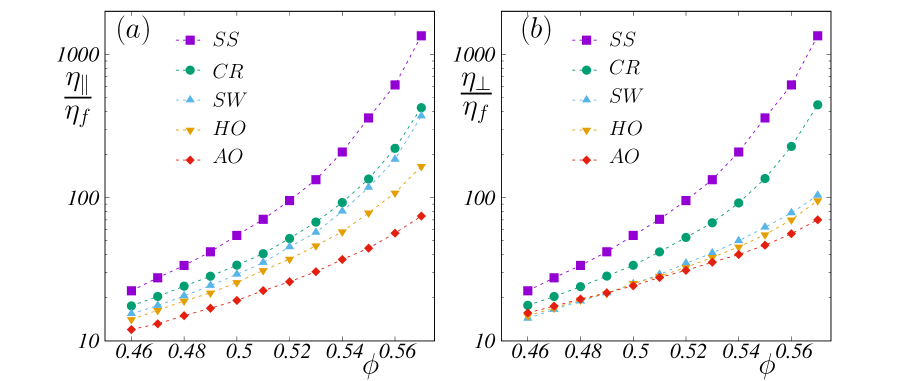
Dense suspensions tend to shear jam at large packing fractions. However, it has recently been shown that various oscillation protocols can unjam as well as reduce viscosity and dissipation. In this numerical work, we ask ourselves what is the optimum shear protocol in terms of dissipation. We show that many cruising protocols' dissipation are similar to shear protocols with a steady primary shear and superimposed cross oscillations, even though the latter's viscosity reduction is more considerable. Furthermore, we find that alternating between primary and perpendicular oscillations yields a much higher dissipation than the two protocols mentioned above, yet has similar viscosity as the cross-oscillatory one. While self-organization has been shown to minimize viscosity, our findings challenge the idea that random organization is the underlying mechanism for reducing dissipation. Instead, shear ``fragility'' combined with geometry seems to be the key ingredients, which explains the counter-intuitive decoupling of the minima of viscosity and dissipation for the cruising protocol. This work paves the way for a new class of highly-energy efficient flow protocols.
研究の動機と目的
- 凝集した懸濁液におけるジャミング転移付近でのエネルギー散逸を最小化する最適なせん断プロトコルを同定すること。
- エネルギー散逸の低減に振動運動が不可欠であるのか、それとも単なる方向転換だけで十分かを調査すること。
- せん断脆さと幾何的配置が、流れプロトコルにおけるエネルギー効率に与える影響を特定すること。
- 数値的にクルージング、振動型、方形波せん断プロトコルの散逸および粘度性能を比較すること。
- 非定常せん断プロトコルにおける粘度と散逸の最小値の分離(デカップリング)を説明する半理論的枠組みを提供すること。
提案手法
- 振動型(AO)、半振動型(HO)、方形波(SW)、クルージング(CR)プロトコルを含む、さまざまなせん断プロトコル下での凝集した懸濁液の数値シミュレーション。
- 時間平均せん断率および異なる方向における粘度成分を用いた、ひずみあたりの散逸に関する解析的表現の導出。
- 定常状態の散逸を基準として正規化した相対的散逸:$ W_{\rm CR}(\theta) = \frac{1}{2(1+\theta)} \big[ \frac{\rho'}{\rho_{\rm ss}} \frac{1}{1-\theta} + \frac{\rho''}{\rho_{\rm ss}} \frac{1}{\theta} \big] $、ここで $ \theta $ は時間割合、$ \rho' $、$ \rho'' $ は主方向および副方向の粘度。
- 正規化された散逸を用いたプロトコル比較において、角度 $ \theta $、時間割合 $ \theta $、および粘度の異方性の役割に注目。
- サイクル全体におけるネットひずみの進行とエネルギー散逸を説明するため、クルージングにおけるひずみベクトルの和の分析。
- 正弦波ひずみ率プロファイルから導出された、振動型散逸項の導入:$ W_{\rm OSC} = T \frac{16\theta_{\rm osc}^2 \rho_{\bot}}{\theta} $。

実験結果
リサーチクエスチョン
- RQ1凝集した懸濁液におけるジャミング点付近でエネルギー散逸を最小化する最適なせん断プロトコルは何か?
- RQ2振動運動が散逸低減に特異的寄与しているのか、それとも単なる方向転換だけで同様の効率が達成可能なのか?
- RQ3非定常せん断プロトコルにおいて、せん断方向のなす角度が散逸および粘度に与える影響は何か?
- RQ4クルージングプロトコルではなぜ粘度の最小値と散逸の最小値が一致しないのか。このデカップリングを説明する物理的メカニズムは何か?
- RQ5複雑な振動的ダイナミクスを必要としない状況でも、せん断脆さと幾何的配置が単独で観察された散逸低減を説明できるか?
主な発見
- 二つの直交するせん断方向を交互に切り替えるクルージングプロトコルは、二つの流れ方向のみを用いるにもかかわらず、最良の性能を示す振動型プロトコルと同等の散逸レベルを達成する。
- 主方向と垂直方向のせん断を交互に繰り返すと、振動型プロトコルに比べて散逸が顕著に高くなるが、粘度の低減効果は同程度に保たれる。これは、エネルギーコストと流れやすさの間のトレードオフを示している。
- 最適なクルージングは、ジャミング点付近で鈍角(90°以上)で発現し、せん断脆さと幾何的異方性が相乗的に作用して散逸を低減する。
- 本研究は、散逸低減が乱雑な組織化に起因するとの仮定を覆し、代わりにせん断脆さと方向転換が主なメカニズムであると特定した。
- 解析的モデルは、散逸が時間割合および粘度成分の逆数に依存することを示しており、最適なバランスは $ \theta \to 0.5 $ かつ $ \theta > 90^\text{o} $ で $ \rho_{\rm J} $ 付近に達成される。
- クルージングプロトコルの散逸は、$ W_{\rm CR}(\theta) = \frac{1}{2(1+\theta)} \big[ \frac{\rho'}{\rho_{\rm ss}} \frac{1}{1-\theta} + \frac{\rho''}{\rho_{\rm ss}} \frac{1}{\theta} \big] $ で定量的に記述され、エネルギー損失の角度的および時間的依存性を捉えている。
この論文を読む
Nubintのビューアで原文を開き、読みながら気になる箇所をすぐに質問できます。
Nubintでこの論文を読むこのレビューはAIが論文の原文をもとに作成しました。引用する前に原文をご確認ください。