
[論文レビュー] Path instabilities and drag in the settling of single spheres
本実験的研究では、静止流体中を沈降する単一球体の沈降ダイナミクスを、広範な粒子対流体密度比(Γ ∈ [1.1, 7.9])およびガリレオ数(Ga ∈ [100, 340])の範囲で調査した。低Γにおける垂直的周期的運動と高Γにおける平面的回転運動という、数値予測された領域が実験的に裏付けられた一方で、半らせん運動や平面的でない運動の共存を示す複雑な経路不安定性が明らかになった。主な貢献は、反応パラメータReₚではなく制御パラメータGaを直接用いた新しい抗力および終端速度の相関式の構築であり、有限の密度比効果が抗力に顕著に影響することを示し、標準的な相関式でΓ依存性を無視できるという一般的な仮定に疑問を呈した。
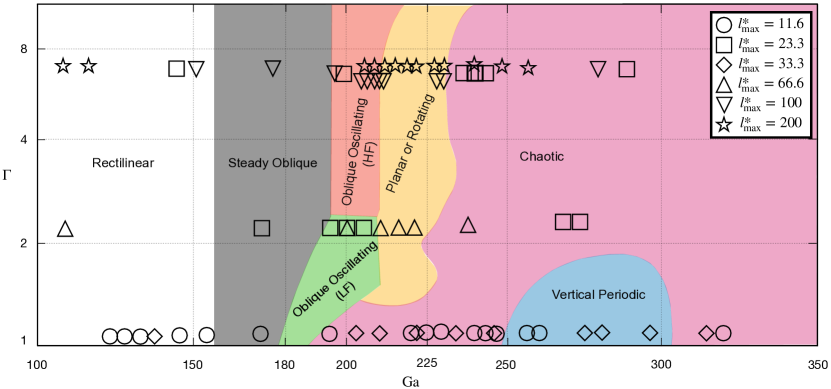
The settling behavior of individual spheres in a quiescent fluid was studied experimentally. The dynamics of the spheres was analyzed in the parameter space of particle-to-fluid density ratio ($Γ$) and Galileo number ($\mathrm{Ga}$), with $Γ\in (1.1, 7.9)$ and $\mathrm{Ga} \in (100, 340)$. The experimental results showed for the first time that the mean trajectory angle with the vertical exhibits a complex behavior as $\mathrm{Ga}$ and $Γ$ are varied. Numerically predicted regimes such as Vertical Periodic and Planar Rotating were validated at high $Γ$ values. In particular, for the denser spheres, a clear transition from planar to non-planar trajectories was observed, accompanied by the emergence of semi-helical trajectories corresponding to the Planar Rotating Regime. The spectra of trajectory oscillations were also quantified as a function of $\mathrm{Ga}$, confirming the existence of oblique oscillating regimes at both low and high frequencies. The amplitudes of the perpendicular velocities in these regimes were also quantified and compared with numerical simulations in the literature. The terminal velocity and drag of the spheres were found to depend on the particle-to-fluid density ratio, and correlations between the drag coefficient and particle Reynolds number ($Re_p$) as a function of Ga were established, allowing for the estimation of drag and settling velocity using $\mathrm{Ga}$, a control parameter, rather than the response parameter $Re_p$.
研究の動機と目的
- ΓとGaの広いパラメータ空間にわたる静止流体中を沈降する単一球体の経路不安定性および抗力特性を実験的に同定すること。
- 実験的に達成可能な条件下で、垂直的周期的運動や平面的回転運動といった数値予測された力学的領域が実験的に妥当であるかを検証すること。
- 低周波数および高周波数の斜め振動領域を含む、経路振動スペクトルを定量的に評価し、GaおよびΓに依存する関係を評価すること。
- 反応パラメータReₚではなく制御パラメータGaを直接用いた、終端レイノルズ数と抗力係数の新しい相関式を確立すること。
- 標準的な抗力相関式において密度比(Γ)の依存性を無視できるという仮定の妥当性を、特に有限密度比を有する粒子に対して評価すること。
提案手法
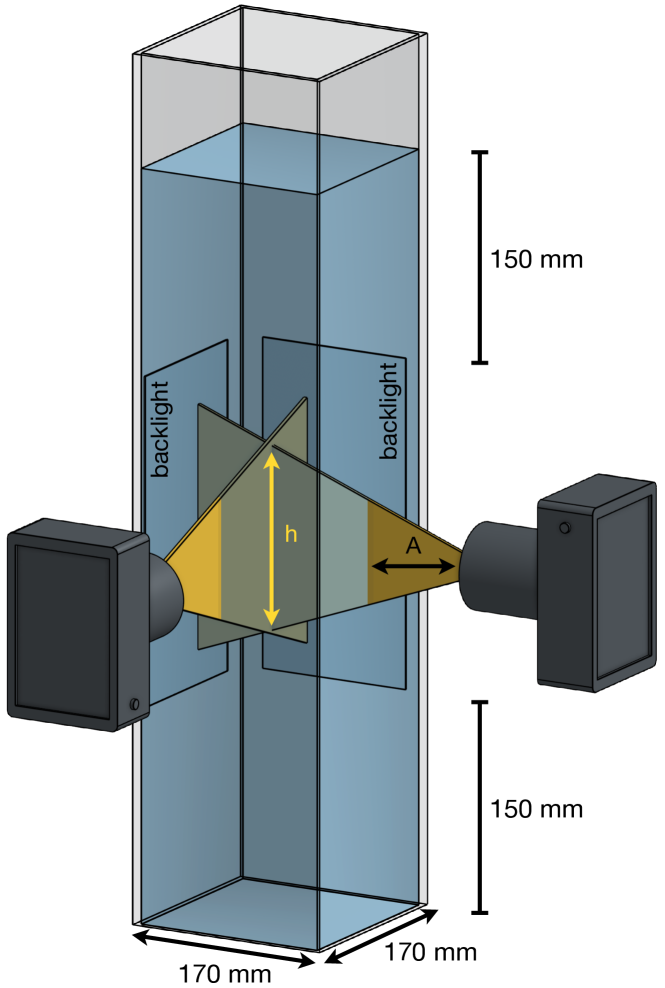
- 静止流体中で密度(Γ = 1.1~7.9)と直径(dₚ)が異なる球体を用いた制御された実験を実施し、沈降経路と終端速度を測定した。
- 粒子追跡ビジコメトリ(PTV)を用いて3次元経路を再構築し、横方向の振幅および周波数を抽出した。
- ガリレオ数をGa = U_g dₚ / ν(U_g = √(|Γ−1|gdₚ))として定義し、抗力相関式におけるReₚの代わりに主な制御パラメータとして用いた。
- 次元なしの横方向速度成分の振動周波数f*および振幅を定量化し、斜め振動領域およびらせん運動領域を特定した。
- 実験的抗力係数C_Dおよび終端レイノルズ数Reₚを、数値シミュレーションおよび古典的固定球体相関式と比較した。
- 高Γ領域における平面的(斜め振動)および非平面的(らせん)経路の共存を分析し、多重安定性を評価した。
実験結果
リサーチクエスチョン
- RQ1高Γ(Γ > 3.9)領域でこれまで実験的に未調査であった領域を含め、Γ–Gaパラメータ空間全域における沈降球体の経路ダイナミクスはどのように変化するか?
- RQ2実験的に観察された経路不安定性(斜め振動や半らせん運動など)は、垂直的周期的運動や平面的回転運動といった数値予測された領域とどの程度一致するか?
- RQ3従来のレイノルズ数の使用と比較して、ガリレオ数が終端速度および抗力の予測に制御パラメータとして果たす役割は何か?
- RQ4Reₚを通じた間接的寄与に加え、抗力係数が粒子対流体密度比Γに明示的に依存する程度はどの程度顕著か?
- RQ5多重安定領域(平面的およびらせん経路が共存する領域)は、どのGaおよびΓの範囲に出現し、その頻度はどの程度か?
主な発見
- 実験データは、低Γ(Γ = 1.1)における垂直的周期的運動領域と高Γ(Γ = 7.9)における平面的回転運動領域の存在を確認し、数値予測を裏付けた。
- Γ = 7.9の場合、Ga ≈ 200付近で次元なし周波数f* ≈ 0.18の高周波数斜め振動領域が観察され、これはこれまでの実験で報告されていなかった。
- 高周波数斜め振動領域と広範囲(約200–220)にわたりらせん経路が共存していることが観察され、シミュレーションで報告されたよりも広い多重安定領域を示した。
- 観察されたらせん経路の半径は約7個分の粒子径、ピッチは数100個分の粒子径程度であり、過去の実験的および数値的報告と整合的であった。
- 軽量粒子(Γ = 1.1)の抗力係数が重い粒子(Γ = 7.9)と比較して最大30%高いという系統的傾向が観察され、Γに顕著で無視できない依存性があることが示された。
- 終端レイノルズ数および抗力係数を制御パラメータGaに直接関連付ける新しい経験的相関式が確立され、沈降速度および抗力の予測に、Reₚに基づく相関式よりも実用的かつ物理的に根拠のある代替手段を提供した。
この論文を読む
Nubintのビューアで原文を開き、読みながら気になる箇所をすぐに質問できます。
Nubintでこの論文を読むこのレビューはAIが論文の原文をもとに作成しました。引用する前に原文をご確認ください。