
[論文レビュー] Problematic Advertising and its Disparate Exposure on Facebook
本研究は、132名の被験者を対象に3か月にわたる縦断的パネル調査を実施し、フェイスブック広告の問題行動を分析した。問題広告の4つの主要なカテゴリー(誤解を招く広告、フェイスブックが禁止する広告、クリックベイト広告、感受性の高いトピック)を同定し、高齢者や人種的マイノリティが不均衡に高い露出を受ける傾向があることを明らかにした。問題広告の露出の22%がプラットフォームレベルのパーソナライゼーションアルゴリズムに起因しており、広告配信におけるアルゴリズム的バイアスが示唆された。
Targeted advertising remains an important part of the free web browsing experience, where advertisers' targeting and personalization algorithms together find the most relevant audience for millions of ads every day. However, given the wide use of advertising, this also enables using ads as a vehicle for problematic content, such as scams or clickbait. Recent work that explores people's sentiments toward online ads, and the impacts of these ads on people's online experiences, has found evidence that online ads can indeed be problematic. Further, there is the potential for personalization to aid the delivery of such ads, even when the advertiser targets with low specificity. In this paper, we study Facebook -- one of the internet's largest ad platforms -- and investigate key gaps in our understanding of problematic online advertising: (a) What categories of ads do people find problematic? (b) Are there disparities in the distribution of problematic ads to viewers? and if so, (c) Who is responsible -- advertisers or advertising platforms? To answer these questions, we empirically measure a diverse sample of user experiences with Facebook ads via a 3-month longitudinal panel. We categorize over 32,000 ads collected from this panel ($n=132$); and survey participants' sentiments toward their own ads to identify four categories of problematic ads. Statistically modeling the distribution of problematic ads across demographics, we find that older people and minority groups are especially likely to be shown such ads. Further, given that 22% of problematic ads had no specific targeting from advertisers, we infer that ad delivery algorithms (advertising platforms themselves) played a significant role in the biased distribution of these ads.
研究の動機と目的
- ユーザーが問題視すると感じるフェイスブック広告の具体的なカテゴリーを特定すること。
- フェイスブックにおける問題広告の露出に、人種的・文化的背景に差が生じているかどうかを検討すること。
- 広告主か広告プラットフォーム(パーソナライゼーションアルゴリズムを介して)が、広告露出の不均衡の主な要因であるかを特定すること。
提案手法
- 3か月間にわたり、フェイスブック広告体験を縦断的に追跡するため、多様な背景を持つ132名の報酬付き参加者を従事した。
- 参加者のデスクトップブラウザを操作し、フェイスブックが提供する詳細なターゲティング情報を抽出するログを取得した。
- 計算的手法、社会科学研究、プラットフォームポリシーに基づいて、クリックベイト、感受性の高いトピック、機会広告を含む8つのタイプをカバーする広告カテゴリーのコードブックを開発した。
- 人間のレーティング担当者が、コードブックを用いて収集された3万2000件以上の広告を定義されたカテゴリーに分類した。
- 定期的なアンケート調査を実施し、参加者が受信した広告に対する感情的反応を評価し、どのカテゴリーが問題視されているかを同定した。
- 統計的モデリングを用いて、問題広告露出における人種的・文化的背景による差を分析し、広告主のターゲティングとプラットフォームのパーソナライゼーションアルゴリズムの役割を解明した。
実験結果
リサーチクエスチョン
- RQ1ユーザーがフェイスブックで問題視すると感じる広告のカテゴリーは何か?
- RQ2ユーザー間で問題広告の配布に人種的・文化的背景による差が生じているか?
- RQ3広告主と広告プラットフォームのパーソナライゼーションアルゴリズムのどちらが、問題広告露出の不均衡の主な要因であるか?
主な発見
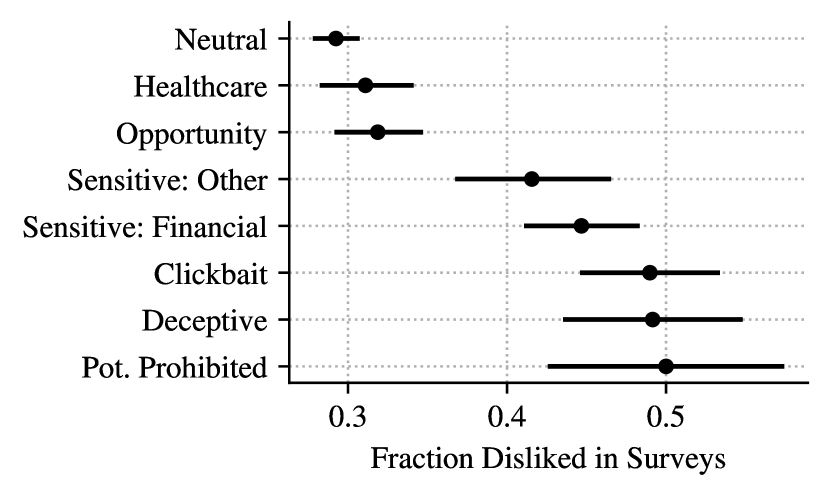
- 参加者が最も頻繁に問題視したのは、誤解を招く広告、フェイスブックが禁止するコンテンツ、クリックベイト広告、および感受性の高いトピック(例:金融、ギャンブル、ダイエット)の広告であった。
- 高齢者ほど、若年層に比べて誤解を招く広告やクリックベイト広告の露出確率が顕著に高かった。
- ブラック・アドバイザーは、クリックベイト広告の露出が顕著に高く、露出に人種的差が生じていることを示している。
- 男性は、規制や政策的制限があるため感受性の高いとされる金融広告に、それらの潜在的な害と利益の両方を伴うにもかかわらず、より多く露出していた。
- 問題広告の22%は広告主による特定のターゲティングがなく、プラットフォームレベルのパーソナライゼーションアルゴリズムがその偏りの主要因であることを示している。
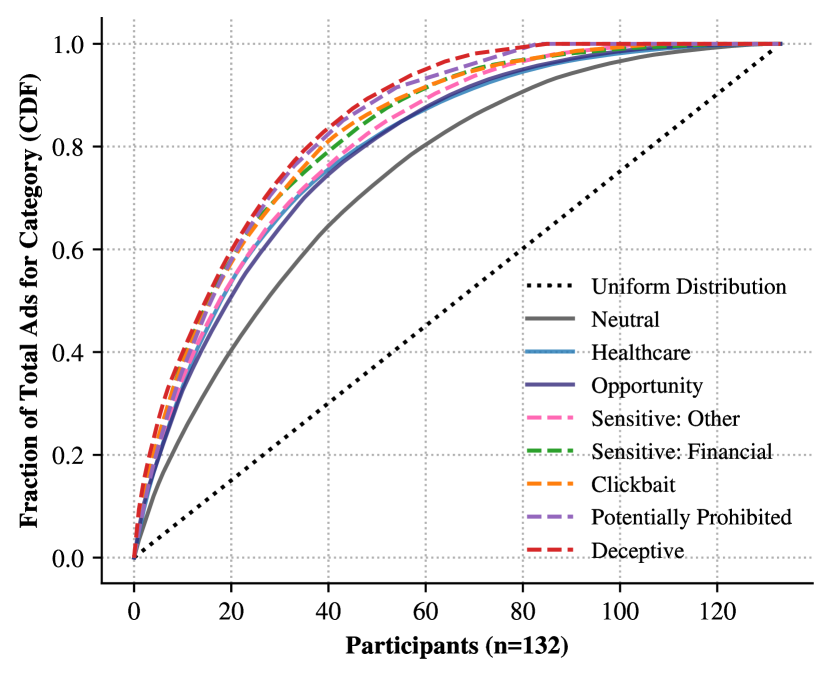
- 問題広告の配布は偏っており、一部のユーザーが中位の露出量の3倍以上を受けていた。
より良い研究を、今すぐ始めましょう
論文の読解から最終レビューまで、研究時間を劇的に削減しましょう。
クレジットカード登録不要
このレビューはAIが作成し、人間の編集者が確認しました。