
[論文レビュー] Quafu-RL: The Cloud Quantum Computers based Quantum Reinforcement Learning
本稿では、ハードウェア効率的なパラメータ化量子回路(PQC)を用いて、クラウドベースのNISQデバイス上で量子強化学習(QRL)を実行するためのフレームワークであるQuafu-RLを提示する。多目的の進化的アルゴリズムを用いてPQCを設計し、Quafuの量子ハードウェアに特化した適応学習アルゴリズムを採用することで、10、18、136量子ビットのデバイス上でRLエージェントを成功裏に訓練した。100回未満の訓練エピソードで、緩い目的関数のもとで安定した性能を達成した。
With the rapid advent of quantum computing, hybrid quantum-classical machine learning has shown promising computational advantages in many key fields. Quantum reinforcement learning, as one of the most challenging tasks, has recently demonstrated its ability to solve standard benchmark environments with formally provable theoretical advantages over classical counterparts. However, despite the progress of quantum processors and the emergence of quantum computing clouds in the noisy intermediate-scale quantum (NISQ) era, algorithms based on parameterized quantum circuits (PQCs) are rarely conducted on NISQ devices. In this work, we take the first step towards executing benchmark quantum reinforcement problems on various real devices equipped with at most 136 qubits on BAQIS Quafu quantum computing cloud. The experimental results demonstrate that the Reinforcement Learning (RL) agents are capable of achieving goals that are slightly relaxed both during the training and inference stages. Moreover, we meticulously design hardware-efficient PQC architectures in the quantum model using a multi-objective evolutionary algorithm and develop a learning algorithm that is adaptable to Quafu. We hope that the Quafu-RL be a guiding example to show how to realize machine learning task by taking advantage of quantum computers on the quantum cloud platform.
研究の動機と目的
- クラウドベースの量子コンピューティングプラットフォームを用いて、実際のノイズの多い中規模量子(NISQ)デバイス上で量子強化学習エージェントを訓練する可能性を示すこと。
- NISQデバイスにおける量子ビット数の制限、デ coherent 時間の短さ、ゲートの不正確性といった課題に対処するため、ハードウェア効率的なPQCアーキテクチャを設計すること。
- Quafuの量子ハードウェアに適応した学習アルゴリズムを開発し、実デバイス上でのトレーニング可能性とパフォーマンスを向上させること。
- 標準ベンチマーク環境(CartPole)上でアプローチを検証し、現実的なノイズとリソース制約下でのパフォーマンスを評価すること。
- PQCベースのQRLやその他の量子機械学習タスクをクラウド量子プラットフォームにデプロイする再現可能なパイプラインを提供すること。
提案手法
- トレーニング可能性を高めるために表現力と低エンタングルメントの両立を図るハードウェア効率的なPQCアーキテクチャを探索するため、多目的の進化的アルゴリズムを採用した。
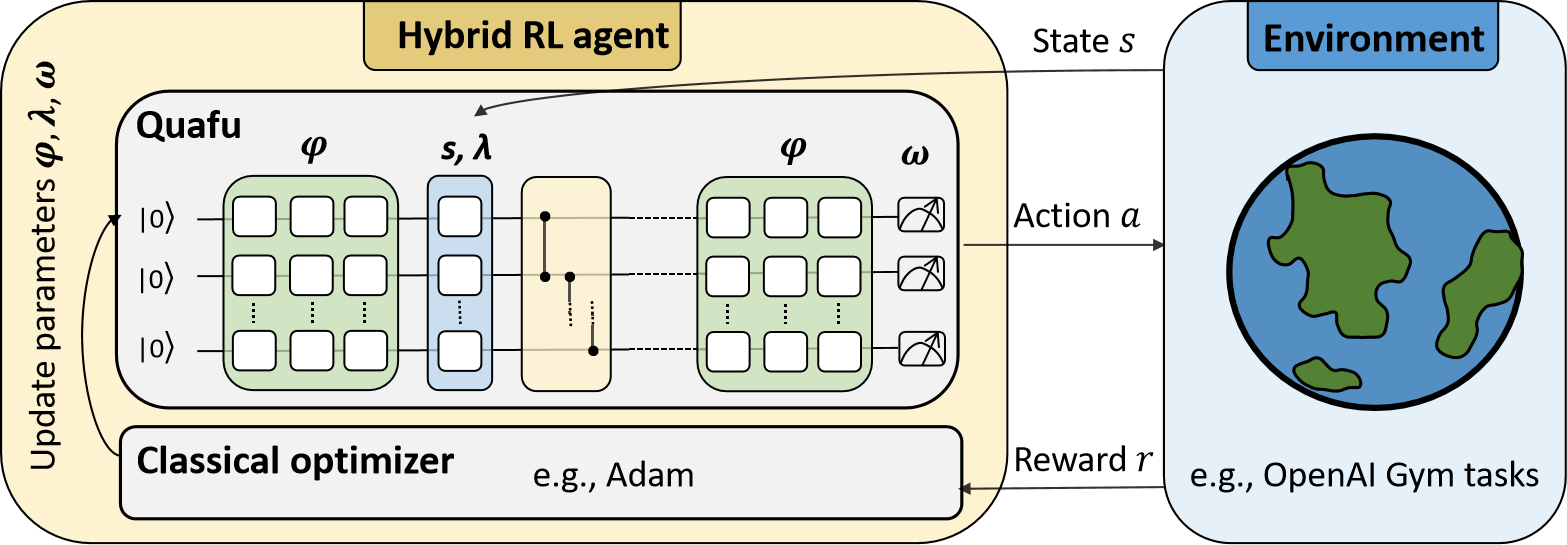
- Quafuの量子コンピューティングスタックに適応した、カスタムREINFORCEベースの学習アルゴリズムを設計し、古典的最適化と量子ポリシー評価を統合した。
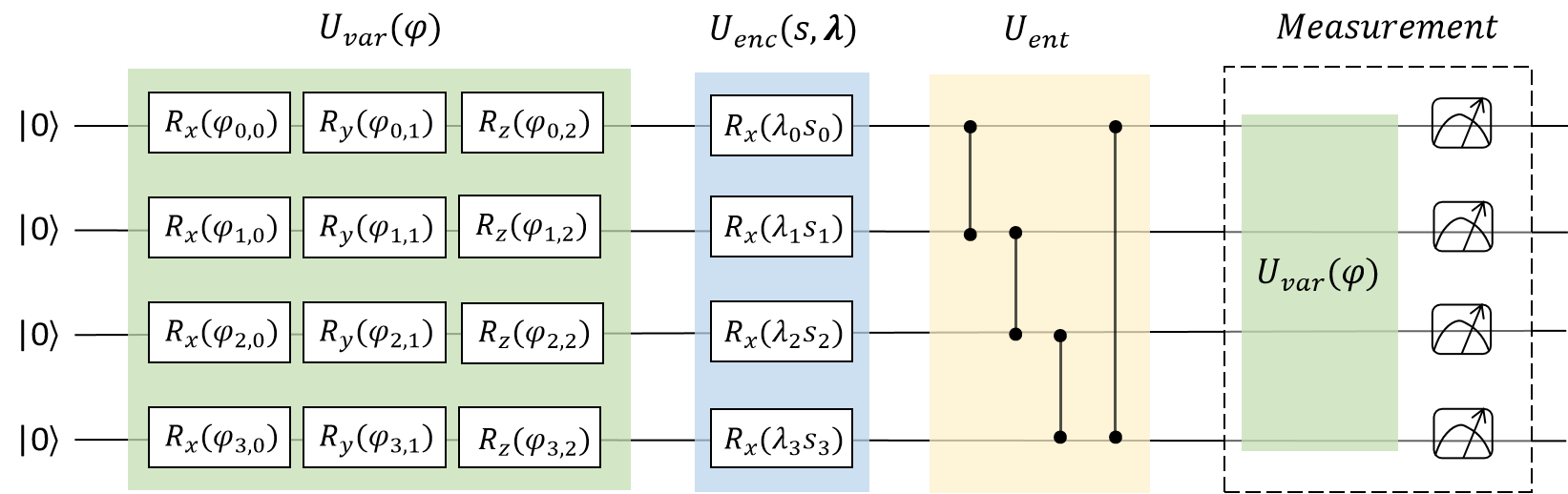
- 選択されたPQCアーキテクチャを量子ポリシー・ネットワークに統合し、状態を行動確率にマップするパラメータ化された量子回路を実装した。
- 訓練および推論を、Quafuのクラウドベースの量子プロセッサ(ScQ-P10:10量子ビット、ScQ-P18:18量子ビット、ScQ-P136:136量子ビット)上で実行した。
- 訓練中の最適化ループと量子回路評価のため、TensorFlow Quantumを用いて古典的シミュレーションを実施した。
- 割引率γ = 1.0を適用し、ポリシー勾配更新における期待リターンの計算に観測量$[Z_0Z_1Z_2Z_3]$を用いた。
実験結果
リサーチクエスチョン
- RQ1限られた量子ビット数と高いノイズレベルを示す実際のNISQデバイス上で、量子強化学習エージェントを成功裏に訓練できるか?
- RQ2ハードウェア効率的なPQCアーキテクチャは、実際の量子ハードウェア上でのQRLエージェントのパフォーマンスと安定性にどのように影響を与えるか?
- RQ3カスタムでデバイスに適応した学習アルゴリズムは、ノイズの多い量子プロセッサ上でトレーニング収束と報酬獲得をどの程度向上できるか?
- RQ4緩い目的関数のもとで、実際の量子デバイス上で訓練されたQRLエージェントは、CartPoleのような標準ベンチマーク環境で意味のあるパフォーマンスを達成できるか?
- RQ5現在のNISQデバイスは、スケーラブルな量子機械学習ワークロードをサポートする上で、どのような実用的限界を有するか?
主な発見
- 10量子ビットのScQ-P10デバイス上で訓練されたRLエージェントは、100回の訓練エピソード以内に最大エピソード報酬132を達成し、平均報酬は約30で安定した。
- 18量子ビットのScQ-P18デバイス上では、エージェントは最大報酬86に達し、100エピソードにわたり平均報酬約30を維持した。
- 136量子ビットのScQ-P136デバイスでは、最高のパフォーマンスが達成され、最大報酬94、平均報酬約30の安定した値を示した。
- 事前に訓練されたScQ-P10モデルの推論では、100エピソードにわたり平均報酬約50を達成し、ノイズの多い訓練にもかかわらず成功裏に一般化が確認された。
- トレーニングプロセスは収束の兆候を示しており、10量子ビットデバイスでは80エピソード以降、移動平均が50以上の安定した値に達したが、元のCartPoleの目標(200)は完全には達成されなかった。
- 緩い目的関数と最適化されたPQC設計を組み合わせることで、実用的な実行時間制限内にQRLエージェントを実際のNISQデバイス上で成功裏に訓練および評価できることが示された。
この論文を読む
Nubintのビューアで原文を開き、読みながら気になる箇所をすぐに質問できます。
Nubintでこの論文を読むこのレビューはAIが論文の原文をもとに作成しました。引用する前に原文をご確認ください。