
[論文レビュー] QuantumNAS: Noise-Adaptive Search for Robust Quantum Circuits
QuantumNAS は、トレーニングと探索を分離する SuperCircuit を用いて、変動量子回路とキュービットマッピングのノイズ適応的共同探索フレームワークを提案する。これにより、効率的でノイズに配慮した最適化が可能となり、実機量子ハードウェア上で最先端の性能を達成した。量子機械学習では 2 クラス分類で 95% を超える、4 クラス分類で 85%、10 クラス分類で 32% の分類精度を示し、複数の分子において VQE の最低エネルギー状態を達成した。
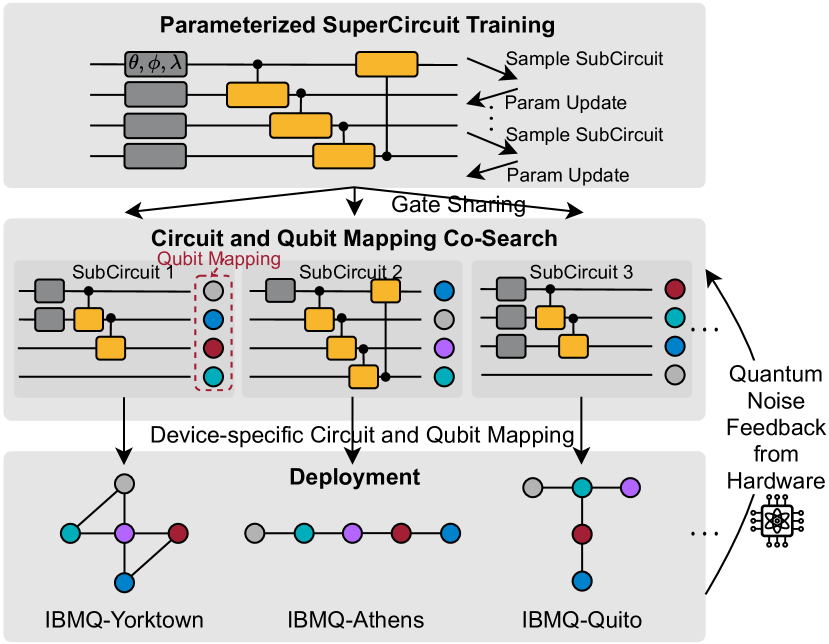
Quantum noise is the key challenge in Noisy Intermediate-Scale Quantum (NISQ) computers. Previous work for mitigating noise has primarily focused on gate-level or pulse-level noise-adaptive compilation. However, limited research efforts have explored a higher level of optimization by making the quantum circuits themselves resilient to noise. We propose QuantumNAS, a comprehensive framework for noise-adaptive co-search of the variational circuit and qubit mapping. Variational quantum circuits are a promising approach for constructing QML and quantum simulation. However, finding the best variational circuit and its optimal parameters is challenging due to the large design space and parameter training cost. We propose to decouple the circuit search and parameter training by introducing a novel SuperCircuit. The SuperCircuit is constructed with multiple layers of pre-defined parameterized gates and trained by iteratively sampling and updating the parameter subsets (SubCircuits) of it. It provides an accurate estimation of SubCircuits performance trained from scratch. Then we perform an evolutionary co-search of SubCircuit and its qubit mapping. The SubCircuit performance is estimated with parameters inherited from SuperCircuit and simulated with real device noise models. Finally, we perform iterative gate pruning and finetuning to remove redundant gates. Extensively evaluated with 12 QML and VQE benchmarks on 14 quantum computers, QuantumNAS significantly outperforms baselines. For QML, QuantumNAS is the first to demonstrate over 95% 2-class, 85% 4-class, and 32% 10-class classification accuracy on real QC. It also achieves the lowest eigenvalue for VQE tasks on H2, H2O, LiH, CH4, BeH2 compared with UCCSD. We also open-source TorchQuantum (https://github.com/mit-han-lab/torchquantum) for fast training of parameterized quantum circuits to facilitate future research.
研究の動機と目的
- ノイズの影響を受ける Noisy Intermediate-Scale Quantum (NISQ) デバイスにおける量子ノイズの課題に対処し、回路構造とキュービットマッピングを共同最適化して耐性を高める。
- 大規模な設計空間における回路探索とパラメータトレーニングの反復的プロセスによるスケーラビリティのボトルネックを解消するため、探索と完全な再トレーニングを分離する。
- 実デバイスのノイズに耐性を持つ回路を同定することで、量子機械学習および変動量子エイゲンソルバー (VQE) タスクのパフォーマンスを向上させる。
- ノイズに配慮しない探索、ランダム探索、人為的に設計された基準と比較して、実量子ハードウェア上で顕著に優れた性能を示すことを実証する。
- TorchQuantum ライブラリを含むオープンソースツールキットを提供することで、耐性を持つ量子回路の実用的導入を可能にする。
提案手法
- 複数のパラメータ化されたゲート層(例:U3、CU3)を含む SuperCircuit を導入し、多数の潜在的 SubCircuit を統合する。
- SubCircuit のサブセットを繰り返しサンプリングおよび更新することで SuperCircuit をトレーニングし、完全な再トレーニングなしに正確なパフォーマンス推定を可能にする。
- 実デバイスのノイズモデルを用いて、回路構造とキュービットマッピングの進化的共同探索を実施し、耐性のある構成へと探索を誘導する。
- SuperCircuit で最適化されたパラメータを継承することで、探索中の SubCircuit 評価を高速化し、トレーニングコストを削減する。
- 繰り返しのゲートプリーニングとファインチューニングを適用し、余分なゲートを削除することで、さらに効率性と耐性を向上させる。
- 実際の IBMQ 量子デバイスを評価に用い、実ハードウェアの誤差特性を反映したノイズモデルを活用する。
実験結果
リサーチクエスチョン
- RQ1ノイズ適応的共同探索フレームワークが、ノイズに配慮しない、または人為的に設計された手法と比較して、実 NISQ デバイス上でのパフォーマンスを顕著に向上させられるか?
- RQ2SuperCircuit を用いたアプローチが、完全な再トレーニングなしに SubCircuit のパフォーマンスをどれほど正確に推定できるか? これにより大規模な探索が可能になるか?
- RQ3探索プロセス中に実デバイスのノイズモデルを統合することで、最終的な量子回路の耐性と精度にどのような影響を与えるか?
- RQ4提案手法が、実ハードウェア上で量子機械学習タスク(例:MNIST)における高い分類精度と、VQE ベンチマークにおける低い基底状態エネルギーを達成できるか?
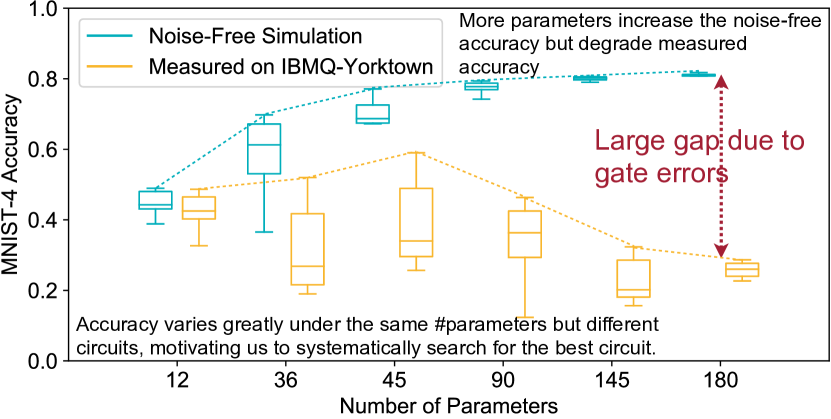
- RQ5回路構造とキュービットマッピングがノイズ下でのパフォーマンスばらつきに与える影響は何か? また、本手法はそのばらつきを体系的に低減できるか?
主な発見
- QuantumNAS は、実量子コンピュータ上で量子機械学習タスクにおいて、2 クラス分類で 95% を超え、4 クラス分類で 85%、10 クラス分類で 32% の分類精度を達成した。これは、同種のベンチマークで初めての成果である。
- 変動量子エイゲンソルバー (VQE) タスクにおいて、H₂、H₂O、LiH、CH₄、BeH₂ に対して、UCCSD ベースラインと比較して最低の基底状態エネルギーを達成した。
- 14 台の実量子デバイスで実施された 12 個の量子機械学習および VQE ベンチマークにおいて、ノイズに配慮しない探索、ランダム探索、人為的に設計された回路と比較して、顕著に優れた性能を示した。
- SuperCircuit は、トレーニングコストを大幅に削減することで、SubCircuit のパフォーマンス推定を高精度に可能にし、大規模な探索を現実可能とした。
- 繰り返しのゲートプリーニングとファインチューニングにより、冗長性が低減され、最終回路の耐性と効率性がさらに向上した。
- オープンソースの TorchQuantum ライブラリは、今後の研究を促進する。PyTorch および Qiskit をサポートし、MIT ライセンスで提供されている。
より良い研究を、今すぐ始めましょう
論文の読解から最終レビューまで、研究時間を劇的に削減しましょう。
クレジットカード登録不要
このレビューはAIが作成し、人間の編集者が確認しました。