
[論文レビュー] Security of discrete-modulated continuous-variable quantum key distribution
本稿では、4つのコherent状態とヘテロダイン検出を用いた離散変調連続変数量子鍵配送(CVQKD)プロトコルについて、有限サイズのセキュリティ証明を提示する。エントロピー蓄積定理を用いて、コherent攻撃に対するセキュリティを確立する。100 kmの伝送距離において、漸近的鍵レートは0.1〜10⁻⁴ビット/ラウンドを達成し、実際のパラメータ下で10¹²ラウンドの後、数十kmの距離で約10 Gbitsの秘密鍵が生成される。
Continuous variable quantum key distribution with discrete modulation has the potential to provide information-theoretic security using widely available optical elements and existing telecom infrastructure. While their implementation is significantly simpler than that for protocols based on Gaussian modulation, proving their finite-size security against coherent attacks poses a challenge. In this work we prove finite-size security against coherent attacks for a discrete-modulated quantum key distribution protocol involving four coherent states and heterodyne detection. To do so, and contrary to most of the existing schemes, we first discretize all the continuous variables generated during the protocol. This allows us to use the entropy accumulation theorem, a tool that has previously been used in the setting of discrete variables, to construct the finite-size security proof. We then compute the corresponding finite-key rates through semi-definite programming and under a photon-number cutoff. Our analysis provides asymptotic rates in the range of $0.1-10^{-4}$ bits per round for distances up to hundred kilometres, while in the finite case and for realistic parameters, we get of the order of $10$ Gbits of secret key after $n\sim10^{11}$ rounds and distances of few tens of kilometres.
研究の動機と目的
- ガウス分布の極端性が適用されない状況下で、離散変調CVQKDプロトコルに対する有限サイズのセキュリティを確立すること。
- 離散変調では有効でないガウス状態最適性に依存しないセキュリティの証明に挑むこと。
- 4つのコherent状態のみを用いたプロトコルのセキュリティ証明により、標準的な通信用部品を用いたCVQKDの実用的実装を可能にすること。
- 有限リソース条件下での長距離量子鍵配送における現実的な鍵レートを導出すること。
提案手法
- 著者らは、エントロピー蓄積定理(EAT)を適用し、漸近的セキュリティ境界を有限サイズのセキュリティ証明に昇格させる。
- 離散変調を4つのコherent状態でモデル化し、ヘテロダイン検出を用いることで、連続変数の仮定に依存しない完全な離散化を実現する。
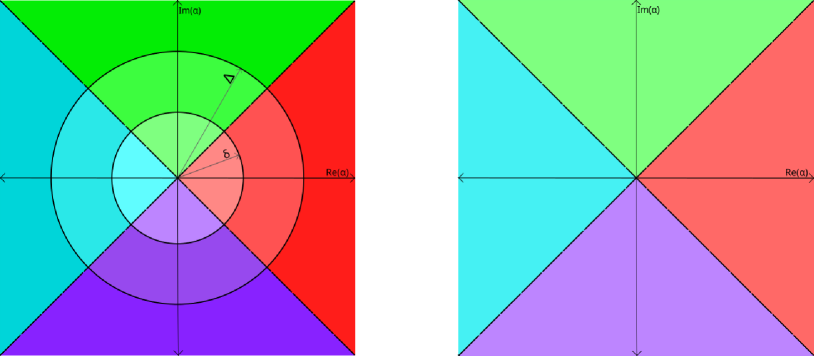
- 実験的制約をモデル化するため、光子数のカットオフを導入し、この仮定下で漸近的鍵レートの上限を求める。
- 純化距離と最大エントロピーの境界を用いて、実際の状態と理想状態の乖離を制御し、ε-ボール内でのセキュリティを保証する。
- ホーフィングの不等式を用いて、高光子数の結果が生じる確率を制御し、エントロピー推定の誤差を制御可能にする。
- プロトコルの結果が特定の結果の部分集合に制限される場合に対応するため、条件付き最大エントロピーの境界を導出する。これにより、統計的ゆらぎに対してもロバスト性が保証される。
実験結果
リサーチクエスチョン
- RQ1ガウス状態最適性に依存しないで、離散変調CVQKDプロトコルに対する有限サイズセキュリティを厳密に証明できるか?
- RQ2実際の光子数制限下で、4状態離散変調CVQKDプロトコルの達成可能な漸近的鍵レートは何か?
- RQ3有限サイズの状況下で、鍵レートはラウンド数にどのように依存するか?また、実用的パラメータ下で得られる総秘密鍵長は何か?
- RQ4ガウス構造が欠落する状況下でも、エントロピー蓄積定理を連続変数プロトコルに効果的に適用できるか?
- RQ5光子数カットオフや有限統計といった実験的不完全性が、最終的な鍵レートとセキュリティに与える影響は何か?
主な発見
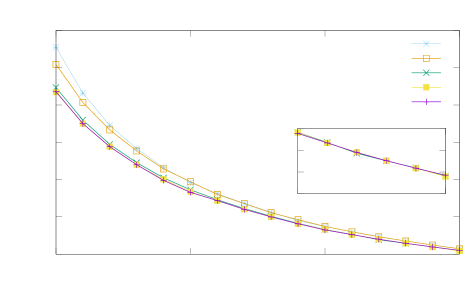
- 100 kmの伝送距離において、離散変調CVQKDプロトコルの漸近的鍵レートは0.1〜10⁻⁴ビット/ラウンドの範囲に収まる。
- n = 10¹²ラウンドの実際のパラメータ下で、数十kmの距離で約10 Gbitsの秘密鍵が生成される。
- セキュリティ証明はコherent攻撃に対して有効であり、デ・フィネッティやポストセレクション技術に依存せずに、有限サイズ効果をエントロピー蓄積定理で処理する。
- 現実的な光子数カットオフ下で鍵レートが上限付きで評価され、分析が実験的制約を反映している。
- 純化距離の制御によりセキュリティを達成し、ホーフィングの不等式を用いて誤差境界を導出する。
- 条件付き最大エントロピーの境界はnの平方根に比例してスケーリングされ、統計的ゆらぎ下でもきめ細かい有限サイズ推定が可能になる。
この論文を読む
Nubintのビューアで原文を開き、読みながら気になる箇所をすぐに質問できます。
Nubintでこの論文を読むこのレビューはAIが論文の原文をもとに作成しました。引用する前に原文をご確認ください。