
[Paper Review] Analysis and controller-design of time-delay systems using TDS-CONTROL. A tutorial and manual
This paper presents TDS-CONTROL, a MATLAB package for analyzing and designing controllers for linear time-invariant time-delay systems with multiple discrete delays, supporting retarded, neutral, and descriptor forms. It enables stability analysis via spectral abscissa, H-infinity norm, and pseudospectral abscissa computation, and offers non-smooth, non-convex optimization-based controller design minimizing spectral abscissa or H-infinity norm, with support for structured controllers like PID and decentralized designs.
TDS-CONTROL is an integrated MATLAB package for the analysis and controller-design of linear time-invariant (LTI) dynamical systems with (multiple) discrete delays, supporting both systems of retarded and neutral type. TDS-CONTROL is based on a state-space representations for these TDSs, although functionality is provided to obtain such a formulation from a frequency-domain description of the system. Firstly, the package offers various functionality for analyzing such systems, like methods for computing the spectral abscissa, the H-infinity norm, the pseudospectral abscissa, and the distance to instability. Furthermore, as TDS-CONTROL is designed with neutral time-delay systems in mind, it has the appealing feature that the sensitivity of certain quantities (such as the spectral abscissa) with respect to infinitesimal delay perturbations can explicitly be taken into account. Secondly, TDS-CONTROL also allows to design fixed-order dynamic output feedback controllers. The corresponding controller-design algorithms are based on minimizing the spectral abscissa, the H-infinity norm, or a combination of both with respect to the free controller parameters by solving a non-smooth, non-convex optimization problem. As a strictly negative spectral abscissa is a necessary and sufficient condition for stability, the presented design methods are thus not conservative. It is also possible to impose structure on the controller, enabling the design of decentralized and proportional-integral-derivative (PID) controllers. Furthermore, by allowing the plant to be described in delay descriptor form (i.e., the system's dynamics are given in terms of delay differential algebraic equations), acceleration feedback and Pyragas-type and delay-based controllers can also be considered.
Motivation & Objective
- To provide a comprehensive, integrated MATLAB toolbox for the analysis and controller design of linear time-invariant time-delay systems with multiple discrete delays.
- To support both retarded and neutral type systems, including delay differential algebraic equations (DDAEs), enabling broader application in control engineering.
- To enable robustness analysis through computation of the distance to instability and pseudospectral abscissa under structured uncertainties.
- To offer fixed-order dynamic output feedback controller design via non-smooth optimization of spectral abscissa and H-infinity norm.
- To facilitate the design of structured controllers such as PID, proportional-integral-retarded (PIR), and decentralized controllers within a unified framework.
Proposed method
- The package uses a spectrum-based approach to compute characteristic roots of quasi-polynomials, enabling stability analysis via the spectral abscissa and pseudospectral abscissa.
- It computes the H-infinity norm of time-delay systems using numerical integration and eigenvalue analysis of associated operators.
- Controller design is performed via non-smooth, non-convex optimization of the spectral abscissa or H-infinity norm with respect to controller parameters.
- The package supports descriptor form modeling, allowing inclusion of acceleration feedback and Pyragas-type controllers via delay descriptor systems.
- Uncertainty modeling is implemented using structured perturbations (real/complex, spectral/Frobenius norm) via tds_uncertain_matrix and tds_uncertain_delay functions.
- The distance to instability is computed using the epsilon-pseudospectral abscissa via tds_dins, providing a robustness measure under parametric uncertainty.
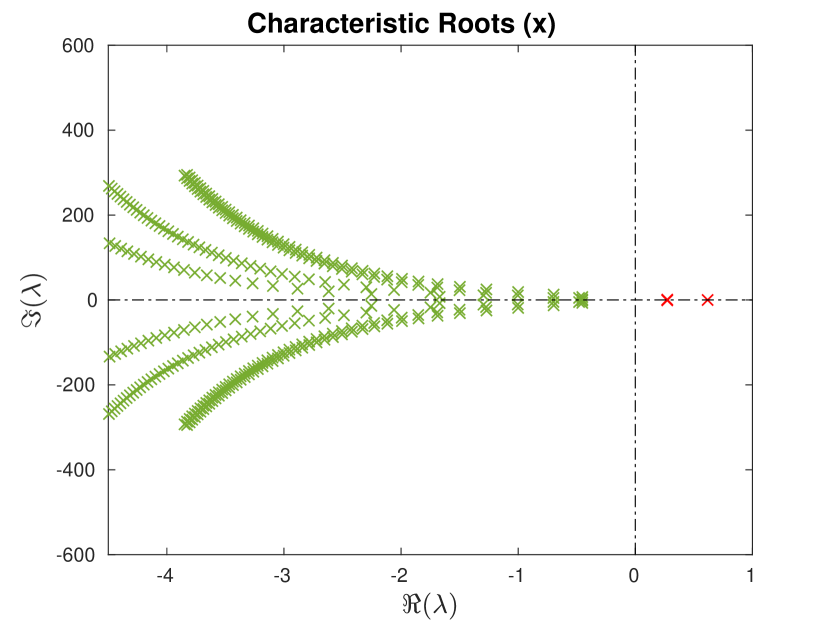
![Figure 2.1 : The characteristic roots of ( 2.8 ) in the region $[-1.5,1]\times\jmath[-40,40]$ .](https://ar5iv.labs.arxiv.org/html/2305.00341/assets/x1.png)
Experimental results
Research questions
- RQ1How can the stability of linear time-delay systems with multiple discrete delays be analyzed efficiently and accurately?
- RQ2What is the impact of infinitesimal delay perturbations on the spectral abscissa in neutral time-delay systems, and how can this be captured in analysis?
- RQ3How can fixed-order dynamic output feedback controllers be designed to minimize the spectral abscissa or H-infinity norm in time-delay systems?
- RQ4What is the robustness margin (distance to instability) of a time-delay system under structured parametric uncertainties?
- RQ5How can structured controllers such as PID or decentralized controllers be designed for time-delay systems using optimization-based methods?
Key findings
- The package successfully computes the spectral abscissa, H-infinity norm, and pseudospectral abscissa for both retarded and neutral time-delay systems with multiple delays.
- For a system with uncertainties in mass, damping, and delay, the distance to instability was computed as 0.4125, indicating robust stability within a 41.25% relative uncertainty margin.
- The epsilon-pseudospectral abscissa for an uncertain system was computed as 20.7022, indicating instability for all admissible uncertainty values.
- The method supports the design of PID and decentralized controllers by imposing structural constraints on the controller parameters during optimization.
- The use of HANSO (version 3.0) enables reliable solution of non-smooth, non-convex optimization problems arising in controller design.
- The framework allows modeling of systems in delay descriptor form, enabling inclusion of acceleration feedback and delay-based controllers in the design process.
Better researchstarts right now
From reading papers to final review, dramatically reduce your research time.
No credit card · Free plan available
This review was created by AI and reviewed by human editors.