
[Paper Review] Complexity of Supersymmetric Systems and the Cohomology Problem
This paper establishes the quantum computational complexity of cohomology problems in supersymmetric systems, proving the $k$-local cohomology problem is $ ext{QMA}$-complete and showing that estimating quasi-Betti numbers is $ ext{DQC1}$-hard yet in $ ext{BQP}$. It further demonstrates that using the supercharge operator $B$ instead of the Laplacian $\Delta$ in Variational Quantum Eigensolver (VQE) algorithms can reduce circuit depth and measurement count by a factor of $d+1$ in structured systems, improving algorithmic scaling.
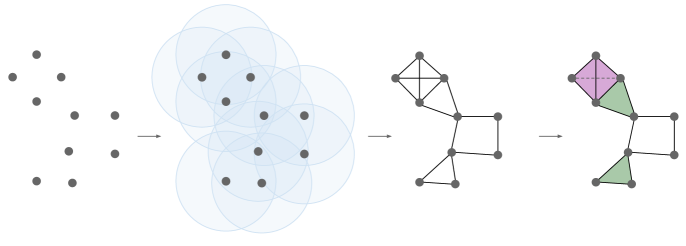
We consider the complexity of the local Hamiltonian problem in the context of fermionic Hamiltonians with $\mathcal N=2 $ supersymmetry and show that the problem remains $\mathsf{QMA}$-complete. Our main motivation for studying this is the well-known fact that the ground state energy of a supersymmetric system is exactly zero if and only if a certain cohomology group is nontrivial. This opens the door to bringing the tools of Hamiltonian complexity to study the computational complexity of a large number of algorithmic problems that arise in homological algebra, including problems in algebraic topology, algebraic geometry, and group theory. We take the first steps in this direction by introducing the $k$-local Cohomology problem and showing that it is $\mathsf{QMA}_1$-hard and, for a large class of instances, is contained in $\mathsf{QMA}$. We then consider the complexity of estimating normalized Betti numbers and show that this problem is hard for the quantum complexity class $\mathsf{DQC}1$, and for a large class of instances is contained in $\mathsf{BQP}$. In light of these results, we argue that it is natural to frame many of these homological problems in terms of finding ground states of supersymmetric fermionic systems. As an illustration of this perspective we discuss in some detail the model of Fendley, Schoutens, and de Boer consisting of hard-core fermions on a graph, whose ground state structure encodes $l$-dimensional holes in the independence complex of the graph. This offers a new perspective on existing quantum algorithms for topological data analysis and suggests new ones.
Motivation & Objective
- To determine the quantum complexity of cohomology problems arising in supersymmetric quantum systems.
- To bridge Hamiltonian complexity and homological algebra by showing that supersymmetric ground states encode cohomology groups.
- To analyze the computational complexity of estimating Betti numbers and quasi-Betti numbers in quantum algorithms.
- To improve VQE efficiency by using the supercharge operator $B$ instead of the Laplacian $\Delta$ in fermionic systems.
- To establish that the $k$-local cohomology problem is complete for the quantum complexity class $\text{QMA}$.
Proposed method
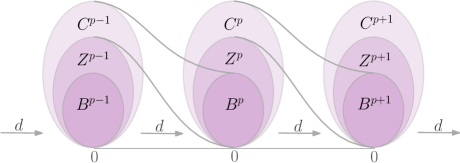
- Formalizes the cohomology problem using a coboundary operator $d$ with $d^2 = 0$, mapping to a supersymmetric quantum mechanical system with Hamiltonian $H = \{\mathcal{Q}, \mathcal{Q}^\dagger\}$.
- Uses the Jordan-Wigner transformation to map fermionic operators to qubit operators, enabling quantum simulation on quantum computers.
- Analyzes the structure of the supercharge $B = \mathcal{Q}$ and the Laplacian $\Delta = B^2$, focusing on their decompositions into commuting Pauli terms.
- Proposes decomposing $B$ and $\Delta$ into sets of commuting terms to reduce circuit depth and measurement count in VQE algorithms.
- Demonstrates that for the independence complex, using $B$ reduces the number of commuting sets by a factor of $d+1$ compared to $\Delta$, improving VQE scaling.
- Applies complexity-theoretic tools to show that quasi-Betti number estimation is hard for $\text{DQC1}$ but solvable in $\text{BQP}$.
Experimental results
Research questions
- RQ1What is the quantum computational complexity of the $k$-local cohomology problem in supersymmetric systems?
- RQ2Can the supercharge operator $B$ be used to improve the efficiency of VQE algorithms compared to using the Laplacian $\Delta$?
- RQ3Is estimating quasi-Betti numbers, a proxy for Betti numbers in topological data analysis, within the power of near-term quantum devices?
- RQ4How does the structure of the underlying graph affect the decomposition of $B$ and $\Delta$ into commuting Pauli terms?
- RQ5What is the relationship between supersymmetric ground states and cohomology groups in fermionic lattice models?
Key findings
- The $k$-local cohomology problem is proven to be $\text{QMA}$-complete, establishing its fundamental quantum hardness.
- Estimating quasi-Betti numbers is $\text{DQC1}$-hard, indicating it is hard for even weakly-entangled quantum computers.
- Quasi-Betti number estimation is contained in $\text{BQP}$, showing it is efficiently solvable on universal quantum computers.
- Using the supercharge $B$ instead of the Laplacian $\Delta$ in VQE reduces the number of commuting sets by a factor of $d+1$ in the independence complex, improving circuit depth and measurement count.
- The Jordan-Wigner transformation maps fermionic operators to non-local qubit operators, but structured graph orderings can minimize non-locality and improve decomposition efficiency.
- The paper establishes a direct link between supersymmetric quantum mechanics and topological data analysis, showing that cohomology problems in TDA are naturally framed in quantum complexity classes.
Read this paper
Open the full text in the Nubint reader and ask about any passage as you read.
Read this paper on NubintThis review was generated by AI from the original paper. Please check the paper before citing it.