
[Paper Review] Exploring Large-Scale Entanglement in Quantum Simulation
This paper demonstrates experimental learning of the entanglement Hamiltonian in a 51-ion quantum simulator, revealing a local structure for entanglement in ground and excited states of a 1D XXZ Heisenberg chain. The key result is compelling evidence that entanglement is predominantly localized near the boundary of subsystems, confirming a local entanglement Hamiltonian for large-scale quantum systems.
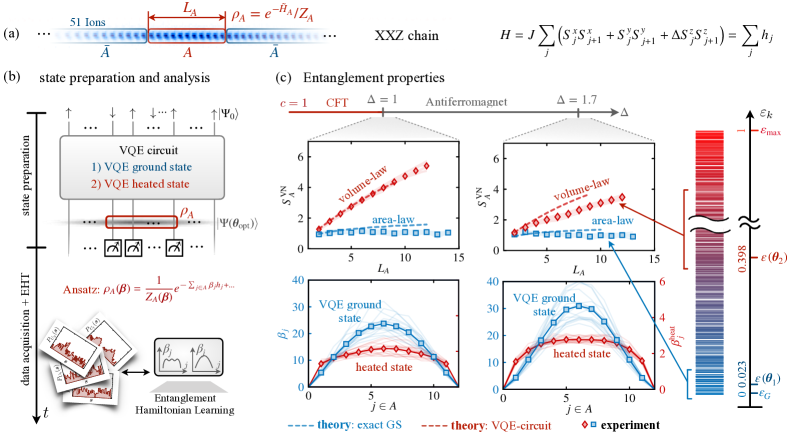
Entanglement is a distinguishing feature of quantum many-body systems, and uncovering the entanglement structure for large particle numbers in quantum simulation experiments is a fundamental challenge in quantum information science. Here we perform experimental investigations of entanglement based on the entanglement Hamiltonian, as an effective description of the reduced density operator for large subsystems. We prepare ground and excited states of a 1D XXZ Heisenberg chain on a 51-ion programmable quantum simulator and perform sample-efficient `learning' of the entanglement Hamiltonian for subsystems of up to 20 lattice sites. Our experiments provide compelling evidence for a local structure of the entanglement Hamiltonian. This observation marks the first instance of confirming the fundamental predictions of quantum field theory by Bisognano and Wichmann, adapted to lattice models that represent correlated quantum matter. The reduced state takes the form of a Gibbs ensemble, with a spatially-varying temperature profile as a signature of entanglement. Our results also show the transition from area to volume-law scaling of Von Neumann entanglement entropies from ground to excited states. As we venture towards achieving quantum advantage, we anticipate that our findings and methods have wide-ranging applicability to revealing and understanding entanglement in many-body problems with local interactions including higher spatial dimensions.
Motivation & Objective
- To investigate the entanglement structure in large-scale quantum many-body systems using quantum simulation.
- To experimentally learn the entanglement Hamiltonian for subsystems up to 20 sites in a 1D XXZ Heisenberg chain.
- To test the hypothesis that the entanglement Hamiltonian exhibits a local structure, particularly near the subsystem boundary.
- To confirm the physical interpretation of entanglement Hamiltonian parameters as local inverse temperatures.
- To provide evidence for the spatial localization of dominant entanglement contributions near the entanglement cut.
Proposed method
- The study uses a programmable 51-ion quantum simulator to prepare ground and excited states of a 1D XXZ Heisenberg chain.
- Entanglement Hamiltonian is learned via sample-efficient quantum state tomography and optimization techniques on subsystems of up to 20 sites.
- The reduced density matrix of the subsystem is reconstructed using Pauli string expectation values, with a focus on strings spanning the entire chain.
- Theoretical modeling assumes a Gibbs state form, ρ_A ∝ exp(−Ĥ_EH), where Ĥ_EH is the entanglement Hamiltonian with site-dependent parameters β_j.
- Spatial structure of entanglement eigenstates is analyzed by computing energy density differences between Schmidt vectors and the ground state.
- Numerical and experimental analysis confirms that off-diagonal coherences vanish in the large system limit, justifying the use of incoherent mixture approximations.
Experimental results
Research questions
- RQ1Does the entanglement Hamiltonian for large subsystems in quantum spin chains exhibit a local structure?
- RQ2Are the dominant contributions to entanglement localized near the boundary of the subsystem?
- RQ3Can the entanglement Hamiltonian parameters β_j be interpreted as local inverse temperatures?
- RQ4How do the entanglement spectrum and Schmidt vectors reflect spatial inhomogeneities in the entanglement structure?
- RQ5To what extent do off-diagonal coherences in the many-body wavefunction affect the reduced density matrix in large systems?
Key findings
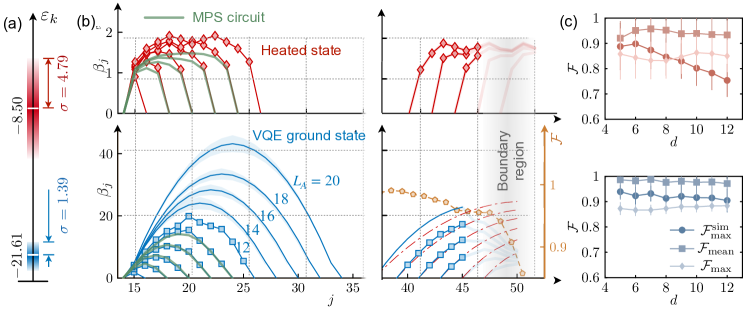
- The entanglement Hamiltonian for subsystems up to 20 sites in the 1D XXZ chain exhibits a local structure, with parameters β_j largest in the middle and smallest near the entanglement cut.
- The reduced density matrix of the subsystem becomes indistinguishable from a Gibbs state ρ_A ∝ exp(−Ĥ_EH) at system sizes L ∼ 10^3, indicating vanishing off-diagonal coherences in the many-body wavefunction.
- The dominant Schmidt vectors of the entanglement spectrum correspond to excitations localized near the entanglement cut, as shown by peak energy density differences in the low-lying entanglement eigenstates.
- The spatial inhomogeneity of the entanglement spectrum supports the interpretation of β_j as a local inverse (entanglement) temperature.
- Numerical verification confirms that expectation values of long Pauli strings vanish in the large system limit, validating the use of local entanglement Hamiltonian models.
- The findings extend the Li-Haldane picture of topological order to general quantum many-body systems, showing that boundary-localized entanglement is a universal feature.
Read this paper
Open the full text in the Nubint reader and ask about any passage as you read.
Read this paper on NubintThis review was generated by AI from the original paper. Please check the paper before citing it.