
[Paper Review] Flexible nuclear power and fluctuating renewables? -- A techno-economic analysis for decarbonized energy systems
This paper conducts a techno-economic analysis using a detailed energy system model to evaluate nuclear power's role in decarbonized European electricity systems. Despite its dispatchability and high energy potential, the study finds that even under optimistic cost assumptions (€4,000/kW overnight cost, <10-year construction time), nuclear power's cost-efficient share is only around 10%, with grid flexibility, storage, and flexible demand being more efficient alternatives for integrating fluctuating wind and solar generation.
Many governments are considering constructing new nuclear power plants to support the decarbonization of the energy system. On the one hand, dispatchable nuclear plants can complement fluctuating generation from wind and PV. On the other hand, escalating construction costs and times raise economic concerns. In this paper, we extensively review construction costs and times. On this basis, we apply a detailed multi-vector energy model to analyze the cost-efficient share of nuclear power in fully decarbonized energy systems, i.e., energy systems that do not utilize any fossil fuels. Our analysis finds that even if, reversing the historical trend, overnight construction costs of nuclear half to 4,000 US-$2018 per kW and construction times remain below ten years, the cost-efficient share of nuclear power in European electricity generation is only around 10%. The analysis still omits the social costs of nuclear power, such as the risk of accidents or waste management. Nuclear plants must operate inflexibly and at capacity factors close to 90% to recover their investment costs, implying that operational flexibility-even if technically possible-is not economically viable. As a result, grid infrastructure, flexible demand in multi-energy systems, and storage are more efficient options for integrating fluctuating wind and photovoltaic generation.
Motivation & Objective
- To assess the economic efficiency of nuclear power in decarbonized energy systems under realistic cost and time assumptions.
- To evaluate whether nuclear power can efficiently complement fluctuating wind and solar generation in Europe.
- To compare nuclear power against alternative flexibility options such as cross-border electricity exchange, storage, and flexible demand.
- To determine the optimal share of nuclear power in a cost-minimizing, decarbonized energy system.
Proposed method
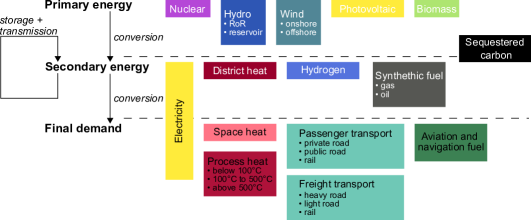
- A comprehensive energy system model is used to simulate decarbonized electricity systems across Europe with high shares of wind and solar PV.
- Levelized cost of electricity (LCOE) for nuclear is computed based on projected and actual construction costs from OECD countries.
- The model includes all major flexibility options: cross-border transmission, flexible demand (e.g., electrolyzers, electric vehicles), and storage (including seasonal storage via synthetic fuels).
- Sensitivity analysis is performed on nuclear construction costs (€2,000–4,000/kW) and construction times (<10 years) to assess cost-efficiency.
- The model optimizes the energy system for minimum system cost while meeting final energy demand across transport, heating, and industrial sectors.
- The analysis excludes social costs of nuclear power (e.g., waste management, accident risks), favoring nuclear in its cost assessment.
Experimental results
Research questions
- RQ1What is the cost-efficient share of nuclear power in a decarbonized European electricity system under realistic construction cost and time assumptions?
- RQ2How does nuclear power compare economically to other flexibility options such as grid interconnections, storage, and flexible demand in integrating variable wind and solar generation?
- RQ3To what extent can nuclear power contribute to meeting increasing electricity demand in decarbonized heating, transport, and industrial sectors?
- RQ4How do high capital costs and long construction times affect the economic viability of new nuclear plants compared to renewables and storage?
Key findings
- Even under optimistic assumptions—overnight construction costs of €4,000/kW and construction times under 10 years—the cost-efficient share of nuclear power in European electricity generation is only around 10%.
- Nuclear plants must operate at utilization rates close to 90% to recover investment costs, indicating they must operate inflexibly, which limits their ability to provide flexibility.
- Grid infrastructure, flexible demand (e.g., electrolyzers, electric vehicles), and storage technologies are more cost-efficient than nuclear power for managing residual load from fluctuating wind and solar generation.
- The model shows that systems with high nuclear shares (e.g., 52%) require significantly more thermal generation to meet residual demand, whereas systems without nuclear rely on demand response and storage to balance supply.
- The inclusion of flexible demand and cross-border exchange reduces the need for thermal backup and lowers overall system costs, making them superior to nuclear for flexibility.
- The analysis suggests that even with favorable cost assumptions, nuclear power is not the most economically efficient option for decarbonization, especially when compared to storage and demand-side solutions.
Read this paper
Open the full text in the Nubint reader and ask about any passage as you read.
Read this paper on NubintThis review was generated by AI from the original paper. Please check the paper before citing it.