
[Paper Review] Full Counting Statistics of Charge in Chaotic Many-body Quantum Systems
This paper establishes that full counting statistics (FCS) of charge transport in chaotic many-body quantum systems—specifically U(1)-symmetric random unitary circuits—approach those of the symmetric exclusion process (SEP) at long times, with subleading $ t^{-1/2} $ quantum corrections. Using a replica statistical mechanics approach and mapping to an effective classical stochastic process, the authors show that typical circuit realizations exhibit emergent fluctuating hydrodynamics governed by a noisy diffusion equation with fluctuation-dissipation noise, validated by matrix-product state simulations.
We investigate the full counting statistics of charge transport in U(1)-symmetric random unitary circuits. We consider an initial mixed state prepared with a chemical potential imbalance between the left and right halves of the system and study the fluctuations of the charge transferred across the central bond in typical circuits. Using an effective replica statistical mechanics model and a mapping onto an emergent classical stochastic process valid at large on-site Hilbert space dimension, we show that charge transfer fluctuations approach those of the symmetric exclusion process at long times, with subleading t^{-1/2} quantum corrections. We discuss our results in the context of fluctuating hydrodynamics and macroscopic fluctuation theory of classical nonequilibrium systems and check our predictions against direct matrix-product state calculations.
Motivation & Objective
- To understand whether quantum fluctuations in chaotic many-body systems can be described by an emergent classical stochastic theory.
- To determine the long-time behavior of full counting statistics (FCS) of charge transport in U(1)-symmetric random unitary circuits.
- To quantify quantum corrections to classical FCS predictions in typical circuit realizations.
- To validate the emergence of fluctuating hydrodynamics with noise from the fluctuation-dissipation theorem in quantum circuits.
Proposed method
- Mapping the FCS of charge transfer to a replica statistical mechanics (SM) model to compute cumulants via ensemble-averaged expectation values.
- Deriving an effective classical stochastic process by coarse-graining the quantum dynamics, leading to a noisy diffusion equation with spatially varying diffusion and noise strength.
- Using the fluctuation-dissipation theorem to set the noise amplitude proportional to the conductivity $ \sigma(\rho) = D(\rho)\chi_s(\rho) $, with $ \chi_s(\rho) = \rho(1-\rho) $.
- Performing matrix-product state (MPS) simulations with the TEBD algorithm to compute the cumulant generating function (CGF) of charge transfer using a counting field $ \lambda $.
- Introducing a modified unitary gate with phase factors $ e^{\pm i\lambda/2} $ to track charge transfer across the central bond.
- Comparing circuit-averaged cumulants to those of the SEP and analyzing deviations via $ \Delta C_n(t) \sim t^{-1/2} $ scaling.
Experimental results
Research questions
- RQ1Does the full counting statistics of charge transport in chaotic quantum circuits converge to that of the symmetric exclusion process (SEP) at long times?
- RQ2What are the nature and scaling of quantum corrections to classical FCS predictions in typical quantum circuit realizations?
- RQ3Can a fluctuating hydrodynamics description with a noise term derived from the fluctuation-dissipation theorem accurately describe charge transport in random unitary circuits?
- RQ4To what extent do matrix-product state simulations confirm the predictions of the effective statistical mechanics and stochastic models?
Key findings
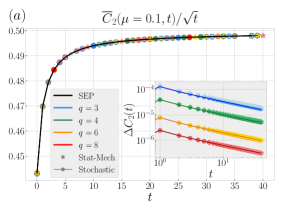
- The second cumulant (variance) of charge transfer approaches the SEP value with a $ t^{-1/2} $ correction, consistent with quantum fluctuations being subleading.
- The third cumulant also exhibits a $ t^{-1/2} $ deviation from the SEP prediction, confirming the universality of the correction scaling.
- Circuit-to-circuit fluctuations in the cumulant generating function decay as $ t^{-2} $, implying $ \chi(\lambda,t)/\sqrt{t} \sim \chi_{\text{SEP}}(\lambda,t)/\sqrt{t} + \mathcal{O}(t^{-1}) $.
- Direct MPS simulations using TEBD with bond dimension $ \chi = 2000 $ confirm the theoretical prediction, showing diminishing deviations from the SEP FCS over time.
- The effective stochastic model of coupled SEP chains reproduces the SM results and the MPS data with remarkable accuracy, validating the classical hydrodynamic description.
- The results hold for various initial biases $ \mu = 2, \infty $, confirming the robustness of the $ t^{-1/2} $ scaling across different regimes.
Read this paper
Open the full text in the Nubint reader and ask about any passage as you read.
Read this paper on NubintThis review was generated by AI from the original paper. Please check the paper before citing it.