
[Paper Review] Generalized Kramers-Wanier Duality from Bilinear Phase Map
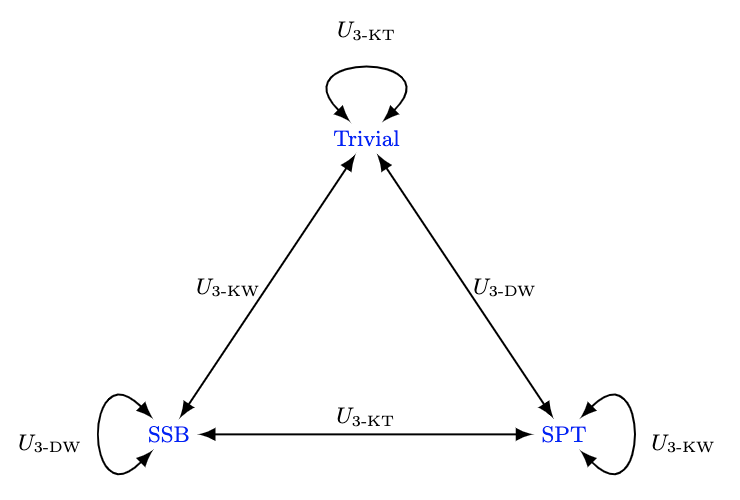
The paper introduces the Bilinear Phase Map (BPM) to generalize Kramers-Wannier duality, analyze unitarity loss and non-invertible fusion rules, and construct new BPMs in (1+1)D that link SPT and SSB phases via a duality web.
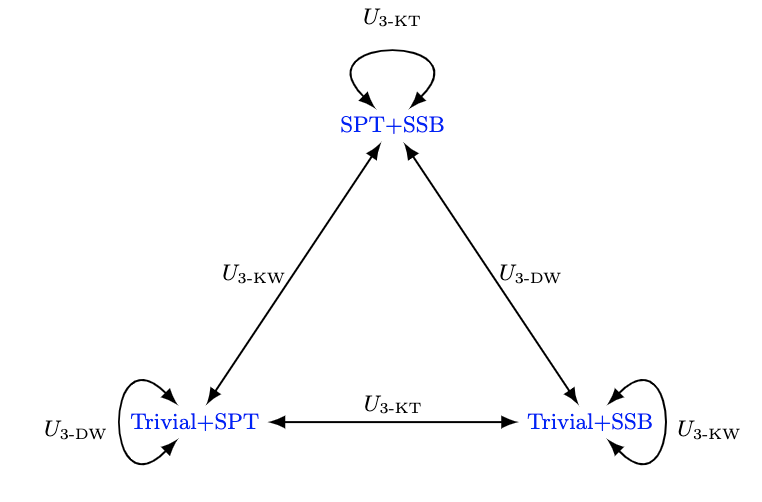
We present the Bilinear Phase Map (BPM), a concept that extends the Kramers-Wannier (KW) transformation to investigate unconventional gapped phases, their dualities, and phase transitions. Defined by a matrix of $\mathbb{Z}_2$ elements, the BPM not only encapsulates the essence of KW duality but also enables exploration of a broader spectrum of generalized quantum phases and dualities. By analyzing the BPM's linear algebraic properties, we elucidate the loss of unitarity in duality transformations and derive general non-invertible fusion rules. Applying this framework to (1+1)D systems yields the discovery of new dualities, shedding light on the interplay between various Symmetry Protected Topological (SPT) and Spontaneous Symmetry Breaking (SSB) phases. Additionally, we construct a duality web that interconnects these phases and their transitions, offering valuable insights into relations between different quantum phases.
Motivation & Objective
- Motivate the study of distinct gapped quantum phases and their dualities beyond the traditional KW transformation.
- Introduce BPM as a Z2-valued matrix framework that captures KW duality and generalizes to broader phases and dualities.
- Show how BPM elucidates unitarity loss, kernel structure, and non-invertible fusion rules through linear algebra.
- Demonstrate concrete BPMs in (1+1)D (N_3-KW and N_4-KW), analyze their symmetries, and reveal dualities between SPT and SSB phases.
- Construct duality webs connecting gapped phases and related phase transitions, including a generalized Kennedy-Tasaki duality.
Proposed method
- Define BPM as a Z2-valued L×L matrix A that generates the duality map via N_BPM |{s}> = 2^{-L/2} sum_{hat{s}} (-1)^{sum_jk s_j A_{jk} hat{s}_k} |hat{s}>.
- Use linear-algebra properties of A (rank, kernel) to determine unitarity, symmetry sectors, and which states map to a paramagnetic state.
- Incorporate boundary twists t to recover unitarity for kernels and distinguish twisted sectors; show how odd/even boundary twists affect dual mappings.
- Derive general non-invertible fusion rules from N_BPM^ dagger N_BPM and relate to the kernel of A^T.
- Apply BPM to explicit (1+1)D models, deriving A for 3-KW and 4-KW type dualities, and analyze resulting symmetry structures (SSB, SPT).
- Explore fusion with translations and interplay with generalized Kennedy-Tasaki duality to connect SPT and SSB phases.
Experimental results
Research questions
- RQ1How can KW duality be generalized beyond two-site interactions using a bilinear phase map (BPM)?
- RQ2What are the unitarity and fusion-rule implications of a BPM-based duality, and how do kernel/ boundary-twist structures resolve them?
- RQ3What new dualities arise in (1+1)D when employing BPMs such as N_3-KW and N_4-KW?
- RQ4Can BPMs connect SPT and SSB phases via dualities and yield a web of phase transitions with consistent anomaly structure?
- RQ5How do generalized KT dualities emerge within BPM frameworks and relate SPT and SSB sectors?
Key findings
- Introduces BPM as a systematic framework generalizing KW duality via a Z2 matrix A.
- Shows how the kernel of A^T governs unitarity loss and the pairing of states under duality.
- Demonstrates two new BPMs in (1+1)D, N_3-KW and N_4-KW, associated with three-site and four-site Ising-like chains.
- Establishes that self-dual BPMs can be anomaly-free or anomalous, enabling or forbidding certain gapped phases.
- Constructs a duality web linking SPT, SSB, and trivial gapped phases, and links dualities to transitions with center charge c=1.
- Proposes a generalized Kennedy-Tasaki duality connecting SPT and SSB within the BPM framework.
Read this paper
Open the full text in the Nubint reader and ask about any passage as you read.
Read this paper on NubintThis review was generated by AI from the original paper. Please check the paper before citing it.