
[Paper Review] Pathways towards instability in financial networks
This paper demonstrates that market integration and diversification—processes widely believed to stabilize financial systems—can instead induce instability by promoting cyclical structures in interbank networks that amplify financial distress. Using a network-theoretic framework, it shows that increasing connectivity and leverage leads to instability when the largest eigenvalue of the interbank leverage matrix exceeds one, regardless of contract-specific details.
Following the financial crisis of 2007-2008, a deep analogy between the origins of instability in financial systems and complex ecosystems has been pointed out: in both cases, topological features of network structures influence how easily distress can spread within the system. However, in financial network models, the details of how financial institutions interact typically play a decisive role, and a general understanding of precisely how network topology creates instability remains lacking. Here we show how processes that are widely believed to stabilise the financial system, i.e. market integration and diversification, can actually drive it towards instability, as they contribute to create cyclical structures which tend to amplify financial distress, thereby undermining systemic stability and making large crises more likely. This result holds irrespective of the details of how institutions interact, showing that policy-relevant analysis of the factors affecting financial stability can be carried out while abstracting away from such details.
Motivation & Objective
- To understand how network topology, particularly cyclical structures, contributes to systemic instability in financial networks.
- To investigate whether processes like market integration and diversification—typically seen as stabilizing—can actually increase systemic risk.
- To develop a method for analyzing financial stability that abstracts from specific contract details and focuses on topological features.
- To identify pathways from stable to unstable regimes in interbank networks by manipulating network structure while preserving key statistical properties.
- To provide policy-relevant insights into systemic risk by linking network topology to instability thresholds, independent of micro-level financial mechanisms.
Proposed method
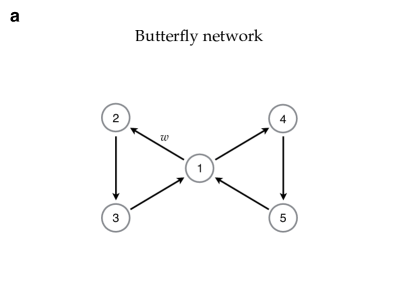
- Model financial networks as directed, weighted graphs representing interbank exposures between institutions.
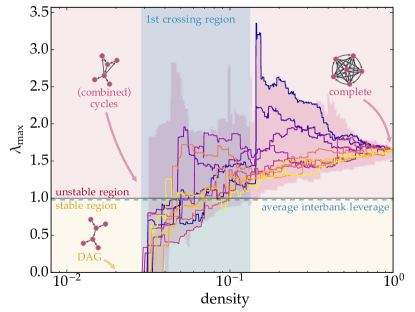
- Use the largest eigenvalue (λ_max) of the interbank leverage matrix as a stability indicator: λ_max > 1 indicates instability.
- Construct synthetic network pathways by iteratively adding or removing banks while preserving average interbank leverage and topology.
- Apply the RAS algorithm to rescale edge weights and maintain consistent leverage levels during network growth or shrinkage.
- Reverse the growth process (from unstable to stable) to maintain constant average leverage, enabling stable trajectory construction.
- Validate findings on real-world data using the Top 176 European banks' balance sheets from 2012, ensuring empirical relevance.
Experimental results
Research questions
- RQ1How do market integration and diversification contribute to systemic instability despite being considered stabilizing mechanisms?
- RQ2What topological features in financial networks—especially cyclical structures—amplify financial distress and lead to instability?
- RQ3Can systemic instability be predicted using a network-level metric like the largest eigenvalue of the leverage matrix, independent of contract-specific dynamics?
- RQ4To what extent can stability be preserved or restored by modifying network structure while maintaining average leverage and topology?
- RQ5What pathways exist from stable to unstable network states, and how do they emerge through incremental changes in network size and connectivity?
Key findings
- Market integration and diversification, despite their stabilizing reputation, can drive financial networks toward instability by increasing the likelihood of cyclical interconnections.
- The largest eigenvalue (λ_max) of the interbank leverage matrix serves as a robust stability threshold: when λ_max > 1, the system becomes unstable regardless of contract-specific details.
- Stable networks with average interbank leverage >1 can become unstable as the number of banks increases, even when edge density remains constant.
- Pathways from stability to instability exist across various network types—including Erdős-Rényi, regular random, scale-free, and core-periphery networks—demonstrating the generality of the mechanism.
- In real-world data from the Top 176 European banks (2012), the interbank network was found to be unstable (λ_max > 1), indicating systemic risk exposure.
- The study confirms that instability arises not from specific default mechanisms but from structural features like cycles, making it possible to assess systemic risk without modeling detailed default propagation.
Read this paper
Open the full text in the Nubint reader and ask about any passage as you read.
Read this paper on NubintThis review was generated by AI from the original paper. Please check the paper before citing it.