
[Paper Review] Putting Language into Context Using Smartphone-Based Keyboard Logging
This paper proposes a privacy-respecting, on-device method for enriching smartphone keyboard logging with contextual metadata by classifying text inputs based on their input prompt UI text, enabling distinction between messaging, comments, and search inputs. Using a six-month study with 624 participants, the authors demonstrate that input motive classification improves data pre-filtering and user privacy while enabling fine-grained linguistic and behavioral research in real-world contexts.
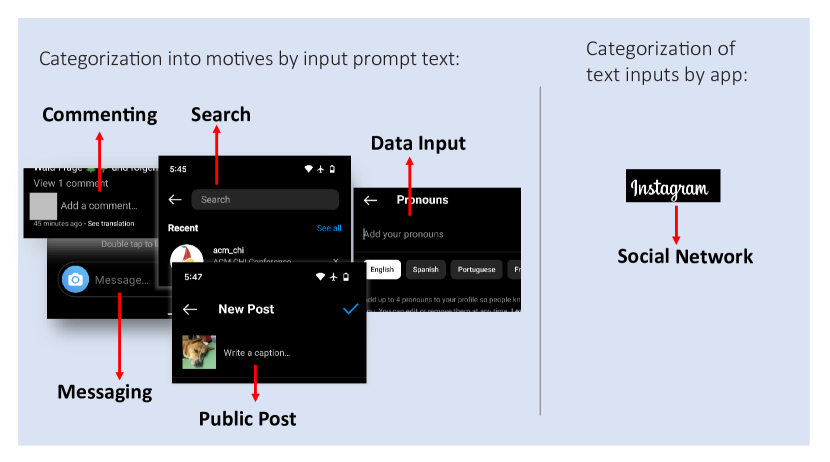
While the study of language as typed on smartphones offers valuable insights, existing data collection methods often fall short in providing contextual information and ensuring user privacy. We present a privacy-respectful approach - context-enriched keyboard logging - that allows for the extraction of contextual information on the user's input motive, which is meaningful for linguistics, psychology, and behavioral sciences. In particular, with our approach, we enable distinguishing language contents by their channel (i.e., comments, messaging, search inputs). Filtering by channel allows for better pre-selection of data, which is in the interest of researchers and improves users' privacy. We demonstrate our approach on a large-scale six-month user study (N=624) of language use in smartphone interactions in the wild. Finally, we highlight the implications for research on language use in human-computer interaction and interdisciplinary contexts.
Motivation & Objective
- To address the lack of contextual information in existing smartphone keyboard logging methods, which often rely on app-based proxies that fail to capture the true purpose of text inputs.
- To improve user privacy by enabling early, on-device filtering of irrelevant or sensitive text inputs before transmission.
- To develop a scalable, on-device system that classifies text inputs by their input motive (e.g., messaging, comments, search) using UI prompt text metadata.
- To provide a reusable, open-source Android library and input prompt text categorization mapping for broader research adoption.
- To critically evaluate privacy risks and long-term sustainability of such context-enriched logging in evolving mobile ecosystems.
Proposed method
- The authors developed an Android logging module that captures input prompt text from on-screen keyboard UIs in real-time during user interactions.
- They created a manual categorization mapping that assigns input prompt texts (e.g., 'Type a message', 'Search') to specific language motives such as messaging, comments, or search inputs.
- The system performs on-device classification of each text input using the pre-defined prompt text mapping, ensuring privacy by not transmitting raw text data.
- The approach leverages a long-tail distribution of input prompt texts, with 88.4% coverage of logged prompts and 52.63% of all inputs classified using the manual mapping.
- A semi-automatic extension strategy is proposed to handle rare or new input prompt texts, combining manual coding with automated similarity-based classification.
- The method was validated in a large-scale, six-month longitudinal study with 624 participants, using data from 3,325 distinct apps and 22,895 unique input prompt texts.

Experimental results
Research questions
- RQ1Can input prompt text from smartphone keyboard UIs be reliably used to classify the motive behind a user’s text input (e.g., messaging vs. search)?
- RQ2How effective is the proposed input prompt text categorization in covering real-world text input data in a large-scale, real-world study?
- RQ3To what extent does context-enriched keyboard logging improve data pre-filtering and user privacy compared to app-based classification?
- RQ4How stable and reusable is the input prompt text categorization across different apps, user groups, and over time?
- RQ5What are the key privacy risks and limitations of this approach, and how can they be mitigated in future research?
Key findings
- The proposed input prompt text categorization achieved 88.4% coverage of logged input prompt texts and classified 52.63% of all text inputs in the six-month study.
- The method successfully distinguished between four main input motives: messaging, comments, search inputs, and other, enabling more precise data selection than app-based filtering.
- By classifying inputs at the time of entry, the system allows for on-device filtering of irrelevant or sensitive content, significantly improving user privacy.
- The approach outperforms traditional app-based categorization by being more stable over time, as input prompt texts are less prone to change than app functionality or naming.
- The long-tail distribution of input prompt texts means that while the majority of inputs are covered, a small but non-trivial fraction (11.6%) remains unclassified, requiring ongoing maintenance.
- The authors provide a reusable Android library and a publicly available input prompt text categorization mapping, supporting reproducibility and future research deployment.
Read this paper
Open the full text in the Nubint reader and ask about any passage as you read.
Read this paper on NubintThis review was generated by AI from the original paper. Please check the paper before citing it.