
[論文レビュー] Confronting primordial black holes with LIGO-Virgo-KAGRA and the Einstein Telescope
この論文は LVK GWTC-3 のベイズ的母集団解析を用いて原初ブラックホール(PBH)を暗黒物質および BH 合併の起源候補として制約し、f_PBH ≈ 10^-3 を見出し、PBH は CDM を支配できないことを示しつつ、ABH+PBH の混合や ET時代の予測を検討している。
The detection of gravitational waves (GWs) from binary black hole (BBH) coalescences by the LIGO-Virgo-KAGRA (LVK) Collaboration has raised fundamental questions about the genesis of these events. In this chapter, we explore the possibility that PBHs, proposed candidates for dark matter, may serve as the progenitors of the BBHs observed by LVK. Employing a Bayesian analysis, we constrain the PBH model using the LVK third GW Transient Catalog (GWTC-3), revealing that stellar-mass PBHs cannot dominate cold dark matter. Considering a mixed population of astrophysical black holes (ABHs) and PBHs, we determine that approximately $1/4$ of the detectable events in the GWTC-3 can be attributed to PBH binaries. We also forecast detectable event rate distributions for PBH and ABH binaries by the third-generation ground-based GW detectors, such as the Einstein Telescope, offering a potential avenue to distinguish PBHs from ABHs based on their distinct redshift evolutions.
研究の動機と目的
- 恒星質量 PBH が冷たい暗黒物質の多数を構成し得るかを評価する。
- GWTC-3 データを用いていくつかの PBH 質量関数の下で PBH 集団パラメータを推定する。
- 混合 ABH+PBH 集団を評価し、LVK イベントに対する PBH の寄与を定量化する。
- Einstein Telescope のような第三世代検出器に向けて PBH/ABH 合併率分布を予測する。
提案手法
- 式 (3) を用いて初期宇宙の PBH 二重星系の合併率密度をモデル化する。
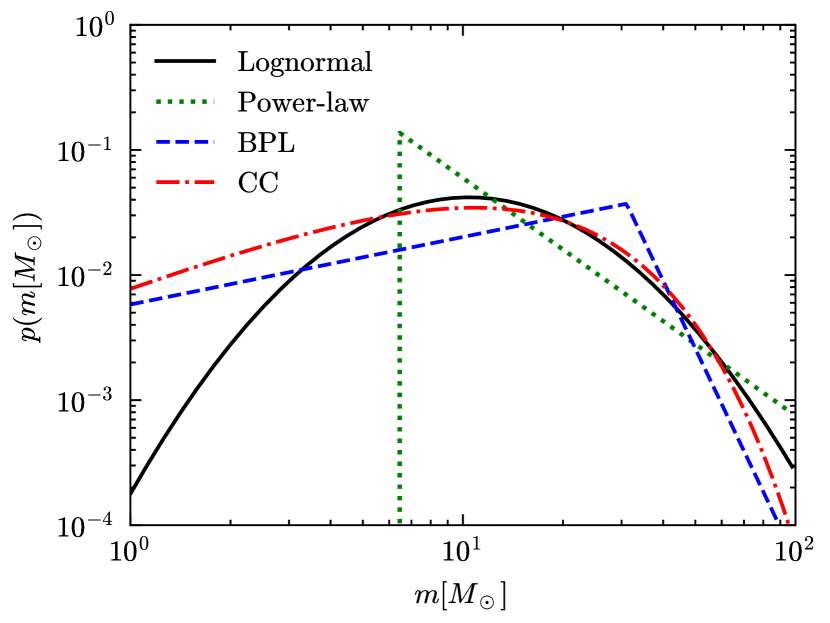
- 対数正規分布、べき分布、ブレーク付きべき分布、臨界崩壊の4つの PBH 質量関数を考慮する。
- 階層ベイズ推定を用いた母集団尤度と検出器選択補正を用いる(式 11-14)。
- ソースフレームのレートを検出器フレームへ変換する式: R_pop(θ|Λ) = (1+z)^{-1} (dV_c/dz) R(t, m1, m2|Λ).
- ICAROGW フレームワークを介して dynesty でハイパーパラメータをサンプルし、事後分布と証拠(Bayes 因子)を得る。
- GWTC-3 のイベント(69 件の使用可能イベント)を組み込み、PBH 分率 f_PBH と質量関数パラメータの事前を設定する(Table 2)。
実験結果
リサーチクエスチョン
- RQ1LVK GWTC-3 BBH データによって許容される CDM における PBH 分率 f_PBH の上限はどれか。
- RQ2検討した4つの形のうち、LVK BBH 観測に最も適合する PBH 質量関数はどの形か。
- RQ3混合 ABH+PBH 集団は純粋な ABH または純粋な PBH モデルよりデータを良く説明するか。
- RQ4Einstein Telescope のような将来の検出器における高赤方偏移での PBH/ABH 合併率の進化予測はどうなるか。
主な発見
- CDM における PBH の存在量は、4つの質量関数に渡りおおよそ 10^-3 のオーダーに制約される。
- 対数正規では、M_c ≈ 17.3 M_sun、σ ≈ 0.71、f_PBH ≈ 1.8×10^-3、局所合併率 R(t0) ≈ 41 Gpc^-3 yr^-1。
- べき分布では、M_min ≈ 6.5 M_sun、α ≈ 1.9、f_PBH ≈ 2.3×10^-3、R(t0) ≈ 48 Gpc^-3 yr^-1。
- ブレーク付きべき分布では、m_* ≈ 31 M_sun、α1 ≈ 0.54、α2 ≈ 5.6、f_PBH ≈ 0.9×10^-3、R(t0) ≈ 46 Gpc^-3 yr^-1。
- 臨界崩壊では、M_f ≈ 10.8 M_sun、α ≈ 1.0、f_PBH ≈ 1.5×10^-3、R(t0) ≈ 49 Gpc^-3 yr^-1。
- 全モデルを通じて f_PBH は 3×10^-3 未満にとどまり、PBHs が CDM の次善的な成分であることを支持する。混合 ABH+PBH 集団は ABH のみでは捉えにくい特徴を説明できる。
- ベイズ因子からの PBH 質量関数の優先度は対数正規が4つの中で最良の適合を示すが、いずれも観測された質量分布を完全には再現していない。
この論文を読む
Nubintのビューアで原文を開き、読みながら気になる箇所をすぐに質問できます。
Nubintでこの論文を読むこのレビューはAIが論文の原文をもとに作成しました。引用する前に原文をご確認ください。