
[論文レビュー] Fault-tolerant quantum algorithm for symmetry-adapted perturbation theory
本稿では、ヘイセンベルク限界の推定法を用いて、第一準位の対称性適合摂動理論(SAPT)の相互作用エネルギー成分(電気的、交換、電気的-交換)を計算する耐故障性量子アルゴリズムを提示する。高次テンソル因子分解とブロック符号化を活用することで、最適な不確実性スケーリングを達成し、ベンチマーク分子およびヘム–アルテミシンイン系の詳細なリソース見積もりを提供する。これにより、大規模な量子化学アプリケーションにおける主なコスト要因が特定される。
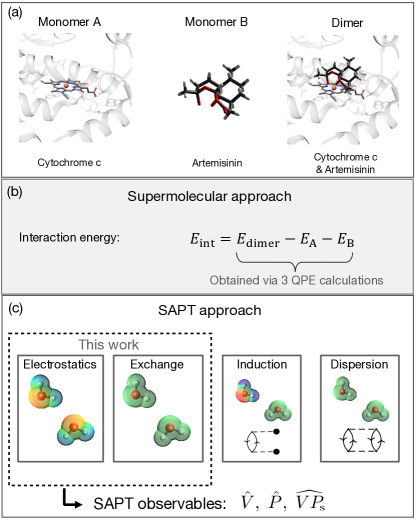
The efficient computation of observables beyond the total energy is a key challenge and opportunity for fault-tolerant quantum computing approaches in quantum chemistry. Here we consider the symmetry-adapted perturbation theory (SAPT) components of the interaction energy as a prototypical example of such an observable. We provide a guide for calculating this observable on a fault-tolerant quantum computer while optimizing the required computational resources. Specifically, we present a quantum algorithm that estimates interaction energies at the first-order SAPT level with a Heisenberg-limited scaling. To this end, we exploit a high-order tensor factorization and block encoding technique that efficiently represents each SAPT observable. To quantify the computational cost of our methodology, we provide resource estimates in terms of the required number of logical qubits and Toffoli gates to execute our algorithm for a range of benchmark molecules, also taking into account the cost of the eigenstate preparation and the cost of block encoding the SAPT observables. Finally, we perform the resource estimation for a heme and artemisinin complex as a representative large-scale system encountered in drug design, highlighting our algorithm's performance in this new benchmark study and discussing possible bottlenecks that may be improved in future work.
研究の動機と目的
- 合計エネルギーを超えて物理的に解釈可能なSAPT相互作用エネルギー成分を計算する耐故障性量子アルゴリズムの開発。
- 耐故障性量子コンピュータ上でSAPT観測値の期待値推定における不確実性がヘイセンベルク限界スケーリングに達することの実現。
- ドラッグデザインに関連する大規模システムも含む、さまざまな分子における論理的キュービットおよびToffoliゲートの観点からの詳細なリソース見積もりの提供。
- 将来の最適化を目的として、特に固有状態準備とブロック符号化における計算ボトルネックの同定。
提案手法
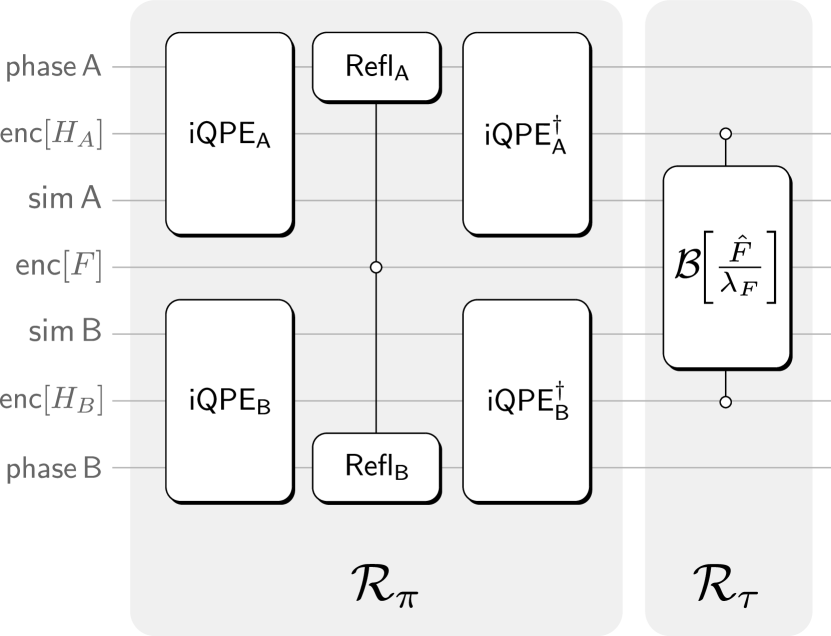
- SAPTオペレータのヘイセンベルク限界スケーリングによる期待値推定に、QSP-EVE法を用いる。
- SAPTハミルトニアンの効率的表現を可能にするためにブロック符号化を採用し、観測値評価の低深さ実装を実現する。
- SAPTオペレータをスパースかつ低ランクの成分に分解するために高次テンソル因子分解を適用し、リソースオーバーヘッドを低減する。
- 形式 ⟨ΨAΨB|F̂|ΨAΨB⟩ の期待値を計算することに特化した手法であり、F̂ は第一準位SAPTオペレータである。
- 論理的キュービット数およびToffoliゲート数を含む、表面コードベースの耐故障性量子コンピューティングモデルを用いてリソース見積もりを導出する。
- フレームワークはベンチマーク分子およびヘム–アルテミシンイン系に適用され、cc-pVDZおよびより大きな基底関数セットにおける基底関数セット依存性が分析されている。
実験結果
リサーチクエスチョン
- RQ1耐故障性量子アルゴリズムは、SAPT相互作用エネルギー成分の推定においてヘイセンベルク限界スケーリングを達成できるか?
- RQ2さまざまな分子系における第一準位SAPT観測値の計算において、主なリソースコスト(論理的キュービットおよびToffoliゲート)は何か?
- RQ3SAPTオペレータの固有状態準備およびブロック符号化は、全体の計算コストにどのように寄与しているか?
- RQ4ドラッグ様複合体のような大規模分子系において、アルゴリズムの主要なボトルネックは何か?
- RQ5基底関数セットのサイズと系の複雑さは、耐故障性ハードウェア上でのSAPTに必要な量子リソースにどのようにスケーリングするか?
主な発見
- 期待値推定における不確実性がヘイセンベルク限界スケーリングに達し、実行時間に比例した最適な精度スケーリングが可能である。
- cc-pVDZ[46]基底関数セットを用いたヘム–アルテミシンイン複合体では、交換項の計算に約3.39×10¹¹個のToffoliゲートと1.43×10⁴個の論理的キュービットが必要である。
- 主なリソースコストはSAPTオペレータのブロック符号化に起因し、特に大きな基底関数セットでは、Toffoliゲート数が基底関数数の二乗に比例して増加する。
- 固有状態準備は、特に大きな分子において全体コストに顕著に寄与しており、現在の実装では主要なボトルネックである。
- リソース見積もりから、基底関数セットのサイズが強い影響を与えることが判明した。cc-pVDZ[90]では、交換項のToffoliゲート数が3.44×10⁴に達し、論理的キュービット数は5×10⁵を超える。
- 本研究では、ブロック符号化と固有状態準備の最適化が、全体のアルゴリズム効率向上に最も寄与すると特定された。
この論文を読む
Nubintのビューアで原文を開き、読みながら気になる箇所をすぐに質問できます。
Nubintでこの論文を読むこのレビューはAIが論文の原文をもとに作成しました。引用する前に原文をご確認ください。