
[論文レビュー] Gate Tunable Josephson Diode in Proximitized InAs Supercurrent Interferometers
非正弦 CPR を持つ近接結合 InAs SQUID でゲート可変のジョセフソンダイオードを実証し、有限磁束バイアス下で最大約30%のダイオード効率を達成。
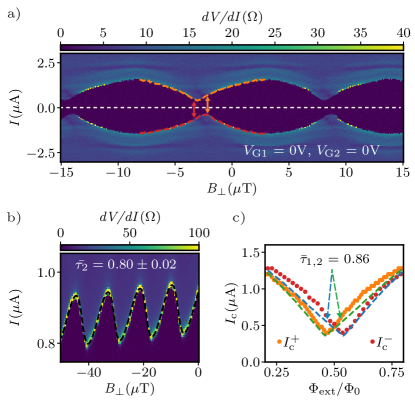
The Josephson diode (JD) is a non-reciprocal circuit element that supports a larger critical current in one direction compared to the other. This effect has gained a growing interest because of promising applications in superconducting electronic circuits with low power consumption. Some implementations of a JD rely on breaking the inversion symmetry in the material used to realize Josephson junctions (JJs), but two recent theoretical proposals have suggested that the effect can also be engineered by combining two JJs hosting highly transmitting Andreev bound states in a Superconducting Quantum Interference Device (SQUID) at a small, but finite flux bias [1, 2]. We have realized a SQUID with two JJs fabricated in a proximitized InAs two-dimensional electron gas (2DEG). We demonstrate gate control of the diode efficiency from zero up to around 30% at specific flux bias values which comes close to the maximum of approxiomately 40% predicated in Ref. [1]. The key ingredients to the JD effect in the SQUID arrangement is the presence of highly transmitting channels in the JJs, a flux bias and an asymmetry between the two SQUID arms.
研究の動機と目的
- 量子技術における低損耗回路素子として超伝導ダイオードの探索を喚起する。
- 2つの非正弦ジョセフソン結合を用いたSQUIDでジョセフソンダイオード(SDE)を設計できるかを調べる。
- ダイオード特性が、高い透過チャネルのCPR中の高次高調波の干渉に起因することを示す。
- ダイオード効率に対するゲート制御を定量化し、理論予測と比較する。
- ループのインダクタンスや他の潜在的アーティファクトからSDEの起源を解明する。
提案手法
- 各接合を非正弦CPRで近似したモデルを用い、I(phi)= (I_c/A_N) * sin(phi) / sqrt(1 - tau* sin^2(phi/2)) をチャネル全体に渡って適用する。
- 多チャネルInAs/Alジョセフソン結合における高透過チャネルを表すため、効果的伝送率 tau* を用いる。
- SQUIDを通じて磁束を作用させ、varphi_ext = 2πΦ_ext/Φ0 によって分岐位相を関連付け、I(phi1)+I(phi2) を合計する。
- 2つのアーム間の臨界電流および伝送チャネルの違いを定量化するため、非対称性パラメータ alpha and beta を導入する。
- Φ_ext の関数としての実験的 I_c^+ および I_c^- をモデル予測と比較してSDEの起源を特定する。
- ループインダクタンスやヒステリシスによる潜在的アーティファクトを、スイッチング・リトラッピング電流の検証とシミュレーションで評価する。

実験結果
リサーチクエスチョン
- RQ1ゲート可変の近接結合InAs SQUIDでジョセフソンダイオード効果を実現できるか?
- RQ2このようなデバイスでSDEを観察するのに必要な条件(非正弦CPR、非対称性、有限磁束バイアス)は何か?
- RQ3高度に透過するチャネルを持つ二接合SQUIDが予測されるSDEの大きさをどの程度再現できるか?
- RQ4このプラットフォームでゲート調整がダイオード効率をどの程度制御できるか?
- RQ5観測されたSDEを説明するにはループインダクタンスやヒステリック効果だけで十分か?
主な発見
- 近接結合InAsを用いた2つの非正弦JJsを組み込んだ直流SQUIDでSDEが観測され、有限磁束バイアスにおいて I_c^+ ≠ I_c^- を示す。
- ダイオード効率は、適切なゲート設定と磁束値のもとで約30%に達する。
- tau* ≈ 0.86 を両方の接合に用いたモデルでデータを適合させ、測定された I_c1, I_c2 が I_c^+ および I_c^- の磁束依存をうまく再現する。
- 大きな tau* は、多チャネルJJsにおける高度伝送チャネルに起因する強く非正弦的なCPRを示す。
- 数値比較は、観測されたSDEを説明するにはループインダクタンスだけでは足りず、CPR干渉の起源を補強する。
- ダイオード効率のゲート制御は特徴的な蝶形パターンに従い、非対称なゲート設定と Φ_ext ≈ 0.25–0.75 Φ0 の近傍で最大となり、最大値は約0.3。
この論文を読む
Nubintのビューアで原文を開き、読みながら気になる箇所をすぐに質問できます。
Nubintでこの論文を読むこのレビューはAIが論文の原文をもとに作成しました。引用する前に原文をご確認ください。