
[Paper Review] The cost of solving linear differential equations on a quantum computer: fast-forwarding to explicit resource counts
This paper provides the first non-asymptotic resource estimates for simulating linear ordinary differential equations (ODEs) on a quantum computer, showing that stability properties enable fast-forwarding, reducing query complexity to O(√T) for systems with negative log-norm. It achieves up to 4 orders of magnitude improvement over state-of-the-art methods in certain regimes, while Hamiltonian dynamics remains subject to the no-fast-forwarding theorem.
How well can quantum computers simulate classical dynamical systems? There is increasing effort in developing quantum algorithms to efficiently simulate dynamics beyond Hamiltonian simulation, but so far exact resource estimates are not known. In this work, we provide two significant contributions. First, we give the first non-asymptotic computation of the cost of encoding the solution to general linear ordinary differential equations into quantum states -- either the solution at a final time, or an encoding of the whole history within a time interval. Second, we show that the stability properties of a large class of classical dynamics allow their fast-forwarding, making their quantum simulation much more time-efficient. From this point of view, quantum Hamiltonian dynamics is a boundary case that does not allow this form of stability-induced fast-forwarding. In particular, we find that the history state can always be output with complexity $O(T^{1/2})$ for any stable linear system. We present a range of asymptotic improvements over state-of-the-art in various regimes. We illustrate our results with a family of dynamics including linearized collisional plasma problems, coupled, damped, forced harmonic oscillators and dissipative nonlinear problems. In this case the scaling is quadratically improved, and leads to significant reductions in the query counts after inclusion of all relevant constant prefactors.
Motivation & Objective
- To provide explicit, non-asymptotic resource counts for quantum algorithms solving linear ODEs, moving beyond asymptotic analysis.
- To investigate how stability properties of classical dynamical systems can enable fast-forwarding in quantum simulation, reducing simulation time scaling.
- To extend quantum linear system solver (QLSA) resource estimates to dynamical systems, including history state and final state output.
- To establish a framework that incorporates Lyapunov-based stability (log-norm) into complexity analysis for improved efficiency.
- To demonstrate that stable systems with negative log-norm exhibit sublinear scaling in simulation time T, unlike Hamiltonian dynamics.
Proposed method
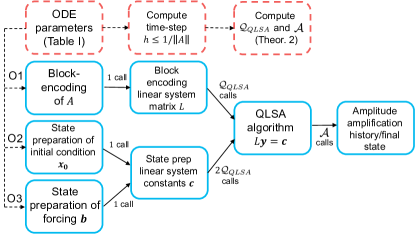
- Embeds linear ODEs into a linear system of equations L y = c, leveraging quantum linear solver (QLS) subroutines for state preparation.
- Applies block-encoding techniques to represent the system matrix A and time-evolution operators, enabling efficient quantum simulation via QLSA.
- Introduces a transformation to a new system ẋ′ = A′x′ with negative log-norm, enabling fast-forwarding via stability-induced compression of time evolution.
- Uses time-marching and history state encoding to output quantum states proportional to x(t) at discrete times, with error bounded in 1-norm.
- Employs non-asymptotic QLSA bounds from Ref. [3] to derive explicit query complexity expressions including prefactors and failure probability corrections.
- Derives complexity lower bounds via reduction to linear solvers, showing that stable systems require Ω(min(log^γ(1/ε), T^γ)) resources under worst-case assumptions.
Experimental results
Research questions
- RQ1Can stability properties of classical dynamical systems enable quantum simulation with sublinear scaling in simulation time T?
- RQ2What are the explicit, non-asymptotic resource costs (query counts, qubit requirements) for simulating linear ODEs on a fault-tolerant quantum computer?
- RQ3How does fast-forwarding via negative log-norm systems affect the query complexity compared to standard quantum ODE simulation approaches?
- RQ4To what extent do constant prefactors and non-asymptotic bounds improve the practical relevance of quantum ODE simulation compared to prior asymptotic analyses?
- RQ5Why does Hamiltonian dynamics remain outside the fast-forwarding regime, and how does this align with the no-fast-forwarding theorem?
Key findings
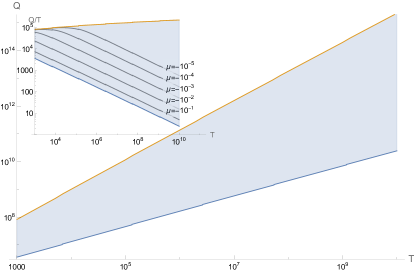
- For linear ODEs with negative log-norm (stable systems), query complexity scales as O(√T), achieving up to 4 orders of magnitude improvement over state-of-the-art asymptotic analysis.
- Explicit resource counts for history state output are bounded between 11,900√T log(T) and 10,300T log(T) for T ∈ [10⁶, 10¹⁵] and ε = 10⁻¹⁰.
- The transformation to a system with negative log-norm enables fast-forwarding, but the error constraint ε′_TD = e^(-zT)ε_TD restores the Ω(T) complexity lower bound, preserving consistency with the no-fast-forwarding theorem.
- Stable systems with A⁻¹b as equilibrium point reduce to linear solvers in the long-time limit, leading to a complexity lower bound of Ω(min(log^γ(1/ε), T^γ)) under worst-case assumptions.
- The framework extends prior QLSA bounds to dynamical systems, providing explicit formulas for expected query counts including failure probability corrections.
- Hamiltonian dynamics (A = -iH) is a boundary case: it does not allow stability-induced fast-forwarding, consistent with the no-fast-forwarding theorem.
Read this paper
Open the full text in the Nubint reader and ask about any passage as you read.
Read this paper on NubintThis review was generated by AI from the original paper. Please check the paper before citing it.